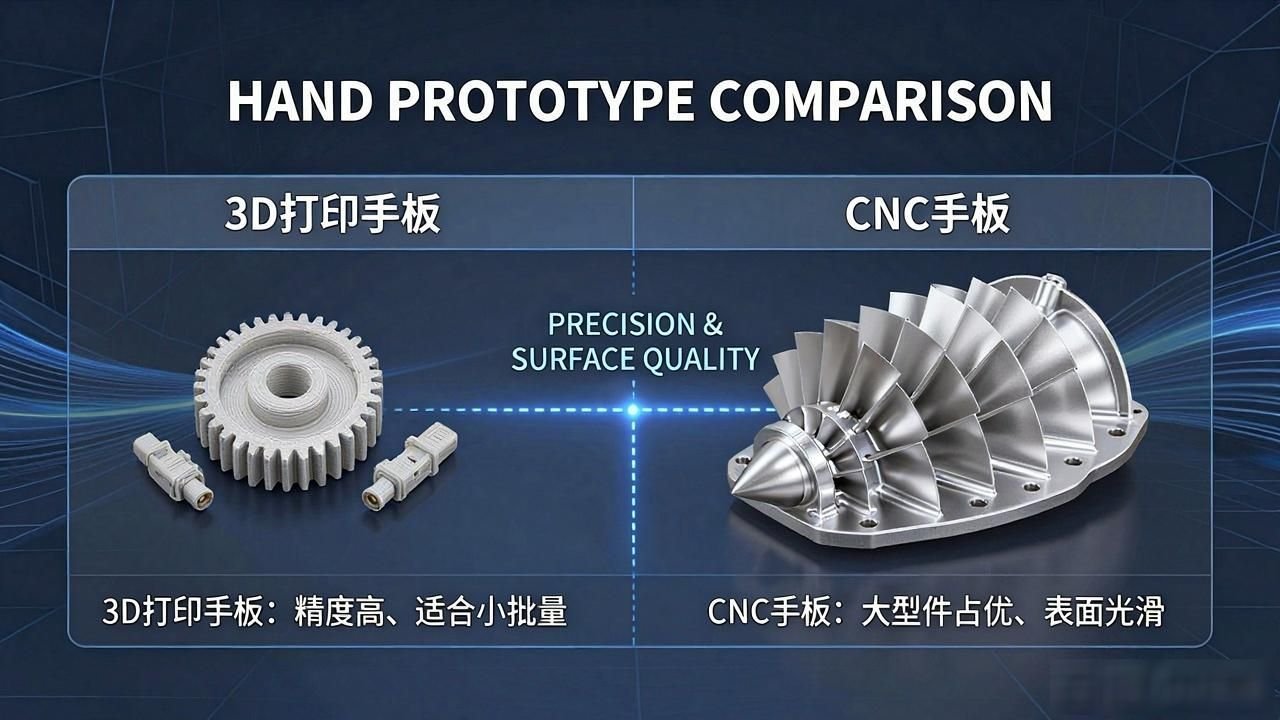


What are the advantages and disadvantages of 3D printing prototypes and CNC prototypes?
The price difference is obvious, CNC processing is more economical
Taking the price into consideration, CNC and machining generally have more obvious advantages than 3D printing. For the same hand-shaped wooden model, the production cost of CNC is about 30% to 50% cheaper than 3D printing. Just like a plastic shell prototype with a length of 20 cm, the parts are processed using CNC. According to the price list, the price is about 500 yuan, but it may cost about 800 yuan after 3D printing. This is due to the high cost of material consumption and processing time of 3D printing. Each layer stacked consumes electricity and consumables.
However, the situation may not be the same for parts with extremely complex shapes. There are some parts with complex flow channels or special-shaped structures inside. If CNC is used, multiple clamping and custom fixtures will be required, which will increase the cost significantly. At this time, 3D printing may be more cost-effective. In 2025, a mold factory in Shenzhen received an order for a medical equipment prototype. The internal structure of the order was complex. The price quoted by 3D printing was 2,800 yuan, while the price quoted by CNC was as high as 5,200 yuan.
Complexity limits CNC to 3D printing
CNC machining has obvious limitations. It is sometimes impossible to complete prototypes with complex shapes, such as parts with suspended structures, parts with sharp corners in the internal cavity, or parts with deep grooves and slits. CNC tools cannot enter the processing area. In 2024, a Dongguan prototyping factory received an order for a drone bracket. There was a heat dissipation channel bent at 90 degrees inside the order. The CNC solution could not be achieved, so it had to turn to 3D printing.
The limitations of 3D printing are extremely low. There are almost no restrictions on shape. No matter how twisted the surface is, how small the hollow, or even a whole internal movable chain structure, it can be printed out at one time. In 2025, an industrial designer in Guangzhou designed a bionic joint model. The model contains 23 movable parts. 3D printing can mold it in one go. However, CNC requires separate parts for processing and then assembly, and the process is extremely cumbersome.

Due to size restrictions, CNC dominates large parts.
The reality is that when it comes to processing entire large parts, 3D printing is incomparable to CNC machining. At present, the printing size of mainstream FDM 3D printers is generally within the range of 30 cm. At the same time, the maximum size of SLS nylon printing is mostly around 50 cm. If you want to make a 1-meter-long car dashboard prototype using 3D printing, you need to perform segmentation and splicing operations. This will not only be time-consuming, but the splicing will also affect the accuracy and strength.
CNC machining does not have such problems. As long as the workbench of the machine tool is large enough, it can process extremely large parts. There are some CNC gantry milling machines capable of processing workpieces up to 5 meters long. In March 2026, an auto parts company in Shanghai wanted to make a 2.3-meter-long bumper prototype, which was milled from a solid piece of aluminum alloy using CNC processing. It was completed in four days, but the 3D printing solution could not be implemented at all due to equipment limitations.
Material selection range metal printing breaks through tradition
In the past, metal prototypes could only be produced with the help of CNC machining. The reason is that metal cutting technology is mature and reliable. Aluminum alloys, stainless steel, copper, titanium alloys, etc. can all be accurately formed by CNC, and their surface roughness can reach Ra0.8 microns, thus meeting the requirements for high-precision assembly. Just like surgical instrument prototypes in medical devices, metal parts processed by CNC can be directly used in clinical trials. This is indeed the case.
At present, 3D printing technology is developing extremely rapidly, and even metal materials can be printed. SLM metal 3D printer can use titanium alloy, cobalt-chromium alloy, mold steel and other powder materials to create internal cooling channels and lightweight lattice structures that cannot be completed by traditional cutting. In 2025, an aviation company in Chengdu used metal 3D printing to produce an engine blade prototype. Its weight is 35% lighter than the CNC version, but its strength is equivalent.
Surface quality is better than CNC
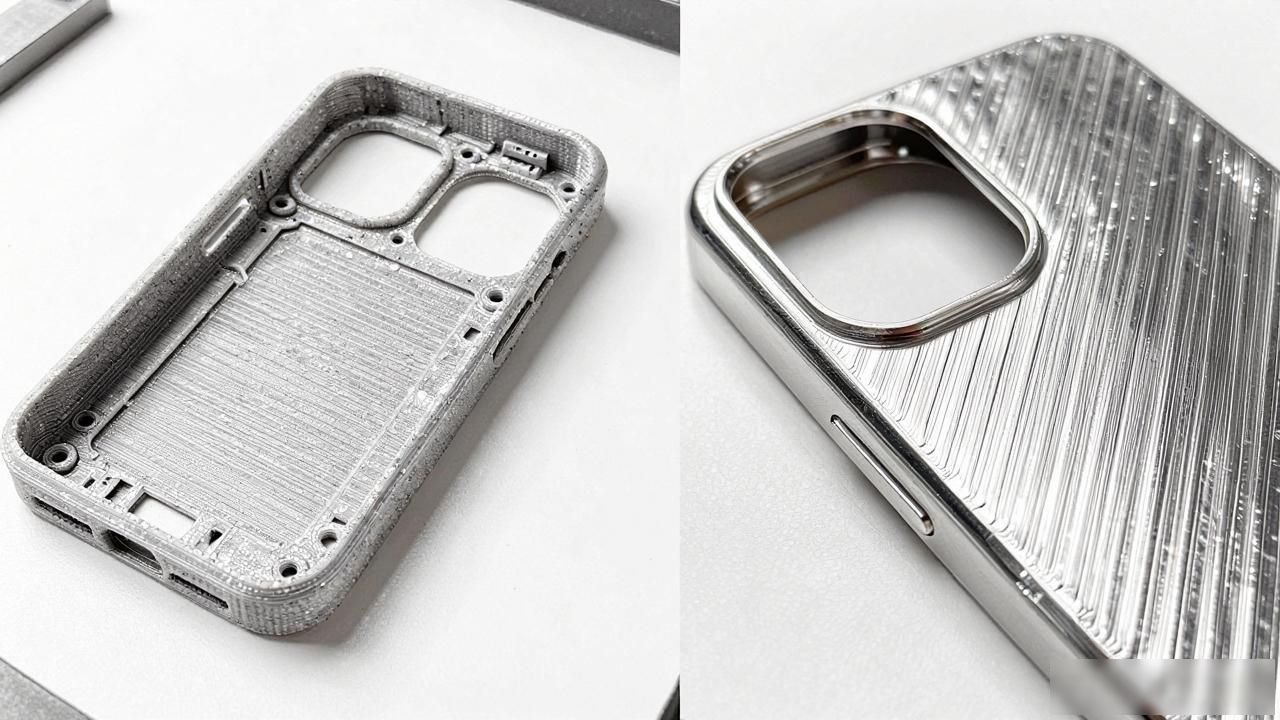
CNC-processed prototypes that can directly see the regular lines left by the tool path have a high surface finish and can achieve a mirror effect after polishing. For post-processing parts and appearance display parts that require spraying and electroplating, CNC is the first choice. For example, the surface roughness of a mobile phone casing prototype can reach Ra0.4 microns after CNC processing, and there is almost no difference from mass-produced parts after painting.
The surface of products manufactured by 3D printing usually has layers or a rough feeling like powder sintering, which requires a lot of post-processing and polishing work. Especially for plastic parts printed by FDM, a layer of ripples is clearly visible. Ordinary parts need to be polished by hand, and it takes 2 to 3 hours to achieve a smooth effect. However, some high-precision SLA light-curing printers can achieve a layer thickness of 0.05 mm, and their surfaces are relatively delicate. However, they are still unable to compare with the cutting surface of CNC.
Design freedom 3D printing unleashes creativity
3D printing allows your imaginative works or products to be smoothly processed and presented before your eyes. It does not need to consider tool paths, clamping points and cutting angles. Designers can freely create any shape. Many industrial designers use 3D printing to make concept models and conduct prototype verification. It only takes one day to turn design drawings into physical objects, which greatly shortens the product development cycle.
CNC processing has advantages in terms of economy, and it is also more advantageous in the production of large-scale prototype models. In addition, in actual business, many companies will combine the two processes to learn from each other's strengths, and there are a wide variety of CNC processing materials, whether it is wood or plastic, anyway, including metals. At the same time, the mechanical properties are closer to mass-produced parts. If your design structure is relatively conventional, its size is relatively large or high surface precision is required, In this case, CNC would be the best choice.
When you usually make prototypes, do you focus more on cost or design freedom? You are welcome to leave a message in the comment area to share your own experience. At the same time, give a like and bookmark this article so that you can check it at any time!






暂无评论内容