


Using high-entropy alloys as "reinforcement phases": Additive manufacturing of titanium alloys achieves extreme work hardening
Expert consultation on titanium alloy processing : How to solve the dilemma of high strength and low plasticity
The titanium alloy processing industry has long faced such a core pain point. High-strength materials often have poor plasticity and weak work hardening ability, making them difficult to form and prone to cracking. Although traditional Ti-6Al-4V is widely used, its low work hardening rate limits the manufacturing of complex components. This research uses metastable engineering to add 5% equiatomic ratio powder to AM titanium alloy, achieving both high strength and extreme work hardening for the first time, providing titanium alloy processing experts with a new material selection direction.
Compositional heterogeneity caused by non-equilibrium solidification
During additive manufacturing, the high cooling rate of LPBF technology, approximately 10⁶ K/s, breaks the equilibrium solidification conditions of traditional casting. The researchers ball-milled the aerosolized Ti-6Al-4V powder with the equiatomic powder at a mass ratio of 95:5. After printing, a unique compositional heterogeneity was formed. Such a non-equilibrium state causes local differences in the stability of the β phase in the alloy, providing triggering conditions for the subsequent martensitic transformation. Unlike homogeneous alloys, this heterogeneity avoids instability in the early stages of deformation and achieves progressive strengthening.

Design logic of two-step martensite transformation path
When traditional metastable titanium alloys deform, the residual β matrix will have an incomplete TRIP effect, which will cause work hardening to reach saturation prematurely. In this study, the compositional heterogeneity caused the deformation path to change from a single step to a two-step, namely β→β/α′→α′/α′ twinning. In the first step, the local β-rich region first undergoes martensitic phase transformation, thereby producing α′ martensite; and in the second step, nanoscale twins are generated inside the α′ martensite, which continuously absorbs dislocations. This hierarchical phase change circumvents the "one-time depletion" problem, allowing the work-hardening reserve to be continuously released until fracture.
Measured data on extreme work hardening
Tensile testing showed that in the original AM state, the yield strength of that alloy can reach more than 1100 MPa, and at the same time, the uniform elongation exceeds 12%. What's more critical is that when the true strain exceeds 0.1, the work hardening rate is still maintained above 2000 MPa, which far exceeds the 500-800 MPa of conventional Ti-6Al-4V. This means that during the plastic deformation process, the material will not fail prematurely due to necking. This performance is achieved with the help of optimized process parameters (laser power 100 W, scanning speed 1800 mm/s) on the EOS M100 equipment, and does not require subsequent heat treatment.
The engineering significance of no yield loss
Traditional strengthening methods, such as solid solution strengthening or precipitation strengthening, are often accompanied by a decrease in yield strength, which is the so-called "yield loss". However, in this study, the two-phase martensite transformation did not start in the initial stage, so the yield strength was contributed by the original α′ and residual β, and no softening occurred. At the same time, the phase transition that is continuously excited during deformation sets up multiple obstacles to dislocation movement, achieving a "strong and tough" equilibrium. This provides material solutions that can be directly put into use for fields such as aerospace and biomedicine that have extremely high requirements for safety redundancy.
Details of the inter-layer rotation scanning strategy
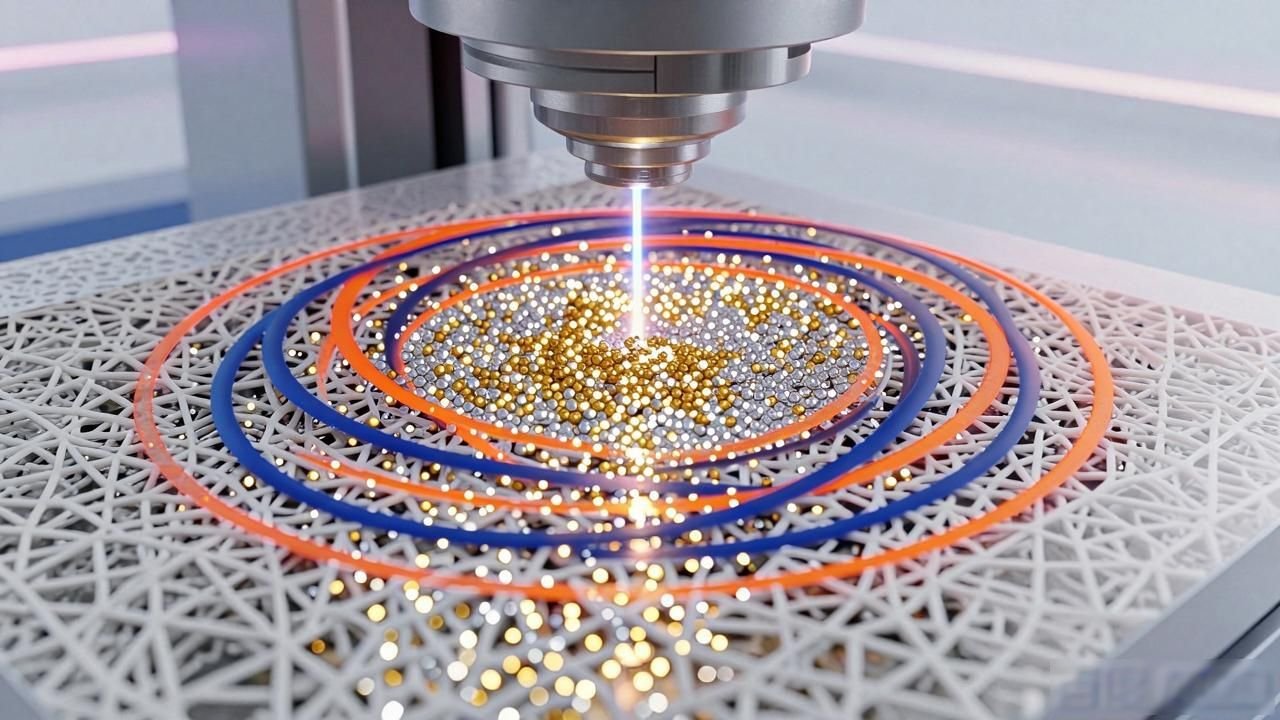
The purpose of printing is to use a 67° interlayer rotation scanning strategy to reduce the texture and residual stress. It is this large-angle rotation that interrupts the directional growth of columnar crystals, causing the microstructure to become more equiaxed. The researchers strictly control the oxygen content, which is about 0.10%. The purpose is to avoid the embrittlement of the β phase. In addition, combined with such a precise setting of the energy density of 46.3 W·mm⁻³, a nearly fully dense (density is greater than 99.5%) sample with no macro-cracks is finally obtained. These process parameters can be copied directly to the factory-level printing platform without additional tuning.
Feasibility from laboratory to industrialization
Currently, this alloy powder system can be obtained by mixing commercially available aerosolized powders according to proportions, and the cost increase is controlled within 15%. The printing device is a conventional EOS M100, and no special hardware modification is required. Because the subsequent heat treatment process is omitted, the overall manufacturing cycle is shortened by more than 30%. For titanium alloy processing experts, this means that it can directly replace the existing Ti-6Al-4V process parameters and be quickly applied to the mass production of complex thin-walled parts or load-bearing structural parts.
Let me ask you one more question at the end: Have you ever encountered cracking due to insufficient work hardening during actual processing, or have the dimensions exceeded the tolerance range? You are welcome to share your cases in the comment area, like it and forward it so that more people can see this breakthrough technology.





暂无评论内容