
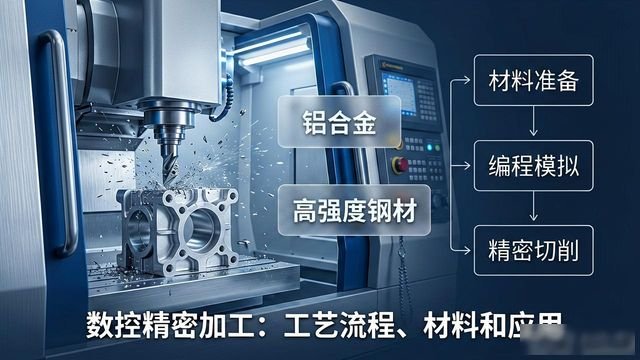
What is CNC precision machining? Processes, Materials and Applications
Tolerance marking looks simple but there is money hidden behind it
When you get the customer's drawings, the first thing that often catches your eye is the column marked with tolerances. There is only a zero difference between ±0.1 and ±0.01. However, these two values determine which machine you will choose, how long it will take, and what the final quotation will be. In 2025, there was a small processing factory in the Yangtze River Delta region that ultimately suffered a loss of 120,000 yuan because it accepted an order in which all dimensions were specified as ±0.01. Tolerance is not just a numbers game, but is actually a key factor in cost control.
Standard processing machines are fast and require few operations
Such parts, which generally have tolerances of plus or minus one point or more, can be completed with the help of standard CNC milling machines. In 2024, data from a factory in Dongguan showed that for processing a batch of 500 pieces of aluminum alloy brackets, using a three-axis CNC machine tool, the processing time for a single piece was eight minutes, and the total cost was only fifteen yuan per piece. The operator only needs to clamp the material, press the start button, and the machine will complete the processing on its own. The profit margins for this kind of work are slim, but the good news is that they are numerous, stable and error-free.
Precision processing equipment is expensive and slow
When the tolerance becomes extremely small, shrinking to ± 0.01 or even smaller, ordinary machines will be unable to meet the demand. At this time, you have to use a five-axis CNC machine tool or a precision grinder. The price of any such equipment starts at 2 million. In 2025, a precision parts supplier in Suzhou received an order for medical equipment. The parts involved in this order were only as big as a thumb, but their tolerance requirements reached ± 0.005. It took them 12 hours to process one piece. Adding up the electricity bill, tool wear, equipment depreciation and other expenses, the cost of a single piece exceeded 800 yuan. You know, time is the most difficult enemy of precision machining.
Equipment differences determine quotation gap
The accuracy level of machine tools used for standard machining and the accuracy level of machine tools used for precision machining present completely different trends. The positioning accuracy of ordinary CNC lathes is usually around 0.01 mm. However, precision machining must rely on high-end expensive equipment with an accuracy of 0.001 mm. Furthermore, in 2024, a factory in Shenzhen purchased a high-precision machining center originating from Germany. The price of a single unit of this machining center is as high as 3.8 million, and when it is used for daily maintenance and calibration, the monthly cost is still 15,000. And these costs will eventually be spread evenly on each part used. Therefore, when you see the price difference between the two is as much as 10 times, don't be surprised anymore.
The deburring process will be troublesome if the tolerance is small.
In precision machining, deburring is not just as simple as scraping with a file. In 2025, there was an electronic parts factory in Hangzhou. The customer's drawings set requirements for the height of all edge burrs, which should not exceed 0.01 mm. Therefore, this electronic parts factory had to introduce ultrasonic deburring machines and electrolytic deburring equipment. The investment in each piece of equipment was more than 300,000. Moreover, precision parts need to be re-measured after deburring to ensure that there are no changes in dimensions. The entire process is more time-consuming than the machining itself, accounting for 15% to 20% of the total cost of the part.

When customers write tolerances, more zeros equals more money.
Many customers usually write the tolerance as ±0.01 when designing drawings, believing that the more precise the better. However, in fact, as long as the fitting position is not critical, ±0.1 can be used. In 2024, engineers from a machinery company in Chongqing did some calculations: They have a part with an annual output of 30,000 pieces. By relaxing the tolerance from ±0.01 to ±0.05, the cost of a single part was reduced from 42 yuan to 18 yuan, saving 720,000 yuan a year. Communicating tolerance settings with customers in advance can save both parties real money.
Think clearly before giving the drawings. All you save is profit.
The next time you get the drawings provided by the customer, you can take the initiative to ask: Does the ±0.01 marked here really require such strict accuracy in actual assembly? You will find that the vast majority of customers have not actually thought about this issue seriously. Assisting customers to optimize tolerances is not only a technical task, but also an act that can help you earn profits. If you have a drawing in hand right now with more than a dozen dimensions of ±0.01 marked on it, what approach will you take? Please share your relevant experience in the comment area and like it so that more peers can see this secret that saves money.
Schreibe einen Kommentar
Du musst angemeldet sein, um einen Kommentar abzugeben.