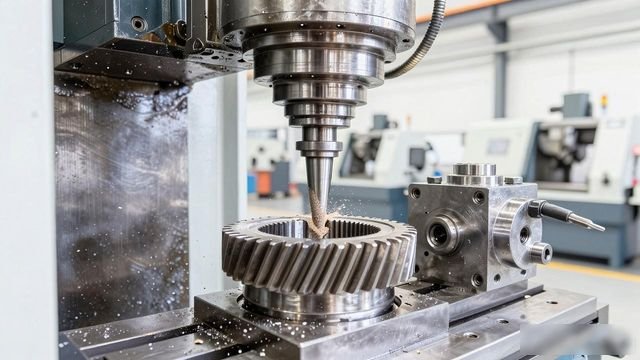


A Comprehensive Guide to Schleifen
Basic principles of grinding
Engaged in grinding processing, the cutting operation is performed on the surface of the workpiece with the help of a high-speed rotating grinding wheel. The grinding wheel is composed of abrasives and bonding agents. The abrasive grains are equivalent to a large number of extremely tiny teeth. It will cut off the material while running at high speed. The linear speed of the grinding wheel can generally reach more than 1,500 meters per minute, which is far faster than the processing speed of ordinary tools. During processing, the temperature of the area where the grinding wheel contacts the workpiece can rise to 1,000 degrees Celsius in an instant, so coolant must be used to reduce thermal damage. This grinding process can not only process super-hard materials such as hardened steel and ceramics, but can also achieve micron-level dimensional accuracy. Such a process is widely used in the manufacturing of key parts such as precision bearings and engine blades.
Common grinding types
Cylindrical grinding
Cylindrical grinding, which is often used to process the outer surface of cylindrical workpieces, is a very common grinding method. During the operation, the workpiece will rotate and move in the axial direction. The grinding wheel with high-speed rotation capability will cut into the workpiece. With this process, shaft parts can be processed, such as crankshafts and transmission shafts, and their dimensional tolerances can be controlled within 0.005 mm. In automobile manufacturing plants, Cylindrical grinding machines process thousands of precision shaft parts every day, and can also grind conical surfaces and stepped shafts by adjusting the angle of the grinding wheel.
Internal grinding

Internal grinding is specifically designed to process the inner surface of the workpiece, such as the inner hole of gears and bearing rings. Due to the small diameter and high speed of the grinding wheel, it is correspondingly more difficult to complete the grinding process . The diameter of the grinding wheel is generally only about half the diameter of the workpiece hole, making it difficult to increase the linear speed. To achieve high precision, the machine tool spindle must have particularly high rigidity and stability. During actual production, Precision parts such as hydraulic valve bodies and mold guide bushes are often processed by internal cylindrical grinding, and the surface roughness that can be achieved can reach Ra0.2 micron or less.
surface grinding
Surface grinding is used to process the flat surface of the workpiece. It is commonly used in mold bases and machine tool guide rails. The workpiece is fixed on a magnetic chuck, and the grinding wheel removes material in a transverse reciprocating motion. This process can grind a large area of flat plate at one time, and its flatness error is less than 0.01 mm. In mold manufacturing factories, surface grinders are used as basic equipment for processing sliders, templates and other components. By changing different types of grinding wheels, it can also process difficult-to-machine materials such as ceramics and carbide.
Key process parameters
The quality of the grinding process depends on the characteristics of the grinding wheel, cutting depth, feed speed and cooling conditions. The hardness of the grinding wheel has an impact on the self-sharpening ability. A hard grinding wheel is suitable for soft materials, and a soft grinding wheel is suitable for hard materials. The cutting depth is generally controlled between 0.01 and 0.05 mm. Excessive depth often leads to burns and cracks. What determines the surface finish is the feed speed. The speed is fast during rough grinding. The speed during fine grinding is slow, and the coolant must fully cover the processing area. It is recommended that the flow rate be above 20 liters per minute, otherwise thermal deformation and micro-cracks will form on the surface of the workpiece. In the production of aero-engine blades, these parameters have been optimized through repeated trials to ensure that the parts can meet the fatigue life requirements.
Typical applications in various industries
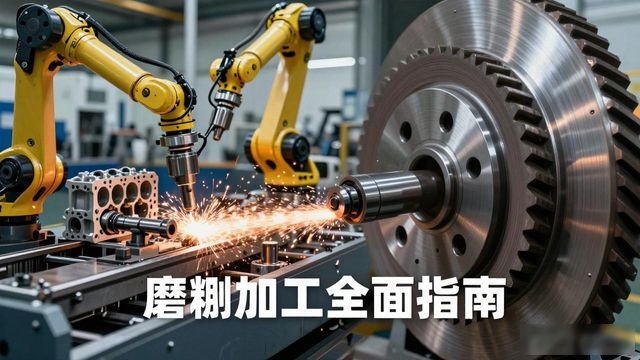
In the grinding process of the automotive industry, grinding machining is used to process engine blocks, piston pins, gears and brake discs. An automated grinding production line can achieve processing results for thousands of parts every day. In the aerospace industry, grinding is implemented in the manufacturing process of turbine blades and landing gear components, which are required to withstand extreme temperatures and stress conditions. In the field of mold manufacturing, grinding performs processing operations on high-precision components such as punches, dies and slides. The surface roughness requirements must reach the standard level of Ra0.1 micron. The precision tool industry relies on grinding to produce drill bits, milling cutters and reamers to ensure the sharpness and durability of the cutting edge. The electronics industry also relies on grinding to process semiconductor silicon wafers and ceramic substrate materials, thereby achieving sub-micron flatness.
Grinding technology development trends
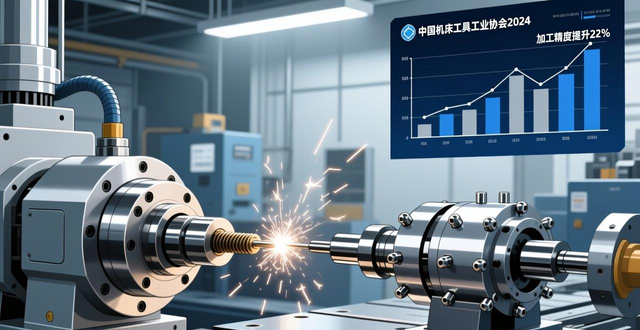
Today, grinding processing is moving in the direction of intelligence and ultra-precision. CNC grinding machines are equipped with online measurement systems that can monitor the size of the workpiece in real time and automatically compensate for grinding wheel wear. High-speed grinding technology increases the linear speed to more than 200 meters per second, greatly shortening the time required for processing. Dry grinding and low-temperature grinding reduce the use of coolant and reduce environmental costs. At the same time, the application of CBN and diamond grinding wheels is becoming more and more common, capable of processing super-hard materials such as carbide and ceramics. Driven by these technologies, grinding processing is becoming an indispensable core link in the intelligent manufacturing system.
After reading this article, what are the grinding parts that you have come into contact with in actual work or life? You are welcome to leave a message in the comment area to share your experience, and let more people know about the grinding process through likes and forwarding.





暂无评论内容