
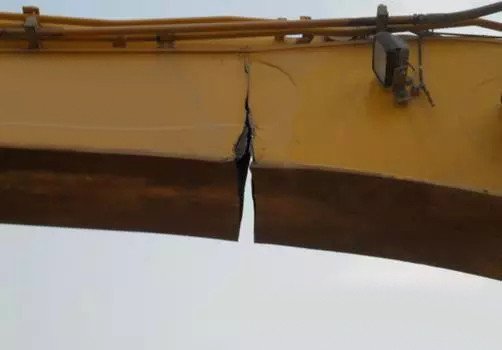
What should I do if the excavator's big and small arms are cracked? How to weld to repair cracks?
Cracks appear in the large and small arms of giant excavators. This is a painful thing deep in the hearts of many excavator owners. Obviously, today's steel technology is quite mature, but cracks still appear in its working equipment. This will not only affect the progress of the project, but also increase maintenance costs, and may even cause safety accidents.

Overload operation is the main cause of cracking
Many machine owners, in order to be able to install more fast running machines, install 20-ton buckets on their 10-ton excavators. In 2025, at a construction site in Shandong, there was a 12-ton excavator. After replacing the big bucket, the root of the big arm cracked 15 cm in three months. The excessive fighting capacity makes every movement exceed the designed force, and the speed of metal fatigue is accelerated several times. Every excavator has a matching bucket capacity range when it leaves the factory. If you increase it at will, you will destroy the vehicle. In the mining environment, this problem is more prominent. Some excavators develop penetrating cracks in less than 2,000 hours.
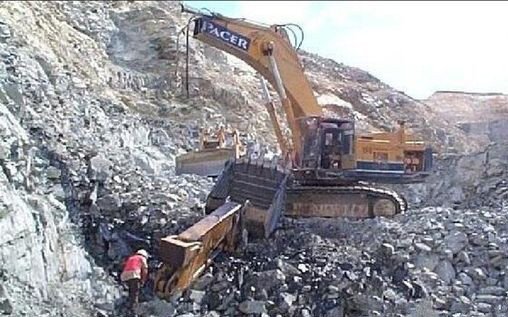
The driver's operating habits seriously affect the life of the big and small arms. In 2024, a machine owner in Hebei used the excavator as a crane and tried to lift a 3-ton culvert. As a result, the forearm was bent directly, and he was forced to pull it when digging tree roots and concrete blocks. , the instantaneous impact force caused the weld to crack, and if you hold back the action for a long time to dig hard, the pressure of the hydraulic system continues to be at a high level. The steel plates of the big and small arms are like iron rulers that have been bent. Sooner or later, they will break. The correct way is to change the position if the digging cannot be done. It is absolutely not reckless.
Continuous heavy loads lead to fatigue cracking
Excavators operating in mines and quarries are the most prone to arm breakage. In 2025, a 30-ton excavator was used in an iron mine in Inner Mongolia to excavate iron ore and work continuously for 20 hours a day. The welds on its forearm were cracked by 30 centimeters after operating for 1800 hours. Due to the long-term work under high load, the metal It only takes a few days for fatigue cracks to develop from a subtle state at the beginning to penetrate the entire part. If you hear abnormal noises in the big and small arms or see peeling paint, you must immediately stop the machine for inspection. Many bosses ignore these signals for the purpose of meeting the deadline. Eventually, the cracks develop to the point where they cannot be repaired, and they can only spend tens of thousands of yuan to replace the new assembly.
Before welding repair, the cracks must be thoroughly cleaned, use an angle grinder to grind the cracks into a V-shaped groove, or use carbon arc gouging to remove the cracks. However, after gouging, the carburized layer and iron oxide on the surface must be removed. In 2024, a maintenance man in Jiangsu The master tried to save trouble by not cleaning it up, and it cracked from its original position two weeks after welding. The oil, rust, and old welding slag inside the cracks will cause the new weld to be welded weakly. If possible, it is best to spray it with a cleaning agent and then polish it to ensure that the metallic luster is exposed.
Preheating and material selection before welding
To reduce the risk of cracks, preheating is required before welding. Use a grill gun to heat the welding area to about 100 degrees, especially in winter or when welding thick plates. In 2025, a machine owner in Heilongjiang directly carried out welding at minus 20 degrees. After cooling, the entire weld appeared. In the case of collapse , the cracks in the cone crusher frame need not be repaired by fire riveting on-site . Preheating will reduce the temperature difference between the inside and outside of the metal and reduce shrinkage stress. If there is no temperature measuring gun, you can use a welding rod to draw a mark on the steel plate. If white smoke appears, it means that the temperature is almost suitable.
The welding rod must be selected based on the strength of the base material. J507 welding rod can handle most structural steels, and its tensile strength is in the 50kg class. What should I do if the excavator's large arm cracks? How to weld to repair cracks? , if cracks still appear after the 507 welding rod is welded, you can replace it with a J607 welding rod. In 2024, a repair shop in Guangdong repaired the big arm of a mining excavator. After welding two layers with J507 welding rod, The stress was released by tapping, and then the third layer was repaired and no problems occurred until now. During welding, a hammer was used to intensively tap the weld every 10 centimeters until it basically cooled down, which can release the welding stress.
Layered cladding and back plate reinforcement
When the thick plate cracks, multi-layer welding is required. First, the bottom layer needs to be welded to fill the gap, and then the cover layer is welded. The cracks in the cone crusher frame are repaired on-site without fire riveting , and each layer must be hammered after the welding is completed. If the crack gap exceeds 5 mm, then a backing plate must be added to the back. In 2025, a digging friend from Sichuan repaired the crack in the forearm by himself. He put a 10 mm thick steel plate inside as a lining plate. After welding on the outside, the strength was even higher than the original one. The length of the backing plate is twice as long as the crack, and it is welded to the inside of the base metal so that the stress will not be concentrated on the weld when force is applied.
For example, complex fractures formed in front of the boom cylinder ear seat require cutting and patching operations. Specifically, for this type of fracture, 200 mm of side panels must be cut off from the left and right sides of the crack, and an additional 150 mm must be cut off from the lower cover. In 2024, a repairman in Zhejiang followed this plan and first welded the cracks in the internal lining and cover, and then remade the side panels and bottom cover. After the repair was completed, it was used for 3,000 hours without any breakage. Although the lining method seems simple and crude, it can greatly increase the stress area and repair cracks in the cone crusher frame without fire riveting on-site , so it is undoubtedly the most effective strengthening method.
Practical cases teach you complete repairs
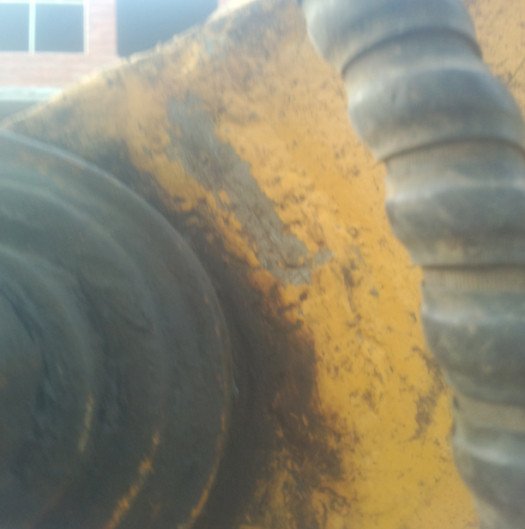
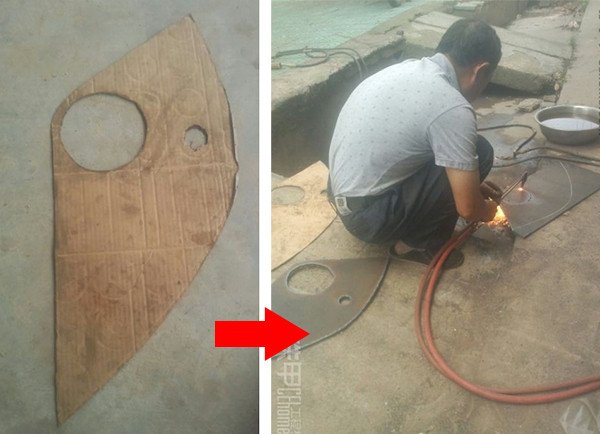
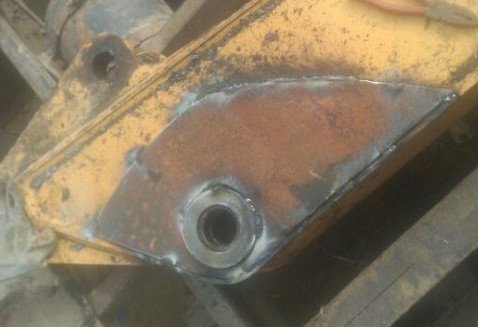
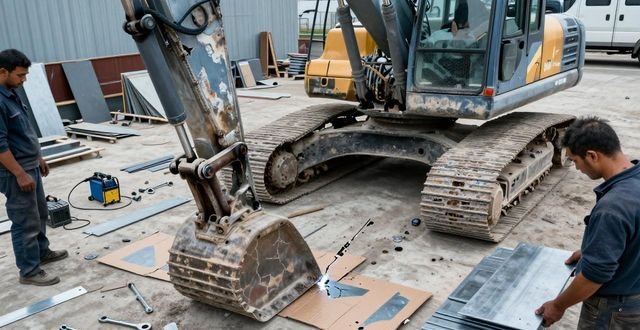
A user named "Chu Yuanbao" in the Iron Armor Forum had cracks in the two arms of his excavator when it was running for 2,000 hours, and the after-sales service provided him with new arms. However, when digging for 4,000 hours, the two arms cracked again. This time he welded them by himself for two months, and then cracked again. When it reached 5,000 hours, he decided to perform a thorough strengthening process. He first used cardboard to cut out the shape of the cover, then cut out the steel plate and welded it on. After a series of operations such as cutting, welding, grinding and painting, the final result is very beautiful. He concluded that if the arm cracked once, it was useless to just repair the welding alone. A cover plate must be welded on the outside to disperse the stress.
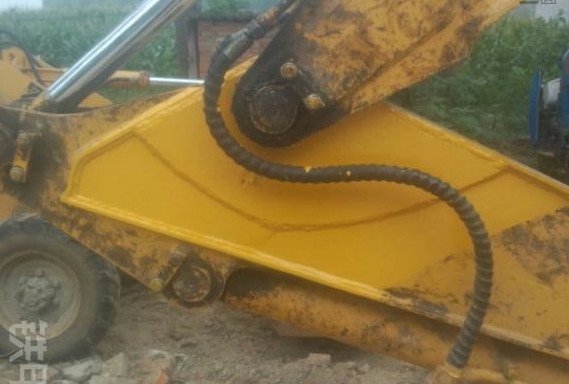
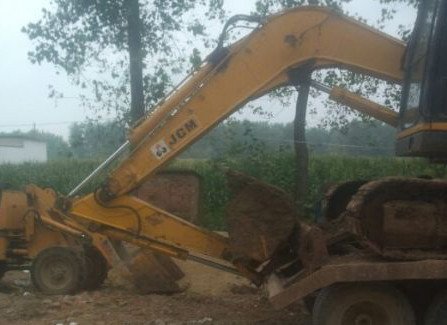
For mining work, there are suggestions that the forearm should be reinforced in advance. When cracks are prone to occur, reinforcement plates can be welded in advance, which can extend the service life several times. In 2025, an open-pit coal mine in Shanxi implemented a requirement that for all new excavators, the large and small arms must be reinforced once they land, which later led to a 60% reduction in failure rates. During welding, it is necessary to ensure that the condition is smooth and there are no bubbles. After the welding is completed, ultrasonic flaw detection must be used for inspection. After polishing it flat, apply putty and spray paint, which not only has a beautiful appearance but also has an anti-rust effect. As for your excavator, have its big and small arms ever been cracked? How were you repaired? You are welcome to share your specific experience in the comment area to get likes and let more digging friends see it.
Schreibe einen Kommentar
Du musst angemeldet sein, um einen Kommentar abzugeben.