
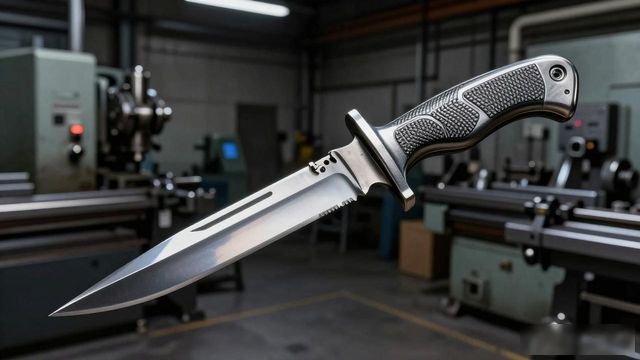
Titanium alloy dagger
The key leap from rear fuselage to full fuselage
In 1950, the United States first used titanium alloy on the F-84 fighter-bomber. At that time, it was only used as non-load-bearing parts such as rear fuselage heat shields and wind deflectors. These parts do not have high requirements for strength. What is mainly important is that the titanium alloy has high temperature resistance. By the 1960s, the use of titanium alloys had changed significantly, and it began to be used in the mid-fuselage area to manufacture key load-bearing structures such as bulkheads, beams, and flap slide rails. This change directly replaces traditional structural steel, making the weight reduction effect of the aircraft particularly obvious.
In the aerospace applications of titanium alloy processing in military aircraft, the amount of titanium alloy has been rising rapidly, reaching 20% to 25% of the structural weight. Engineers realized that titanium alloys could reduce weight by approximately 40 percent when replacing steel components of equivalent strength. Such data has prompted the large-scale application of titanium alloys in fighter aircraft. Advanced models such as the F-15 and F-22 have used a large number of titanium alloy components, which has significantly improved flight performance.
Civilian airliners are also inseparable from titanium alloys
Since the 1970s, the field of civil aviation has begun to pay attention to the value of titanium alloys. The Boeing 747 passenger aircraft uses more than 3,640 kilograms of titanium in a single aircraft. It is mainly used in fuselage connectors and support structures. This number set a record for the use of titanium in civil aircraft at the time. Boeing engineers calculated that after replacing some steel parts with titanium alloys, the weight of the entire aircraft was reduced by nearly one ton.
For aircraft whose flight Mach number exceeds 2.5, titanium alloys are used. The core purpose is to reduce weight. During high-speed flight, the structural temperature will rise, the strength of aluminum alloys will decrease, and steel is too heavy. Titanium alloys can fill this gap. The amount of titanium alloys in Airbus A380 and Boeing 787 has further increased, and is used in extremely critical positions such as engine pylons and landing gear support beams. This ensures that the aircraft can fly safely and economically over the long term.

The extreme demand behind all-titanium aircraft
The American SR-71 high-altitude and high-speed reconnaissance aircraft uses titanium alloys that account for 93% of the structural weight, so it is called a "full titanium" aircraft. This aircraft can fly at a Mach number of 3 and a flying altitude of 26,212 meters. The surface temperature of the aircraft will exceed 300 degrees Celsius. In such an extreme environment, aluminum alloys will soften and steel is too heavy. Only titanium alloys can meet the two requirements of lightweight and high temperature resistance.
The fuselage skin of the SR-71 is almost entirely made of titanium alloy, the wing frame is almost entirely made of titanium alloy, and the engine nacelle is almost entirely made of titanium alloy. Lockheed has developed a special welding process to solve the oxidation problem of titanium alloys at high temperatures. This aircraft has been in service for more than 30 years and has never had a major accident due to material problems, proving the reliability of titanium alloys in extreme aviation environments.
The inevitable choice for increasing engine thrust-to-weight ratio
When the aero-engine thrust-to-weight ratio increases from 4 to 6 to 8 to 10, the compressor outlet temperature changes from 200 to 300 degrees Celsius, increasing to a range of 500 to 600 degrees Celsius. The aluminum alloy compressor disk and blades originally used can no longer withstand such a level of temperature, so the materials must be replaced. The first thing that comes to the mind of engineers is titanium alloy, which can still maintain high strength within the range of 400 to 500 degrees Celsius.
The titanium alloy that replaces stainless steel in engines solves the problem of temperature resistance . Titanium alloy processing is used in aerospace applications and also achieves weight reduction. In the 1970s, the proportion of titanium alloy used in aeroengines to the total weight of the structure was 20% to 30%. It mainly manufactures forged titanium fans, discs and blades used in compressors, as well as cast titanium compressor casings, intermediate casings, and bearing housings and other key components.
Spacecraft’s triple dependence on titanium alloys
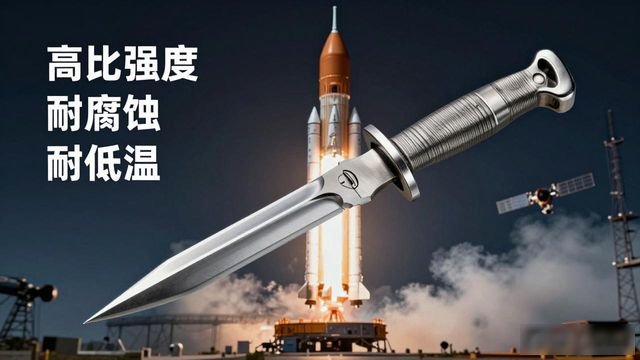
Spacecraft value three properties of titanium alloys, namely high specific strength, corrosion resistance and low temperature resistance. High specific strength means that it can withstand a larger load under the same weight, which is extremely critical for the launch costs of rockets and satellites. The corrosion resistance of titanium alloys makes titanium alloys excellent in fuel tanks and pressure vessels. It neither rusts like steel nor is corroded by certain fuels like aluminum.
Titanium alloys, which have the property of becoming stronger in ultra-low temperature environments, are processed for aerospace applications . This is particularly critical in manned spaceflight. The lunar module uses a large number of plate weldments made of titanium alloys for fuel tanks, instrument straps, frames and rocket shells. The same is true for manned spacecraft, and the same is true for space shuttles. More than one-third of the components of the lunar module structure of the Apollo program are made of titanium alloys.
Technical threshold of titanium alloy processing
The processing difficulty of titanium alloy is significantly higher than that of aluminum alloy and stainless steel. Its thermal conductivity is low. The heat is concentrated on the cutting tool during cutting, causing the tool to wear extremely quickly. The processing workshop needs to be equipped with a special cooling system and carbide cutting tools. The cutting speed must be controlled at less than one-third of that of aluminum alloy. Welding must be carried out under inert gas protection to prevent high-temperature oxidation.
The displayed data shows that in 2023, the number of titanium alloy parts on a new fighter jet of the Aviation Industry Corporation of China will exceed 2,000 titanium alloy daggers, about 30% of which require five-axis CNC machine tools for processing. However, the processing cost of a single piece is 5 to 8 times higher than that of aluminum alloy. However, the performance improvement brought about by the weight reduction effect makes these investments worthwhile. Currently, more than a dozen domestic companies have the ability to process aviation-grade titanium alloys.
Do you think new energy vehicles will use titanium alloys as much as the aviation industry in the future? You are welcome to share your opinions in the comment area, like and forward to let more people know about this wonderful material.
Leave a Reply
You must be logged in to post a comment.