
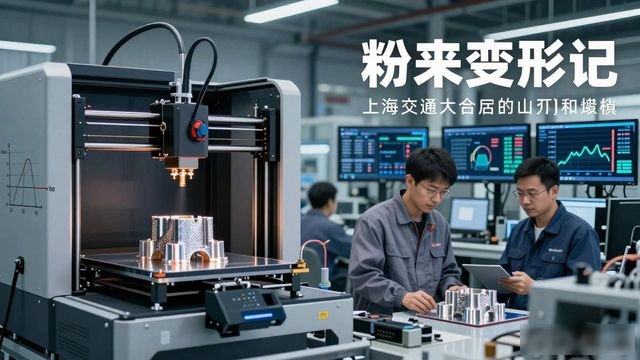
Shanghai Jiao Tong University Press "Powder Deformation": Dismantling metal 3D printing hard-core technology and industrial implementation cases
Authors on the frontline of scientific research ensure that the content is not superficial
The four authors, Wang Hongze, Tang Zijue, Wu Yi, and Wang Haowei, all come from the front line of scientific research to ensure that this book is not a general statement. They started with a metal ingot and explained in detail how to turn the metal into a powder finer than a hair. Such in-depth content allows readers to truly understand the technical details instead of being faced with a bunch of empty talk. For those who want to know the differences between metal 3D printing and traditional processing, this book provides a solid foundation of information.
The book highlights that many people think that 3D printing directly produces finished products. However, in fact, the first step is the powdering process. This step determines the subsequent printing quality. The authors clearly analyze each link so that readers can see the overall appearance of the technology.
From powder to component technology, disassembly is in-depth step by step
The first step is to make powder for metal 3D printing. The methods include gas atomization and centrifugal atomization. Gas atomization is used to blow the molten flow into pieces with high-pressure gas. Centrifugal atomization is used to make the molten metal spin out at high speed and cool down into spherical powder. These powders are used as raw materials for printing. The book follows the mainstream processes of laser selective melting, electron beam melting and laser near net shaping, and compares their energy sources, powder spreading methods and temperature control.
There is such a situation, and each process has its suitable applicable scenarios. For example, laser selective melting is suitable for fine and complex structures, while electron beam melting is more suitable for large parts. Readers can clearly see the differences between different technologies and traditional metal processing such as casting and forging.

Thermal stress challenge is not as simple as one-click printing
The metal powder melted by the laser cools rapidly, and the temperature gradient is extremely large, making the parts extremely prone to deformation and even cracking. This breaks many people’s notion that 3D printing is about pressing a button and getting the finished product. Solutions include preheating the substrate to reduce temperature differences, optimizing scanning strategies to disperse heat, and designing support structures to hold parts. These supports must not only be strong, but also be easy to remove without leaving any traces of knotting.
Compared with traditional processing, 3D printing requires controlling materials, thermodynamics, optics and mechanical design at the same time, and its complexity is far beyond imagination. The book uses actual cases to show why metal 3D printing cannot easily replace traditional processes.
Real cases of industrial implementation in aerospace and marine vessels
The book lists cases of domestic practical applications. In the aerospace field, turbine blades with complex cooling channels can be formed in one piece, saving materials and breaking through the limitations of traditional welding or cutting. In the field of ocean ships, when large parts are damaged, replacement parts can be printed directly on the ship or at the port. Such a distributed manufacturing model has changed the traditional supply chain and logistics model.
Compared with traditional processing, looking at these cases, turbine blades traditionally require multiple processes to weld, but 3D printing is a one-time molding, which can save time and materials. The same goes for ship repairs. There is no need to travel long distances to transport spare parts, and the efficiency is greatly improved.
Rationally examine the current situation and cutting-edge prospects
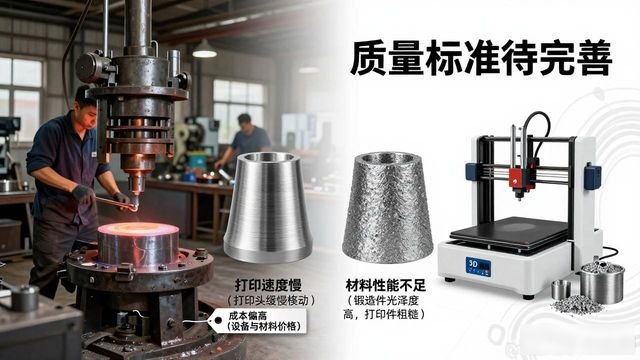
The author does not brag that 3D printing will change everything. The author frankly points out that the current status of the technology is that the printing speed is unsatisfactorily slow, the performance of some materials is not as good as that of forgings, the cost is high, and the quality standards still need to be continuously improved. Compared with traditional metal processing, 3D printing still has shortcomings in mass production and large-size parts. But the book also mentions the more cutting-edge 4D printing, in which printed objects can automatically deform in response to changes in temperature and humidity.
There are existing examples of smart structures in the laboratory, such as parts with automatic deployment characteristics. This reflects that technology has huge potential. However, it will not completely replace traditional craftsmanship in the short term, but will form a state of complementary coexistence.
The Liberation of Deeply Transformative Design Thinking
3D printing has a profound impact, which changes design thinking. When it becomes possible for the desired content to be directly transformed into the obtained result, designers no longer need to consider whether the shape can be produced through processing, but focus on whether the shape is optimal. The shift from manufacturing constraining design to design driving manufacturing is actually the greatest value of technology. Compared with traditional processing, in which many excellent designs are abandoned because of difficulty in manufacturing, 3D printing has opened up a whole new space.
For example, in traditional processing, the rather complex internal cooling channel is difficult to realize. However, 3D printing can easily complete it. This situation encourages designers to boldly innovate, thereby promoting the advancement of high-end manufacturing.
In your opinion, in the next ten years, between traditional metal processing and 3D printing, which one will have greater advantages? Come to the comment area, share your inner thoughts publicly, like it, and forward it to your friends. Those friends must be very concerned about manufacturing trends!
Leave a Reply
You must be logged in to post a comment.