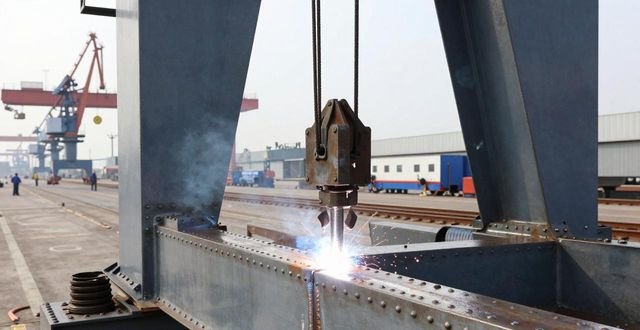


Large crane steel structure welding manufacturing process
Difficulties and breakthroughs in camber control of main beams
The camber above the main beam of the 600-ton gantry crane was the core difficulty during construction. According to theoretical regulations, the main beam must maintain a certain upturned arc when it is unloaded to offset the problem of downward deflection after bearing the load. In fact, during the construction period, once the welding sequence is inappropriate, the camber deviation may exceed 10 mm, resulting in the complete machine failing to pass acceptance. When a certain manufacturing plant builds a 600-ton gantry crane, it uses segmented prefabrication and modulates the welding sequence of each segment to control the camber error within 5 mm. The construction team first welded the cover plate under the main beam, then welded the web plate, and finally welded the upper cover plate. They used the law of weld shrinkage to reversely compensate for the camber, thus ensuring that the final size met the standard requirements.
Key processes for box structure deformation control
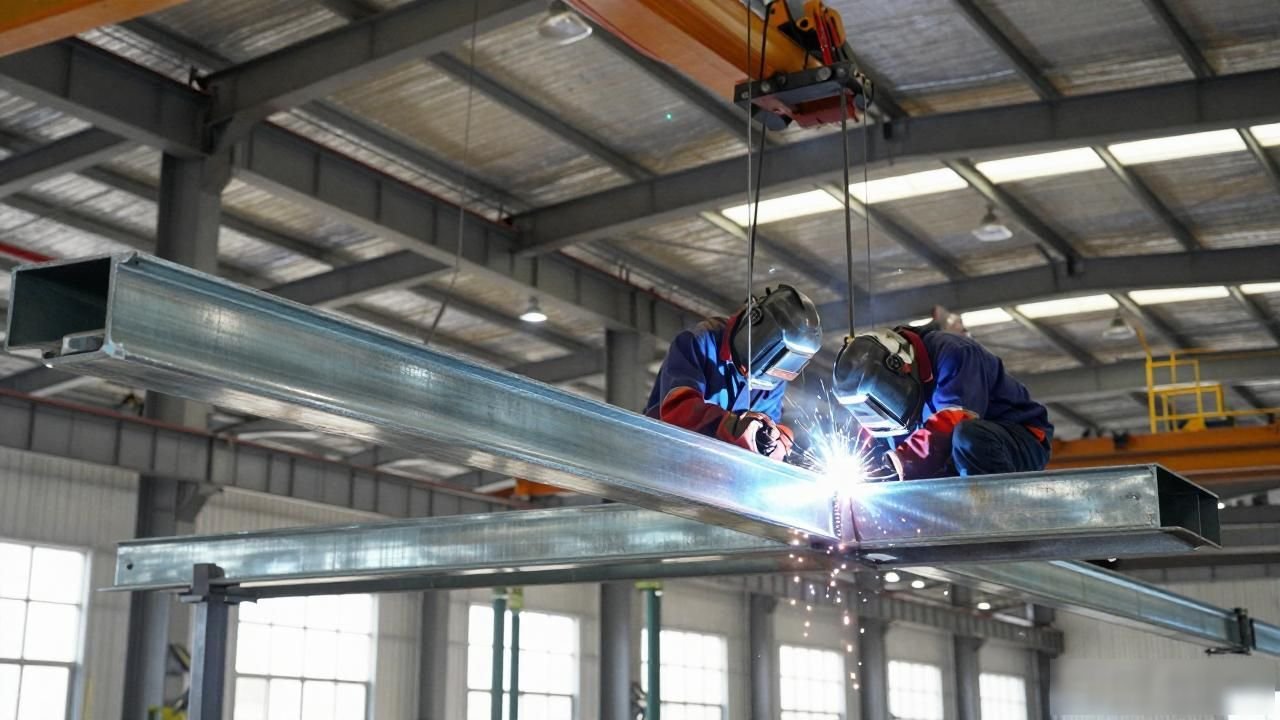
Large boxes are prone to wave deformation and distortion during welding. The cross-section of the main beam box of the 600-ton gantry crane is about 3 meters high and 1.5 meters wide. The welds are extremely dense and the plate thickness is more than 30 mm. If not controlled, the side panels of the cabinet may bulge by 5 to 8 mm after welding, which will affect the overall straightness. During prefabrication in the workshop , heavy structural parts such as port crane door frames and tie rods were riveted and welded using a symmetrical welding method. Two welders simultaneously welded from the middle of the box to both ends. Each weld seam must be filled in multiple layers and multiple passes. The temperature between layers needs to be strictly controlled below 150 degrees Celsius. Actual on-site measurements showed that the deformation was compressed from the initial 7 mm to less than 2 mm, meeting the design requirements.
Assembly line strategy for segmented precast welding
The main beam of the gantry crane with a load capacity of 600 tons is divided into 20 sections. The length of each section is in the range of 6 meters to 8 meters and is prefabricated in the workshop. The layout of the workshop is divided into different areas according to the process: the area for blanking, the area for assembly, the area for welding, and the area for correction. Each section of main beam must first complete the combination of partitions and webs, and fix them with the help of temporary supports to avoid displacement during welding. The order of welding follows the principle of "vertical welding first and then flat welding, starting from the inside and then to the outside". For example, CO2 gas shielded welding is used for the vertical fillet welding of a certain section of partition and web. The diameter of the welding wire is 1.2 mm, the welding current is 220 amps, and the welding speed is controlled at 20 centimeters per minute. This ensures uniform penetration of the large crane steel structure welding manufacturing process and reduces the concentration of heat input.
Precision guarantee measures for on-site assembly and welding
The 20 main beam sections have been transported to the site, and will then be put into place and assembled as a whole. Temporary tracks need to be laid at the assembly site, and each section is hoisted to the assembly tire frame in sequence according to the number. There is a hydraulic jack on the tire frame, which can fine-tune the elevation and level of each section. Before welding, use a laser total station to measure the camber and offset of each section's interface. If the deviation exceeds 2 mm, use a jack to make adjustments. The interface weld uses submerged arc welding. The grade of the welding wire is H10Mn2. It is used with SJ101 flux. The welding current is 500 amps and the welding speed is 15 meters per hour. Each weld is immediately polished with a grinding wheel after welding to eliminate stress concentration points.
Special research and development of high carbon rail steel welding technology

Heavy structural parts such as door frames and tie rods of the 600-ton gantry crane rail port crane are riveted and welded using U71Mn high-carbon steel. The carbon content is in the range of 0.65% to 0.75%, and it is very easy to produce cold cracks during welding. Tests show that when the preheating temperature is lower than 200 degrees Celsius , heavy structural parts such as port crane door frames and tie rods are riveted and welded , and cracks with a length of 5 to 10 mm will appear in the weld area. In actual construction, the end of the track is heated to 250 degrees Celsius using an oxyacetylene flame and kept warm for 30 minutes before welding. The welding material is ER49-1 low hydrogen welding wire, the welding current is 180 amps, the voltage is 24 volts, and the interpass temperature is maintained at 200 to 250 degrees Celsius. Immediately after welding, cover with an asbestos insulation blanket and cool slowly for more than 4 hours. After application, no cracks occurred in the welded joints, and the pass rate reached 100%.
Welding deformation results verification and customer value
With the above process, the welding deformation of the main structure of the 600-ton gantry crane is controlled within the specified accuracy range. The measured value of the main beam camber is 22.5 mm, and the design value is 20 mm plus or minus 5 mm, which has fully reached the standard. The maximum wave deformation of the side panels of the box is 2.3 mm, which is small. Within the allowable value of 3 mm, the orbital welding joints were ultrasonic tested and no defects were found. This process has been applied in three port projects, saving a total of about 800,000 yuan in rework costs. Customer feedback shows that the welding quality is stable, the hoisting operation is smooth, and there is no abnormal vibration.
When building large gantry cranes, what problems has your company encountered in welding deformation? You are welcome to share relevant experiences in the comment area, like and forward so that more peers can see this set of processes.



暂无评论内容