

Will stainless steel rust after welding?
When stainless steel is welded, many people think that it is inherently rust-proof. However, soon after welding, rust spots appear on the weld, which affects the appearance and service life of the equipment. In fact, the high temperature during welding will destroy the protective layer on the surface of stainless steel, causing it to lose its original corrosion resistance.
Reasons why high temperature in welding destroys the anti-rust layer
Stainless steel will be anti-rust. Stainless steel processing is anti-rust because there is an extremely thin protective film of chromium oxide on its surface. When welding, the temperature can reach more than 1,400 degrees. At this temperature, chromium will react with oxygen to form new oxides. However, the composition and structure of the protective film have changed. Data provided by a shipyard in 2025 shows that the chromium content in the weld area of manual arc welding has dropped from the original 18% to about 12%.
The severity of the problem regarding heat-affected zones is also quite prominent. During the welding process, in the area between 200 degrees and 800 degrees on both sides of the weld, chromium elements will combine with carbon to form chromium carbide, and this process is called "sensitization." In 2024, a test report issued by a food machinery factory in Zhejiang showed that obvious rust spots would appear on sensitized stainless steel in a normal humid environment within two weeks.
Mechanical grinding to remove surface rust
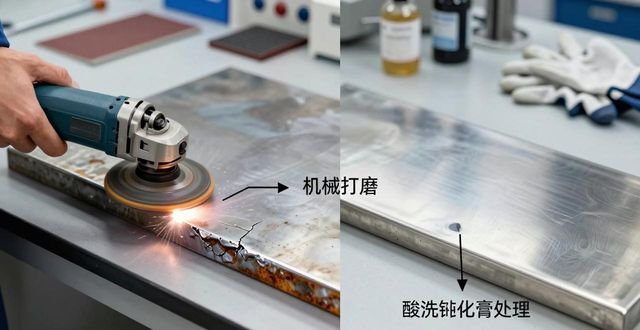
For welds that have just appeared rusty spots, the most direct way is to grind them with tools. Use a louver wheel or sandpaper to gradually grind from coarse to fine. First use 80 mesh to remove the scale and rust, and then use 240 mesh and 400 mesh to polish to restore the surface finish. In 2025, workers at a hardware processing factory in Shenzhen reported that it takes about 15 minutes to manually polish a 1-meter-long weld.

Mechanical treatment has the advantage of being fast, but it can only remove surface rust. If the rust has penetrated deep into the grain boundaries, simply polishing will cause the damaged area to expand. Moreover, the protective film on the surface of the stainless steel is damaged after polishing. If it is not passivated immediately, it will rust again after two or three days. Therefore, it is best to use pickling passivation paste after polishing.
Chemical pickling completely removes oxides
At present, when factories have complex weld shapes that are difficult to polish, the most commonly used method is chemical treatment. During operation, first use cleaning agent to remove oil stains, and then apply pickling passivation paste. Then wait 10 to 30 minutes for the acid to dissolve the oxide scale and chromium-poor layer. At the beginning of 2026, experiments conducted by a stainless steel products factory in Shanghai showed that pickling at room temperature of 25 degrees for 20 minutes has the best effect.
After pickling, be sure to rinse thoroughly, and then use an alkaline neutralizer to deal with the remaining acid. Many workers ignore this step, causing the acid to remain in the gaps and continue to corrode. In 2024, at a certain chemical plant in Jiangsu, it was precisely for this reason that one month after pickling, the welds became even more rusty. The last step is passivation, which requires the nitric acid solution to form a dense oxide film on the surface again.
Anti-corrosion coating blocks moist air
There is a suitable method for applying coating treatment to stainless steel equipment that is outdoors or in a humid environment. The method is quite simple. First, polish it to prevent rust, and then apply anti-corrosion coating to separate the weld from the air. Epoxy zinc-rich primer and fluorocarbon topcoat are often used on the market. The former has strong adhesion, while the latter has better weather resistance. In 2025 In 2016, the welds of a stainless steel guardrail located on a seaside bridge in Qingdao showed no signs of rust after two years of application of fluorocarbon paint.
The coating has shortcomings and will age and fall off over time. Usually the service life of epoxy coating is 3 to 5 years, and fluorocarbon paint can reach 8 to 10 years. If the equipment requires frequent high-temperature sterilization or comes into contact with food, the coating may release harmful substances and is not suitable for use at this time. In addition, the welds must be thoroughly cleaned before painting, otherwise the paint will cover the rust and the inside will rot faster.
Prevention before welding is more important than treatment afterwards
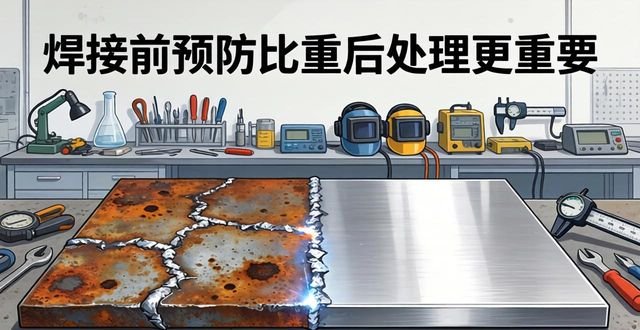
The best way to prevent rust is to make relevant preparations before welding. Before welding, polish the groove and the oxide scale within 20 mm on both sides of the weld. Will stainless steel rust after welding? , but also use acetone or alcohol to wipe away the oil stains. When performing welding operations, the protection method of back filling with argon should be used, so that a protective film can also be formed on the back of the weld. In 2025, a comparative test conducted by a pressure vessel factory in Tianjin showed that the corrosion resistance time of welds protected by argon was extended to three times longer than that of welds without argon protection.
Welding process parameters must also be strictly controlled. The interlayer temperature should not exceed 150 degrees. The smaller the heat input, the better. Using low-carbon welding wire such as 308L or 316L can reduce the generation of chromium carbide. Anti-rust treatment for stainless steel processing . After a medical device company switched to automatic argon arc welding in 2024, the welding heat-affected zone was reduced by half, and the complaint rate of weld rust dropped by 70%.
Routine maintenance and timely treatment of rust spots
After the equipment is put into use, the welds must be inspected regularly. For food processing plants and chemical plants, it is recommended to conduct inspections every three months. For seaside equipment, it is recommended to inspect every two months. If there are small rust spots, they need to be wiped off immediately with rust removal paste or fine sandpaper, and then applied with passivation liquid. In 2025, a beverage factory in Guangdong avoided the scrapping of a production line because of the timely discovery and treatment of a small rust spot.
When cleaning equipment, do not use detergents containing chlorine, such as 84 disinfectant or hydrochloric acid. Chloride ions will damage the passivation film, causing pitting corrosion of stainless steel. Neutral detergent or special stainless steel cleaner should be used, and rinsed with clean water after wiping. The place where the equipment is stored should be kept ventilated and dry, and the stainless steel processing should be anti-rust , and the humidity should be controlled below 60%. This can greatly delay the rust of the welds.
Have you ever had a problem with rust in the stainless steel welding areas at your home or factory? What methods did you use to solve this situation? Welcome to share your experience in the comment area. If you feel that this article is useful, please like it and forward it to friends in need.




暂无评论内容