

Stainless steel screw material selection principles
When choosing stainless steel screws, 90% of people make mistakes in the first step, just focusing on the price, or just looking for 304. Eventually, the screws will rust, break, and seize after only a few months of use. The cost of repair is dozens of times more expensive than the price of the screws themselves. In fact, it is not difficult to choose the right materials. The key core lies in five principles, which will be clearly explained at once today.
Whether the strength is enough depends on the force first.
The strength grade of austenitic stainless steel like 304 and 316 is generally 70, which means the tensile strength is 700 MPa. The strength grade of stainless steel screws is mainly divided into three types. Martensitic stainless steels such as 410 and 420 can reach temperatures above 1100 MPa through heat treatment. Ferritic stainless steel has the lowest strength, only 400 to 500 MPa.
In March 2026, there was a bridge project in China. Due to the use of grade 70 304 bolts, fatigue fracture occurred under vibration loads. Engineers conducted subsequent analysis and found that the actual strength of the material required for this part was above 800 MPa. Therefore, in the first step of material selection, it is necessary to calculate clearly the tensile force or shear force that the screw will bear, and then make the selection according to the material strength table.
Corrosion resistance depends on how harsh the usage environment is
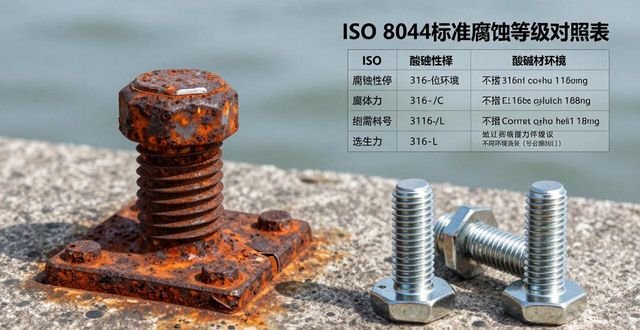
When the room is in a dry environment, ordinary 304 stainless steel can fully meet the needs of use. However, if you are in special environments such as the seaside, chemical plants, and sewage treatment tanks, you must use 316 stainless steel. This 316 stainless steel is added with 2% to 3% molybdenum, and its chloride ion corrosion resistance is 3 to 5 times that of 304 stainless steel.

There is such a real case. In 2025, 304 stainless steel bolts were used on a scenic trestle in a coastal area of Zhejiang. However, in less than two years, all of them were corroded. It was later replaced with 316L material and is still in good condition today. In addition, it should be noted that different acid and alkaline environments have different requirements for materials. It is recommended to use 316Ti in a sulfuric acid environment, while 304L would be more suitable in a nitric acid environment. For specific conditions, please refer to the corrosion grade comparison table in the ISO 8044 standard.
The working temperature determines the heat resistance performance requirements
Under normal temperature conditions, any stainless steel can work normally. However, once the temperature exceeds 300 degrees, problems will arise. When 304 stainless steel is in the range of 400 to 850 degrees, chromium carbide will precipitate, which will lead to the tendency of intergranular corrosion. If you are facing long-term high temperature working conditions, it is recommended to choose 304L or 316L. Their low carbon content can effectively avoid this problem.
The low temperature environment must also be considered. Ordinary austenitic stainless steel can still maintain good toughness below minus 100 degrees, but martensitic stainless steel will become brittle. A certain LNG project in 2024 has stipulated that flange connections must use 304 or 316 stainless steel bolts at minus 162 degrees. 410 must not be used. Remember this rule, high temperatures depend on oxidation resistance and creep strength, and low temperatures depend on impact toughness.
Due to processing technology limitations, do not choose materials that cannot be produced.
There are three main processes for manufacturing screws: cold heading, hot forging, and turning. Cold heading has the characteristics of high efficiency and low cost, but it requires good plasticity of the material. 304 and 316 are particularly suitable for cold heading. However, 410 martensitic stainless steel is prone to cracking during cold heading. In 2025, a fastener factory in Dongguan suffered losses and took orders for 410 cold heading. The final scrap rate was as high as 40%.
If high-strength martensitic stainless steel must be used, the only option is hot forging or turning. Hot forging requires heating to about 1100 degrees, and the cost is three times higher than that of cold forging. Turning is suitable for small batches or special shapes. However, the material utilization rate is not good. In addition, tapping performance must be considered. For some precipitation hardened stainless steels such as 17-4PH, the tap is very easy to break during tapping, and special tools and lubricants are required.
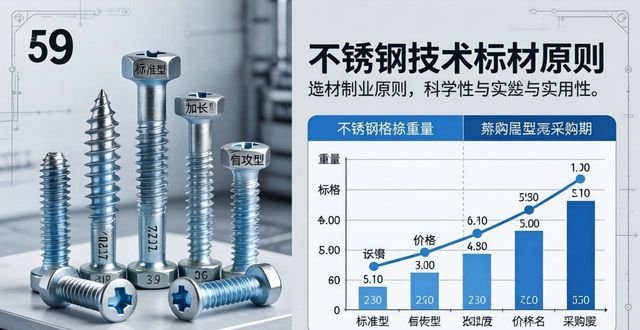
Don’t ignore other factors such as weight, price, and procurement cycle.
From a weight perspective, the density of stainless steel is 7.93 grams per cubic centimeter, and the difference between them is not significant. However, the price gap is extremely obvious. According to market quotations in March 2026, 304 stainless steel is about 18 yuan per kilogram, 316 stainless steel has risen to 32 yuan, and the price of 904L super stainless steel is as high as 120 yuan. The procurement cycle also needs to be taken into consideration. 304 and 316 are conventional materials . How to choose the riveting method and welding materials according to the metal composition . If you place an order today, it can be shipped tomorrow. However, 2205 duplex stainless steel may require a long 45-day delivery time.
In addition, the difference between national standards and imports must be considered. Domestic materials can be used if they meet the GB/T 1220 standard. There is no need to blindly pursue imported materials. Only under extremely special working conditions, such as bolts used in nuclear power plants, imported materials must be purchased according to the ASME SA-19 standard. In short, under the premise that the first three properties can be met, choose the cheapest and best material.
Remember that all five of the combination rules must be met at the same time
It is incomplete to think about each principle alone. The correct way to proceed is to draw a table that lists the strength of the candidate materials, as well as the five indicators of stainless steel screw material selection principles: corrosion resistance, heat resistance, processability and price. After scoring each item, the results are obtained through weighted calculations. How to determine the weight? This depends on your actual working conditions: if it is a seaside terrace, then adjust the weight of corrosion resistance to 40%, if it is heavy machinery, then adjust the weight of strength to 50%.
In 2025, a wind power company will have such a practice. This practice has three requirements: minus 40 degrees, high salt spray, and high intensity, and these three requirements need to be met at the same time. In the end, they selected 254SMO super austenitic stainless steel. Although its unit price is more expensive, it solved all the problems of how to select the riveting method and welding materials according to the metal composition . Compared with it, the overall cost of frequent replacement is lower. Therefore, the five principles are not questions that can be chosen, but thresholds that must be passed together.
After reading this article, think about which principle was most easily missed when you were choosing stainless steel screws. You are welcome to leave a message in the comment area to share your experience of the pitfalls you have stepped on. Also, don’t forget to like and forward it, so as to help more people working in the same industry avoid those detours.



暂无评论内容