

焊接 vs riveting: a showdown of body-in-white connection solutions
Do you know? The body-in-white of a car is like a human skeleton. From the moment it is formed, it has already determined whether the car is a "crispy" type or a "tough guy" type. However, the technological process that connects these iron men contains even more profound knowledge. Today we will avoid complicated and difficult formulas and use easy-to-understand human language to talk about the various and diverse connection technologies used in building cars.
![图片[1]-Welding Vs Riveting: A Showdown Of Body-in-white Connection Solutions-Dalian Fuhong Machinery Co., Ltd](/wp-content/uploads/2026/03/1773418932436_0.webp)
The big brother of spot welding has a stable position in the world
Stepping into any traditional car manufacturing factory, the most shocking sight must be hundreds of robots waving their arms and "radiating light" on various parts of the car body. This shining light is resistance spot welding at work. The principle is quite simple. It uses a strong current to pass through two steel plates, instantly generating high temperatures to melt the metal, and then press it into a solder joint. There are generally four to five thousand such solder joints on a car body.
Although spot welding technology has been used for nearly a hundred years, it is still key. The reason is one word: fast. It only takes one or two seconds between two welding points. Welding VS riveting: a great showdown of body-in-white connection solutions, and the cost is also extremely low. However, its shortcomings are obvious at a glance. It can only weld steel plates with similar properties, but it is "incompetent" when it comes to aluminum alloy or carbon fiber. This makes it appear to be more than capable in the face of today's car bodies that are mixed with multiple materials.
Bolt and nut removable joints
![图片[2]-Welding Vs Riveting: A Showdown Of Body-in-white Connection Solutions-Dalian Fuhong Machinery Co., Ltd](/wp-content/uploads/2026/03/1773418932436_1.jpg)
Comparing the noise and environmental impact of welding and riveting of a large number of body parts, such as doors and front and rear bumpers, the need for future repair and replacement was taken into consideration during the design. At this point, the screwing process comes into play. By tightening the bolts and nuts, the two parts are firmly fixed together and can be easily disassembled when needed, which is extremely convenient.
This connection method may seem simple, but the control of torque is a complicated matter. Tightening too tight may cause slipping, and tightening too loose may cause abnormal noises. Many high-end models now use computer-controlled electric wrenches to accurately control the tightening degree and angle of each screw. This is like performing precision surgery on every "joint" of the car body, ensuring that it is both extremely stable and silent during driving.
![图片[3]-Welding Vs Riveting: A Showdown Of Body-in-white Connection Solutions-Dalian Fuhong Machinery Co., Ltd](/wp-content/uploads/2026/03/1773418932436_2.jpg)
Arc welding thick plate nemesis
![图片[4]-Welding Vs Riveting: A Showdown Of Body-in-white Connection Solutions-Dalian Fuhong Machinery Co., Ltd](/wp-content/uploads/2026/03/1773418932436_3.png)
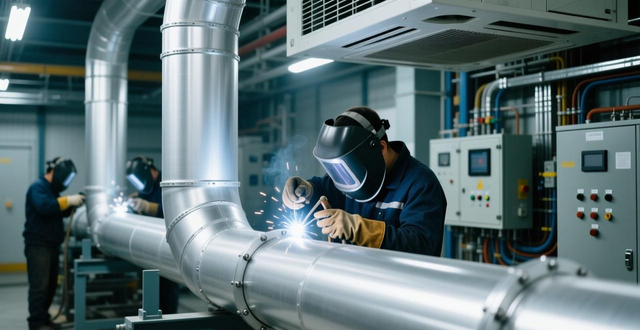
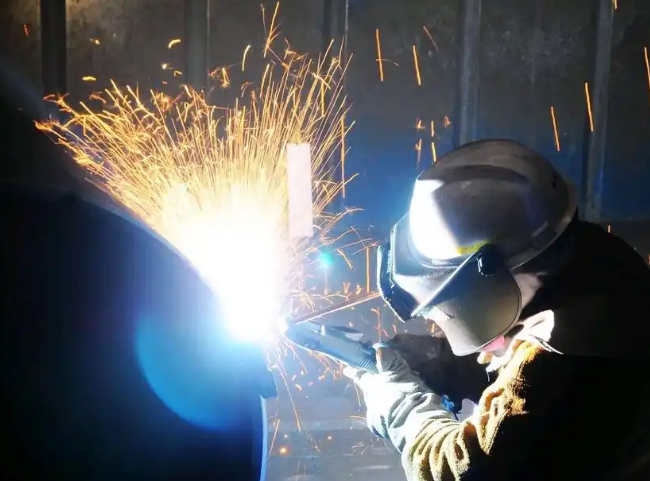
On some chassis parts or truck beams, you can see a long, centipede-like weld. This is most likely the result of MIG or TIG welding. This is a process that uses arcs to generate high temperatures and fill them with welding wire to achieve metal connections. Its penetration depth is large and the connection is extremely strong, making it particularly suitable for thick steel plate structures that can withstand huge forces.
However, this process has obvious shortcomings. It requires very high skills of workers, the welding speed is quite slow, and the high temperature will cause thermal deformation of the steel plate. Therefore, except for those parts that have extreme requirements for strength, they are rarely used on car bodies. It is more like a silent "power player", silently undertaking the heaviest work out of sight.
Self-piercing riveting lightweight savior
As Audi, Jaguar and other brands took the lead in using all-aluminum bodies, a process called SPR (self-piercing riveting) began to take center stage. It is like an extreme stapler. With the help of a high-strength rivet, it stubbornly penetrates the upper aluminum plate , and then opens the "skirt" under the action of the lower bottom mold, locking the two layers of plates together like an expansion screw.
![图片[5]-Welding Vs Riveting: A Showdown Of Body-in-white Connection Solutions-Dalian Fuhong Machinery Co., Ltd](/wp-content/uploads/2026/03/1773418932436_4.jpg)
For the steel-aluminum hybrid body, this process is a perfect match. It does not require drilling operations, compared to the noise and environmental impact of welding and riveting . Furthermore, no dust is generated, and the entire process is a cold connection, which will not damage the heat treatment performance of the material. Although the cost of rivets is much higher than that of solder joints, in order to achieve the fuel-saving effect or long-lasting performance brought about by lightweighting, car companies have calculated this calculation clearly and clearly.
FDS hot-melt screw joints can also be used on one side
In many cases, the structural parts of the car body are closed. For example, like the section of an A-pillar, you can't open it from the back at all. At this moment, the FDS (Hot Melt Screwing) process reveals its unique skills. It is like a drill that rotates at high speed. While rotating, it generates heat to melt the material while drilling into the inside. Finally, a threaded sleeve is formed on the back to firmly screw several layers of boards together.
![图片[6]-Welding Vs Riveting: A Showdown Of Body-in-white Connection Solutions-Dalian Fuhong Machinery Co., Ltd](/wp-content/uploads/2026/03/1773418932436_5.jpg)
![图片[7]-Welding Vs Riveting: A Showdown Of Body-in-white Connection Solutions-Dalian Fuhong Machinery Co., Ltd](/wp-content/uploads/2026/03/1773418932436_6.png)
The biggest advantage of this process is that it only needs to be operated from one side, which is very suitable for those parts that are in the "corners". At present, this process is used on a large scale to connect the battery pack shells of many electric vehicles to the car body, because it has high strength and can be well sealed to prevent the intrusion of water and dust.
Gluing technology is more than just bonding
Never underestimate body structure glue, it is no ordinary glue. In the field of modern automobile manufacturing, gluing technology is ubiquitous. Applying a single layer of high-strength structural adhesive between two layers of steel plates can not only play a buffering and shock-absorbing role, reducing the friction noise between metals, but also increase the connection strength to a level significantly higher than 30%.
In addition to structural adhesives, there are polyurethane adhesives used for windshields, which adhere the glass directly to the body and make it a part of the body structure. There is also sealant for the chassis to prevent rust and isolate noise. In this way, without these glues, the car would run like a big iron box, making creaking noises everywhere, leaking and rusting. Although the gluing process is low-key, it plays the dual role of adhesive and sealant.
![图片[8]-Welding Vs Riveting: A Showdown Of Body-in-white Connection Solutions-Dalian Fuhong Machinery Co., Ltd](/wp-content/uploads/2026/03/1773418932436_7.jpg)
From traditional spot welding to emerging SPR and FDS, no process is omnipotent. Spot welding is responsible for efficient tasks, SPR and FDS are responsible for overcoming the problem of lightweighting, and gluing is silently doing the work of ensuring NVH (noise, vibration and harshness) and sealing behind the scenes. The manufacturing of future cars is a wonderful display of this combination.
After reading this article, which connection technology do you think has the most promising development prospects in the pursuit of extreme lightweight and battery safety in new energy vehicles? Welcome to leave a message in the comment area to start a discussion, and don’t forget to give it a like to support it, so that more people can understand the secrets of building a car!
![图片[9]-Welding Vs Riveting: A Showdown Of Body-in-white Connection Solutions-Dalian Fuhong Machinery Co., Ltd](/wp-content/uploads/2026/03/1773418932436_8.webp)



暂无评论内容