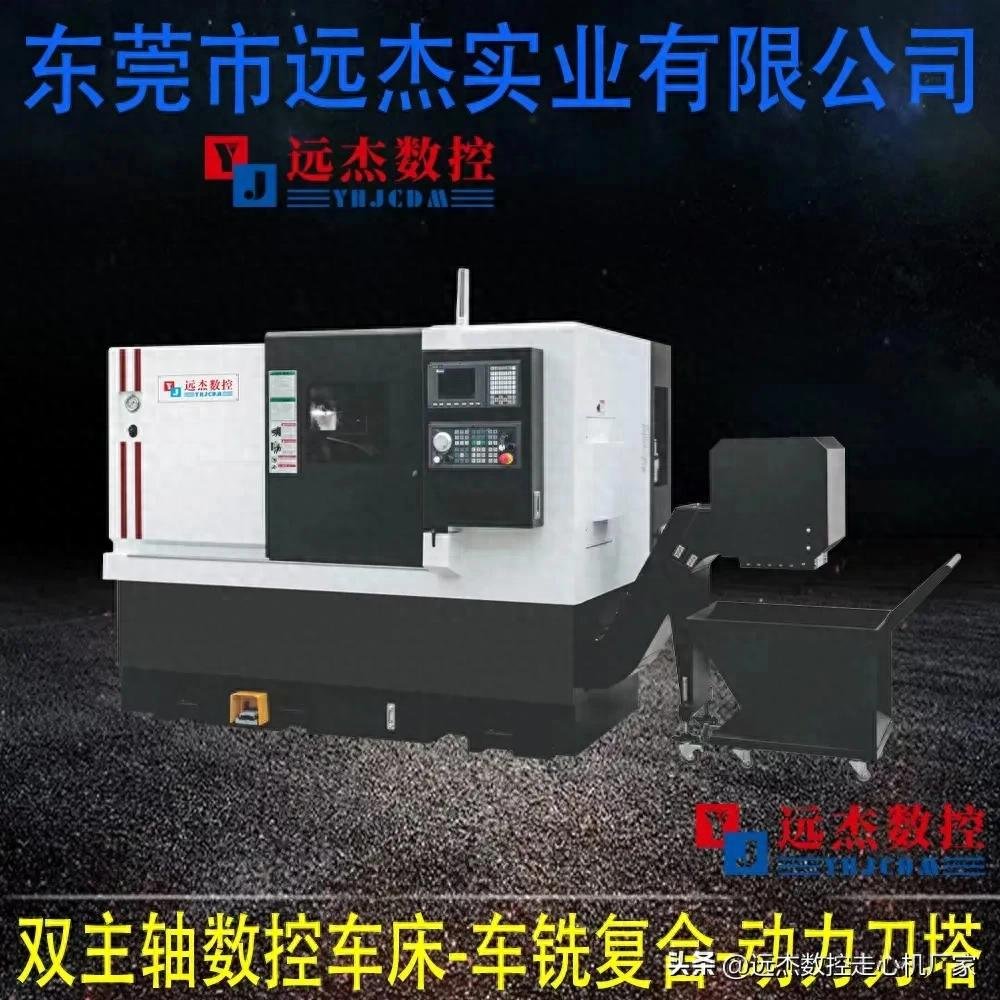


Is it difficult to learn how to combine turning and milling with CNC lathe?
Turning to CNC lathe turning and milling combined processing technology, the income potential seems to be doubled. However, 90% of people stagnate at these three obstacles. In fact, there are feasible solutions for all of them.
![图片[1]-Is It Difficult To Learn How To Combine Turning And Milling With CNC Lathe?-Dalian Fuhong Machinery Co., Ltd](/wp-content/uploads/2026/03/1772395832339_0.jpg)
Thinking transformation between coordinate system and tool path
In the turn-milling compound machine tool, the coordinate system suddenly jumps from the original two-axis to the five-axis linkage state. This is the first obstacle that beginners encounter. Ordinary CNC lathes only have X-axis and Z-axis, while turning-milling machine tools additionally incorporate Y-axis, A-axis, and C-axis symmetry. During processing of special-shaped screws, it is necessary to simultaneously control the rotation of the spindle and the helical interpolation operation of the milling cutter. Many experienced masters were stunned when they saw movement instructions for the five coordinate axes of X, Y, Z, A, and C appearing simultaneously in the program for the first time.
Using simulation software to conduct drills in advance is the most efficient way to achieve breakthroughs. For example, build a complete machine tool model in Vericut, input blank and tool parameters, and practice targeted multi-axis linkage programming logic. Data presented in actual cases show that by using helical milling to replace traditional turning threads, the processing efficiency can be increased by more than 30%, and the tool wear will be more uniform. Spend two hours a day practicing on the simulation software, and you can build up a feel for the spatial coordinate system in two weeks.
Composite process planning capability advancement
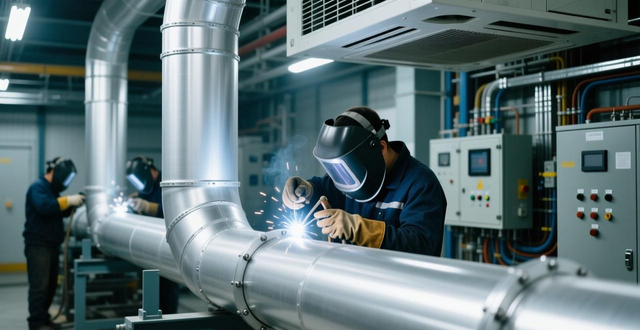
![图片[2]-Is It Difficult To Learn How To Combine Turning And Milling With CNC Lathe?-Dalian Fuhong Machinery Co., Ltd](/wp-content/uploads/2026/03/1772395832339_1.png)
The key advantage of turning-milling is that all the work can be completed in one process. However, this requires the operator to have comprehensive process planning capabilities. When processing aero-engine blades, the design of the process sequence is extremely particular. First, the outline of the blade must be turned, then the complex flow channel surface must be milled, and finally, precise cooling holes must be drilled at specific locations. Once the order is reversed, the workpiece may be scrapped or the tool may be broken.
The intelligent process recommendation system can be used to greatly reduce the difficulty of planning. For example, Siemens' NX CAM process module only needs to import the 3D model of the part, select the material type and accuracy requirements, and the system will automatically generate the optimal process route and cutting parameters. After the aerospace parts company in a city introduced this system, the process planning time was increased from planning 3 parts per person per day to 8, and the efficiency increased by 60%.
Key points for operation and maintenance of complex equipment
The structure of a turn-milling compound machine tool is much more complex than that of an ordinary lathe. It contains new technical contents such as a powered turret and a B-axis milling head, which require new learning. The tool changing logic of the power tool turret is not just about changing the blade. The high-speed rotating tool holder must be dynamically balanced and calibrated. Otherwise, the surface finish obtained by processing will simply not meet the specified requirements. When processing taper parts, the B-axis milling head needs to implement angle compensation. How to measure the compensation value and how to input the compensation value are all new knowledge points.
The auxiliary operation manuals provided by manufacturers often include 3D animation demonstrations, which are the most intuitive examples of learning materials. Just like the manual of Demagison's turn-milling machine tool, you can use your mobile phone to scan the QR code on the device, and you will see the disassembly animation of the internal structure and the demonstration of the operating process. Follow the animation step by step to operate the turning and milling composite machining simulation software , and then understand the engagement principle of the tool change mechanism and the angle locking mechanism of the B-axis. After a week, you can master the operating points of these new mechanisms.
Laying the foundation for practical operation of simulation software
Focus the first phase of learning on simulation software, and arrange two hours a day for one to two weeks. Start practicing with a very simple four-axis machining impeller, paying attention to the interference between the tool path and the workpiece. Then gradually increase the difficulty, simulate the tool changing process of the power turret, and test the compensation effect of the B-axis at different angles. Domestic software like CAXA CAM also has a turning and milling composite module, supports post-processor customization, and can directly generate G codes that can be recognized by machine tools.
Don’t rush to get on the machine at this stage, you need to simulate all situations where there is a possibility of knife collision in the software. Note the changes in the tool path after each parameter change, and compare the advantages and disadvantages of different programming strategies. Training data from a certain vocational and technical college show that the tool breakage rate of students who have undergone two weeks of simulation training using turn-milling composite machining simulation software during practical operations on the machine is reduced by 70% compared with novices who directly use the machine.
Process optimization training to improve efficiency
![图片[3]-Is It Difficult To Learn How To Combine Turning And Milling With CNC Lathe?-Dalian Fuhong Machinery Co., Ltd](/wp-content/uploads/2026/03/1772395832339_2.png)
In the second stage, a month was spent dedicated to process optimization, looking for some typical parts, such as high-precision shaft parts, inputting parameters, allowing the process recommendation system to generate a "turning-milling-grinding" composite process route, and then comparing the traditional process with multiple machine tools to calculate the total processing time, clamping times and accuracy stability.
An actual comparison case is presented. An optimized composite process is used to process the motor spindle. The number of clampings is reduced from 5 to 1, and the total processing time is reduced from 3.5 hours to 1.2 hours. During this month, focus on the differences between the parameters recommended by the system and traditional experience, such as why higher spindle speed and smaller depth of cut are recommended, and clarify the logic of this series.
Actual machine operation and case reproduction
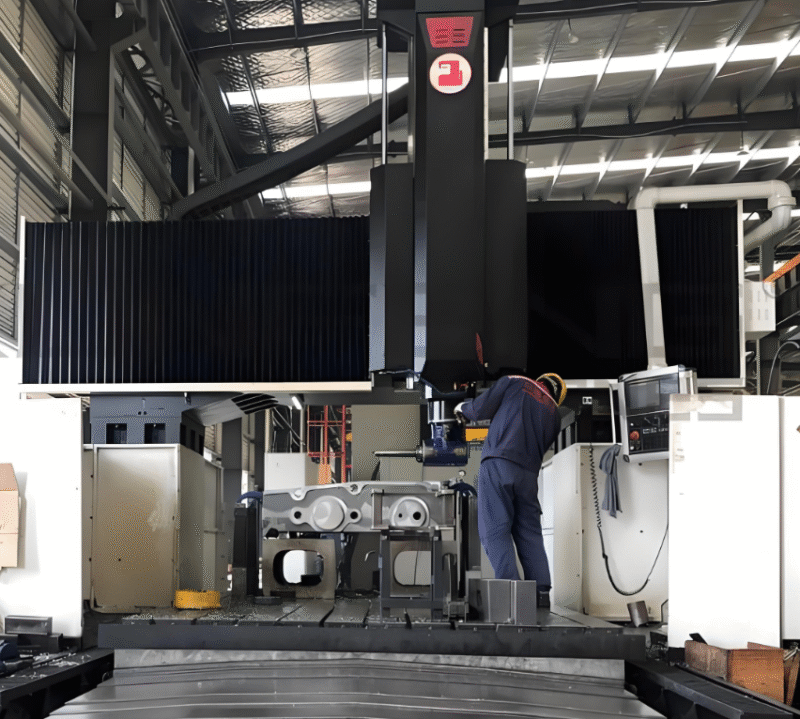
The third stage is the on-site operation start-up period, which takes two to three months. Parts from the classic case library are selected, such as complex curved surface parts and special-shaped screws, and are processed according to the G code and process parameters provided by the case. During the processing process, the actual spindle speed, feed rate and cutting depth are recorded, and compared with the recommended parameters, and then the adjustment range suitable for the own machine tool is found.
In a precision machinery factory, a master master used this method to learn. After three months, he learned how to combine turning and milling with a CNC lathe, and then independently completed the trial production of an artificial hip joint. This part required turning the femoral stem and milling the acetabular cup at the same time. The accuracy required was as much as plus or minus 0.01 mm, and he He successfully trial-produced the turning-milling composite machining simulation software in one go, and subsequently directly accepted orders from hospitals. When processing new energy vehicle motor casings, he combined end-face turning, inner hole milling and thread tapping into one process, reducing the processing time for a single piece from the original 45 minutes to 18 minutes.
How long did it take you to switch from CNC lathe to mill-turn? Have you ever encountered a processing problem that left a deep impression on you? Feel free to share your experiences in the comment area. If you find the article helpful, don’t forget to like it and forward it to friends in need.






暂无评论内容