
Tag: Titanium

  • Titanium 4 Chemical Element Titanium Is A Chemical Element With The Chemical Symbol Ti And Atomic Number 22. It Is Located In The Fourth Period And Group IVB Of The Periodic Table Of Chemical Elements. It Is A Silver-white Transition Metal Characterized By Light Weight, High Strength, Metallic Luster, And Resistance To Moisture Chlorine Corrosion. However, Titanium Cannot Be Used In Dry Chlorine Gas. Even Dry Chlorine Gas With A Temperature Below 0°C Will Undergo A Violent Chemical Reaction To Generate Titanium Tetrachloride, Which Will Then Decompose Into Titanium Dichloride And Even Burn. Only When The Water Content In Chlorine Gas Is Higher Than 0.5%, Titanium Can Maintain Reliable Stability In It. 1/3 Titanium Is Considered A Rare Metal Due To Its Dispersed Presence In Nature And Difficulty In Extraction1. But It Is Relatively Abundant, Ranking Tenth Among All Elements. Titanium Ores Mainly Include Ilmenite And Rutile, Which Are Widely Distributed In The Earth's Crust And Lithosphere. Titanium Also Exists In Almost All Living Things, Rocks, Water And Soil. The Extraction Of Titanium From The Main Ore Requires The Kroll Or Hunter Process. The Most Common Compound Of Titanium Is Titanium Dioxide, Which Is Used To Make White Pigments. Other Compounds Include Titanium Tetrachloride (TiCl4) (used As A Catalyst And Used To Create Smoke Screens For Air Cover) And Titanium Trichloride (TiCl3) (used To Catalyze The Production Of Polypropylene). Basic Information

    Titanium 4 Chemical Element Titanium Is A Chemical Element With The Chemical Symbol Ti And Atomic Number 22. It Is Located In The Fourth Period And Group IVB Of The Periodic Table Of Chemical Elements. It Is A Silver-white Transition Metal Characterized By Light Weight, High Strength, Metallic Luster, And Resistance To Moisture Chlorine Corrosion. However, Titanium Cannot Be Used In Dry Chlorine Gas. Even Dry Chlorine Gas With A Temperature Below 0°C Will Undergo A Violent Chemical Reaction To Generate Titanium Tetrachloride, Which Will Then Decompose Into Titanium Dichloride And Even Burn. Only When The Water Content In Chlorine Gas Is Higher Than 0.5%, Titanium Can Maintain Reliable Stability In It. 1/3 Titanium Is Considered A Rare Metal Due To Its Dispersed Presence In Nature And Difficulty In Extraction1. But It Is Relatively Abundant, Ranking Tenth Among All Elements. Titanium Ores Mainly Include Ilmenite And Rutile, Which Are Widely Distributed In The Earth's Crust And Lithosphere. Titanium Also Exists In Almost All Living Things, Rocks, Water And Soil. The Extraction Of Titanium From The Main Ore Requires The Kroll Or Hunter Process. The Most Common Compound Of Titanium Is Titanium Dioxide, Which Is Used To Make White Pigments. Other Compounds Include Titanium Tetrachloride (TiCl4) (used As A Catalyst And Used To Create Smoke Screens For Air Cover) And Titanium Trichloride (TiCl3) (used To Catalyze The Production Of Polypropylene). Basic Information

    Titanium 4 chemical element Titanium is a chemical element with the chemical symbol Ti and atomic number 22. It is located in the fourth period and group IVB of the periodic table of chemical elements. It is a silver-white transition metal characterized by light weight, high strength, metallic luster, and resistance to moisture chlorine corrosion. But titanium cannot be used in dry chlorine, even in dry chlorine with a temperature below 0°C. Titanium 4 Chemical element Titanium is a chemical element with chemical symbol Ti and atomic number 22. It is located in the fourth period and group IVB of the periodic table of chemical elements. It is a silver-white transition metal characterized by light weight, high strength, metallic luster, and resistance to moisture chlorine corrosion. However, titanium cannot be used in dry chlorine gas. Even dry chlorine gas with a temperature below 0°C will undergo a violent chemical reaction to generate titanium tetrachloride, which will then decompose into titanium dichloride and even burn. Only when the water content in chlorine gas is higher than 0.5%, titanium can maintain reliable stability in it. 1/3 Titanium is considered a rare metal due to its dispersed presence in nature and difficulty in extraction1. But it is relatively abundant, ranking tenth among all elements. Titanium ores mainly include ilmenite and rutile, which are widely distributed in the earth's crust and lithosphere. Titanium also exists in almost all living things, rocks, water and soil. The extraction of titanium from the main ore requires the Kroll or Hunter process. The most common compound of titanium is titanium dioxide, which is used to make white pigments. Other compounds include titanium tetrachloride (TiCl4) (used as a catalyst and used to create smoke screens for air cover) and titanium trichloride (TiCl3) (used to catalyze the production of polypropylene). Basic information: Violent chemical reactions will also occur to form titanium tetrachloride, which will then decompose to form titanium dichloride, and even burn. Only when the water content in chlorine gas is higher than 0.5%, titanium can maintain reliable stability in it. 1/3 Titanium is considered a rare metal due to its dispersed presence in nature and difficulty in extraction1. But it is relatively abundant, ranking tenth among all elements. Titanium ores mainly include ilmenite and rutile, which are widely distributed in the earth's crust and lithosphere. Titanium also exists in almost all living things, rocks, water and soil. The extraction of titanium from the main ore requires the Kroll or Hunter process. The most common compound of titanium is titanium dioxide, which is used to make white pigments. Other compounds include titanium tetrachloride (TiCl4) (used as a catalyst and used to create smoke screens for air cover) and titanium trichloride (TiCl3) (used to catalyze the production of polypropylene). Basic information

    The physical properties of titanium determine the difficulty of processing

    Titanium, with atomic number 22, is a silver-white transition metal that is light in weight but extremely strong. In 2025, global titanium production will exceed 250,000 tons, of which the aviation sector will account for more than 45%. This metal is unique in that its strength is similar to steel, but its density is only 60% of steel, making it the material of choice for aerospace and medical devices.

    Titanium has an extremely low thermal conductivity, which is only one-fifth that of steel. This indicates that the heat generated during cutting cannot be conducted quickly, causing a large amount of heat to accumulate on the cutting edge of the tool. According to 2024 data from the American Tool Manufacturers Association, the tool temperature can reach more than 1,000 degrees Celsius when processing titanium alloys. This temperature is far higher than the 600 degrees Celsius when processing ordinary steel.

    Titanium alloy machining tools require special design

    To process titanium alloy tools, carbide or polycrystalline diamond materials must be used. In 2025, the German Walter Company launched a special milling cutter, which uses micron-sized tungsten carbide particles and can reach a hardness above HRA92. The cutting angle of this kind of tool needs to be specially designed. Its rake angle is generally 5 to 8 degrees, which is 3 to 5 degrees smaller than the rake angle when processing steel.

    For cutting tools, coatings play the same key role. In tests conducted in 2024, the AlTiN coating developed by Swiss company Sandvik extended the service life of cutting tools by three times. This coating has the ability to withstand high temperatures of 1,200 degrees Celsius. At the same time, it can also reduce the adhesion between titanium alloy and cutting tools to prevent the formation of built-up edges. Data shows that after using special cutting tools, the processing efficiency is increased by 40%.

    钛合金加工专用刀具_钛矿石提取_钛化学性质

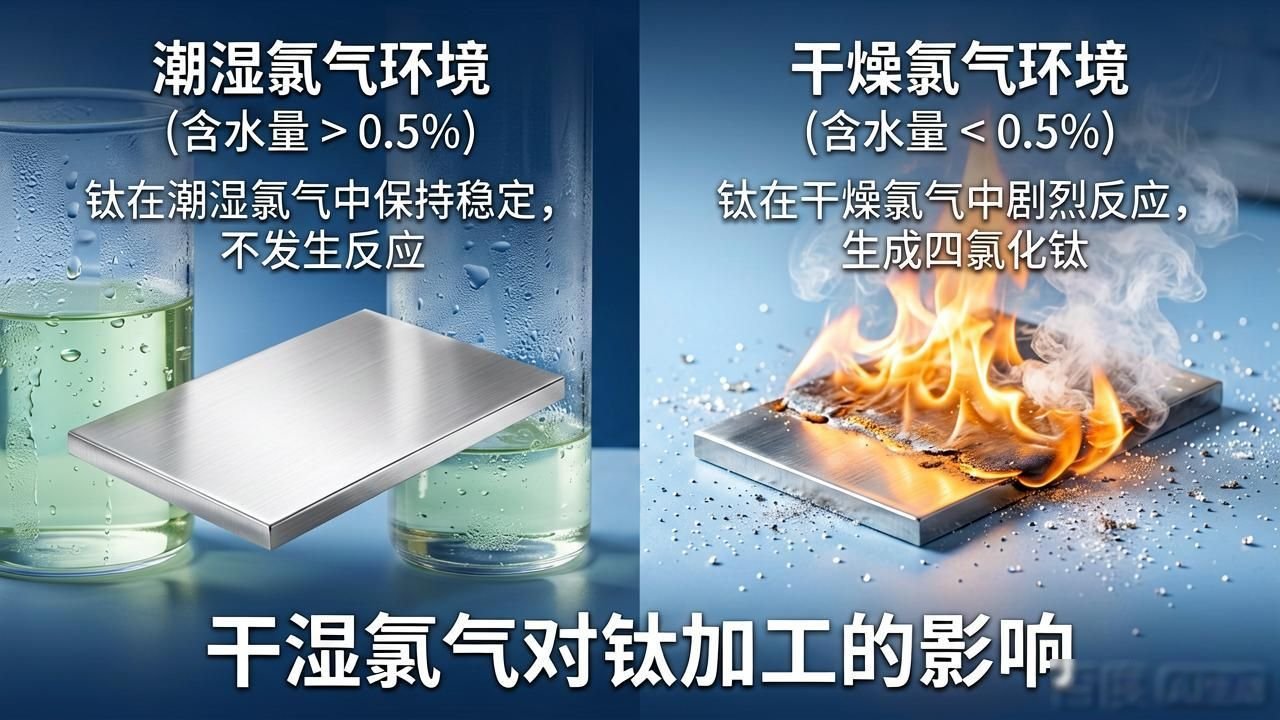
    Effect of dry and wet chlorine on titanium processing

    Titanium is in a stable state in wet chlorine gas, but when the water content of the chlorine gas is less than 0.5%, a violent chemical reaction will occur. There is a titanium alloy processing factory in Shenyang. In 2023, due to incorrect use of chlorine-containing cutting fluid, titanium tetrachloride was generated on the surface of the tool. The corrosion rate reached 0.3 mm per hour. Such a reaction would seriously damage the tool structure.

    If the processing environment is to be stably controlled, the chlorine content must be strictly controlled. According to the standards set by Japan's Mitsubishi Heavy Industries for workshops, the chlorine concentration in the area used for titanium alloy processing needs to be less than 5ppm. The water content in the cutting fluid must always be maintained above 1%. In 2025, there was a precision machinery factory in Suzhou. After the introduction of an online monitoring system, the tool scrap rate dropped from the original 15% to 3%.

    Temperature control strategy for titanium alloy processing

    Cutting speed is the key indicator for controlling temperature. According to the 2024 research report of the American Society of Mechanical Engineers, when processing TC4 titanium alloy, the cutting speed should be controlled in the range of 40 to 60 meters per minute. Once it exceeds 80 meters per minute, the tool wear rate will increase exponentially. For every 10 meters per minute increase in cutting speed, tool life will be shortened by 25%.

    Equally important is the cooling method. The high-pressure cooling system launched by the German Gühring Company in 2025 can spray cutting fluid into the cutting area at a pressure of 80 bar, thereby reducing the temperature by 200 degrees Celsius. In practical applications, this system has reduced the cost of single-piece processing by 18%, and the frequency of tool replacement has been reduced by half.

    钛合金加工专用刀具_钛矿石提取_钛化学性质

    Geometric parameters of titanium alloy processing tools

    The processing quality is directly affected by the tool helix angle and edge treatment. Data released by the Swedish Seco Tools company in 2025 shows that for milling cutters processing titanium alloys, the helix angle selection range should be 35 degrees to 40 degrees. Compared with ordinary milling cutters, this value is 5 degrees larger. This design can reduce cutting force fluctuations and reduce the risk of vibration.

    The issue of edge passivation cannot be ignored. Japan's OSG company uses micro-sandblasting technology to process the edge. It controls the radius of the blunt circle from 0.02 mm to 0.05 mm. After such treatment, when the tool is processing titanium alloy, its surface roughness can be reduced from Ra0.8 to Ra0.4 microns, while also reducing the probability of chipping of the tool.

    Cost optimization solution for titanium alloy processing

    There is a need to balance tool costs and processing efficiency. A certain domestic aerospace parts company switched to solid carbide tools in 2024. Although the price of a single tool has increased from 80 yuan to 200 yuan, the tool life has increased from the 20 parts that can be processed to 80, and the overall cost has dropped by 35%.

    A tool supplier signed an annual agreement with a mold factory in Ningbo, Zhejiang, and the unit price dropped by 20% when purchasing more than 500 tools, which shows that bulk purchasing is feasible. The mold factory has also established an internal grinding workshop. Each tool can be grinded 3 to 5 times, and the cost of a single grinding is only 20 yuan, thus effectively extending the tool life cycle, which shows that tool grinding is also feasible.

    What is the most difficult tool problem you have encountered during actual processing of titanium alloys? Please share your experience in the comment area. Like and bookmark this article. More information about titanium alloy processing will be continuously updated.

  • What Are The Common Machining Processes For Titanium Alloys?

    What are the common machining processes for titanium alloys?

    Due to its high specific strength and good corrosion resistance, the use of titanium alloys in the aerospace and medical implant fields continues to grow. However, many factories have repeatedly encountered troubles during turning and boring. The three problems of high cutting temperature, rapid tool wear, and large chip rebound have caused many operators extreme headaches. In fact, as long as the appropriate processing conditions are controlled, turning and boring are not as difficult as rumored.

    Carbide tools are preferred for continuous cutting

    For continuous cutting of titanium alloy parts or titanium alloy parts for mass production, as well as titanium alloy parts with large amounts of metal removal, carbide cutting tools will be the preferred choice for most factories. This material has the ability to withstand higher cutting temperatures and maintain a stable cutting edge at high speeds. There is an aviation parts factory in Jiangsu that conducted actual measurements at the end of 2025. It used carbide tools to turn TC4 titanium alloy, and finally found that the tool life was increased by 5 times compared with high-speed steel.

    When intermittent processing such as forming cutting, grooving or cutting is required, high-speed steel cutting tools have more advantages. High-speed steel has better toughness and can withstand impact loads during cutting. There is a medical device company in Shenzhen. When processing the undercut grooves of titanium alloy bone screws, the chipping rate was reduced by 80% after switching to high-speed steel tools.

    Applicable scenarios for cermet tools

    In titanium alloy finishing, cermet cutting tools are being used more and more, especially in those situations where good surface finish is required. This kind of tool has the characteristics of high hardness for boring processing , and its friction coefficient is also low for boring processing , which can effectively reduce the heat accumulation in the cutting area. A precision machinery factory in Chengdu used cermet tools to boring titanium alloy thin-walled sleeves during the test in January 2026, and the surface roughness reached Ra0.8 microns.

    However, cermet cutting tools are relatively sensitive to cutting parameters and are not suitable for heavy-duty roughing. Its bending strength is lower than that of cemented carbide, and if the feed rate is too large, it will easily cause the cutting edge to peel off. Therefore, it is recommended to use it in the finishing stage. The cutting speed needs to be controlled in the range of 40 to 60 meters per minute, and the feed per revolution cannot exceed 0.08 mm.

    Forced feed and cutting parameter selection

    Always use a constant forced feed method to prevent any kind of cutting interruption. This is one of the core principles of titanium alloy processing. If a sudden stop or deceleration occurs during the cutting process, the tool will rub on the hardened surface, immediately producing very high temperatures and severe tool wear. When programming, the operator should ensure that there are no pause points in the entire tool path.

    Before forging, the oxygen-rich layer on the surface of the original bar needs to be turned, which requires the use of carbide tools, and the cutting depth must be greater than the thickness of the oxygen-rich layer. In actual production, the depth of the oxygen-rich layer of titanium alloy bars is generally between 0.3 and 0.5 mm, so the cutting depth of the first knife is recommended to be set at 0.8 to 1.0 mm. The recommended cutting speed is 20 to 30 meters per minute, and the feed rate should be controlled at 0.1 to 0.2 mm per revolution.

    The correct method of cooling and lubrication

    Do not use dry cutting when turning and boring titanium alloys. Sufficient cooling must be carried out. The purpose of cooling is to take away the cutting heat, reduce the adhesion between the tool and the chips, and prevent titanium chips from forming built-up edge on the rake face of the tool. Many workshops have found that when the coolant supply is insufficient for boring processing , the wear of the tool flank surface will accelerate rapidly.

    It is recommended to use two coolants, one is a 5% sodium nitrate aqueous solution, and the other is a soluble oil emulsion diluted to 1/20. Sodium nitrate solution can effectively inhibit the chemical reaction between titanium and tool materials, and soluble oil emulsion has better lubrication performance. The coolant flow rate should reach 15 to 20 liters per minute and must be sprayed directly into the cutting area, not just poured on the left chips.

    Tips for preventing burning and deformation during boring processing

    In titanium alloy finishing, boring is an important process, especially for thin-walled products. It shoulders two key tasks, namely preventing burns and ensuring that parts are clamped without deformation. Thin-walled titanium alloy parts have poor rigidity. If the clamping force is too large, the workpiece will be out of round. After boring, the dimensions will exceed the tolerance range due to springback. When processing titanium alloy thin-walled shells, an aerospace company in Shanghai used low-stress soft claws and axial compression methods to successfully control the clamping deformation within 0.01 mm.

    Rely on controlling cutting heat and sufficient cooling to prevent burns. During boring, the cutting speed should not be too high. The recommended value for rough boring is twenty to twenty-five meters per minute, and the recommended value for fine boring is twenty to twenty meters per minute. Five to thirty meters, the boring tool needs to use a blade with a sharp positive rake angle, and ensure that the arc radius of the tool tip does not exceed 0.2 mm. After each part is processed, check whether the cooling nozzle is aligned with the position of the boring tool tip.

    Details that are easily overlooked in actual production

    An invisible killer in titanium alloy processing is that the cutting springback is very large and the elastic modulus of the material is low. The machined surface will rebound outward during cutting, which causes continuous friction between the flank surface and the workpiece. The heat generated by this friction is more concentrated than the chip deformation heat, which accelerates the bonding wear and diffusion wear of the tool. To solve this problem, the clearance angle must be kept small enough and a sharp cutting edge must be used.

    When machining, try not to cut, but maintain sufficient cooling. This statement is easily misunderstood. The correct understanding is that do not stop cutting to clean the chips. Use high-pressure coolant to directly wash away the chips. The cutting speed, feed rate and The three cutting depths must be matched reasonably. A proven starting parameter is that the cutting speed is 25 meters per minute, the feed is 0.12 mm per revolution, and the cutting depth is 1.5 mm, and then fine-tuned according to the tool wear.

    What are the common machining processes for titanium alloys when turning titanium alloys? , what is the most troublesome and difficult tool wear problem you have ever encountered? When boring titanium alloys, what is the most difficult and particularly difficult tool tip wear condition you have encountered? Welcome to share the parameters you use during processing and the processing methods you adopt in the comment area. The three friends with the highest likes will receive an electronic version of the titanium alloy processing manual.