Tag: Q345

  • Detailed Explanation Of The Differences Between 16Mn, Q345 And Q355 Steel Grades

    Detailed Explanation Of The Differences Between 16Mn, Q345 And Q355 Steel Grades

    Detailed explanation of the differences between 16Mn, Q345 and Q355 steel grades

    The historical context of brand evolution

    The national standard GB 1591-88 was born in 1988. 16Mn was a very commonly used low alloy steel in engineering structures in the last century. At that time, it filled the gap in domestic high-strength steel products. Q345 thick plate (above 30mm) riveting price , was widely used in bridges, factories, pressure vessels and other fields, and has been in service for decades.

    After entering the 21st century, with the progress of metallurgical technology, Q345 replaced 16Mn in the 2008 version of the national standard and became the mainstream brand. The "Q" in the name represents yield strength, and 345 indicates that the minimum yield strength is 345 MPa. The naming method is more in line with international standards.

    The new standard was promulgated in 2018, with Q355 taking over as the current brand, and 16Mn and Q345 gradually withdrawing from the commercial field. This evolution reflects the development of Chinese steel standards in line with international standards, and the continuous increase in performance requirements.

    The hard difference between ingredients and performance

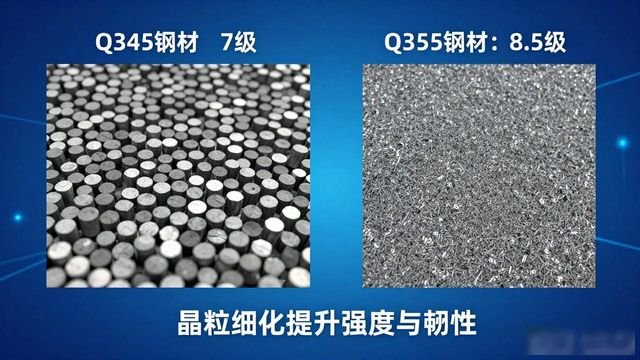
    The most critical improvement of Q355 over Q345 is the addition of micro-alloying elements such as vanadium and titanium. These elements can effectively refine the grains of steel, thereby improving the comprehensive mechanical properties of the material. The finer the grains, the better the combination of strength and toughness of the steel.

    The yield strength increased from 345 MPa to 355 MPa, an increase of approximately 3%. This is a significant leap for structural design. Specifically, for large-span and heavy-load structural members, this 10 MPa increase can bring a more reliable safety margin.

    In terms of low-temperature toughness, the highest impact test temperature that Q355 can reach is minus 40 degrees, which is better than Q345. The control of phosphorus and sulfur content is more stringent, the upper limit of phosphorus content is lower, and the requirement of sulfur content is more stringent Q345 thick plate (above 30mm) riveting price . As a result, the weldability and brittle fracture resistance of steel have been raised to a new level.

    actual difference in market price

    Q345厚板(30mm以上)铆焊价格_钢材牌号16Mn Q345 Q355核心差异_钢材牌号16Mn Q345 Q355演变关系

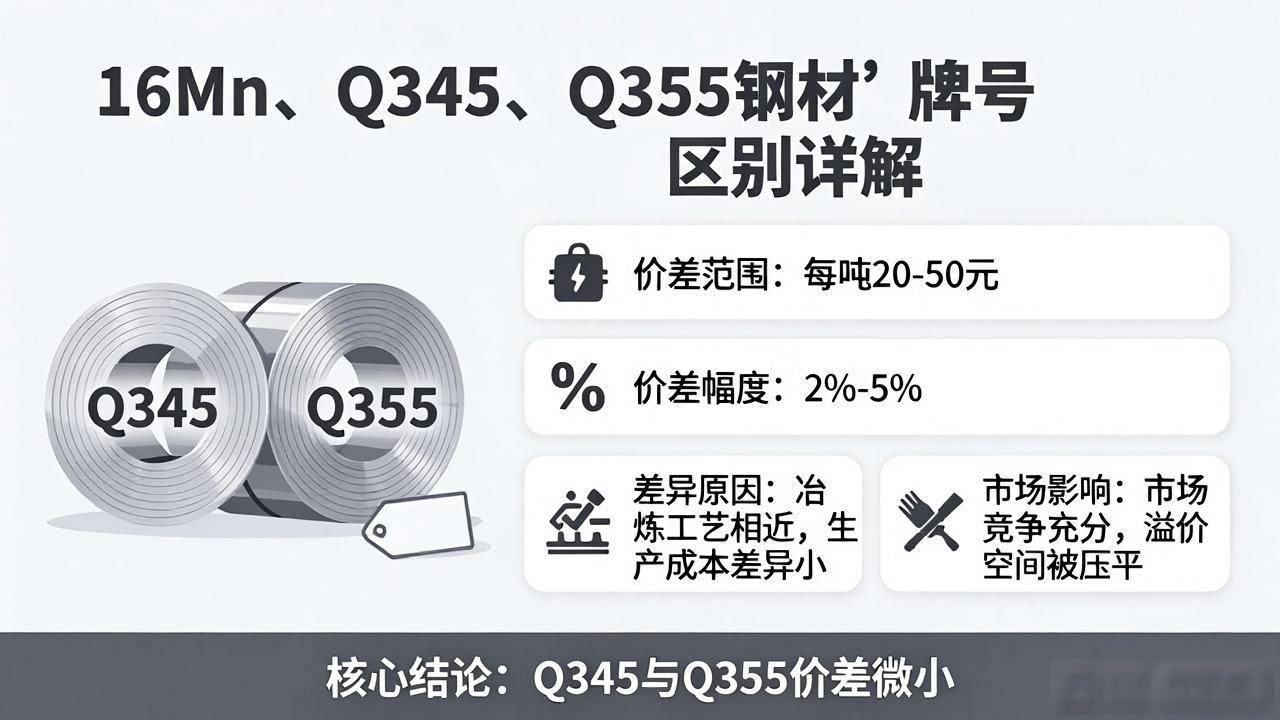
    In the market, the price difference between Q345 and Q355 is generally in the range of 20 to 50 yuan per ton, with a range of about 2 to 5 percent. This price difference is quite small. The main reason is that the smelting processes of the two brands are similar to each other, and the difference in production costs is relatively limited. The market competition is sufficient, resulting in the premium space being flattened.

    For thick plates over 30 mm, the differences between 16Mn, Q345, and Q355 steel grades are explained in detail. The resource supply of Q355B is quite sufficient. Major steel plants such as Baowu, Shagang, and Rizhao have stable production capacity. There are large inventories in East China and North China, and there is basically no need to wait for the production schedule when purchasing.

    From the perspective of cost performance, while spending the same amount of money, purchasing the Q355 with better performance is obviously a better choice for procurement projects. Especially for projects that have high requirements for structural safety, even if you spend more money in exchange for better low-temperature toughness and welding performance, the input-output ratio is very cost-effective.

    Practical advice on selecting materials for new projects

    If it is a new construction project, priority should be given to the Q355 series, which is the material recommended by the current national standards. The design drawings are directly marked with Q355B or Q355C, which can avoid the trouble caused by later material replacement and facilitate material traceability during construction acceptance.

    When old projects are being renovated and reinforced, if the original design uses 16Mn or Q345, Q355 can be used directly to replace it. The strength margin after replacement is sufficient to meet the safety reserve requirements of the original design, and the quality stability of the new grade is more guaranteed.

    However, during the replacement process, engineers need to recalculate the carrying capacity of the node connection. Although the strength of Q355 is higher, the matching of the welded joints must be considered. It cannot simply be assumed that the higher the strength, the better. The calculation must be done based on the actual working conditions.

    Key points for adjusting the welding process

    钢材牌号16Mn Q345 Q355核心差异_钢材牌号16Mn Q345 Q355演变关系_Q345厚板(30mm以上)铆焊价格

    The carbon equivalent of Q355 is slightly higher than that of Q345. When welding, the preheating temperature must be increased appropriately based on the plate thickness. For thick plates above 30 mm, it is recommended to control the preheating temperature at 100 to 150 degrees Celsius . Q345 thick plate (above 30 mm) riveting price . After welding, heat preservation and slow cooling can effectively reduce the risk of hydrogen-induced cracks.

    The selection of welding materials also needs to be adjusted accordingly. It is recommended to use corresponding welding materials that match the strength of Q355, such as the E50 series. The performance of the deposited metal of the welding rod or welding wire must match that of the base metal. Only in this way can we ensure that the mechanical properties of the weld will not be lower than the standards of the base metal.

    The interlayer temperature also needs to be properly controlled and usually does not exceed 200 degrees Celsius. For joints with relatively large constraints, the interlayer temperature can be moderately reduced to reduce the structural coarsening in the heat-affected zone. Process assessment must be done before construction, which can greatly reduce the probability of on-site welding quality accidents.

    Things to note when purchasing goods

    When purchasing Q355 thick plates, you need to check whether the chemical composition and mechanical properties included in the warranty can meet the requirements set forth in GB/T 1591-2018. Focus on the three indicators of yield strength, tensile strength and impact energy. These data must meet the minimum values ​​stipulated in the standard.

    For thick plates over 30 mm, attention should be paid to the judgment of Z-direction performance. If the structure needs to prevent lamellar tearing, the Z15 or Z25 grade should be stated in the purchase contract. The steel plant will make corresponding adjustments in composition during production.

    When receiving the goods, it is necessary to carry out appearance inspection and dimensional measurement to check whether there are defects such as delamination and cracks on the surface. If necessary, non-destructive testing can be carried out, or samples can be taken for re-inspection to ensure that the quality of the materials entering the site meets the standards and to prevent problems with the materials from affecting the subsequent construction progress.

    The project you have is using Q345 material or Q355 material. When replacing the grade, have you encountered the troublesome situation of welding requiring rework? Welcome to leave your comments and tell us about your experience!

  • Detailed Explanation Of The Differences Between 16Mn, Q345 And Q355 Steel Grades

    Detailed Explanation Of The Differences Between 16Mn, Q345 And Q355 Steel Grades

    Detailed explanation of the differences between 16Mn, Q345 and Q355 steel grades

    The true identity of the third generation brand

    Low alloy structural steel with a carbon content of 0.16% and a manganese content of about 1.5% is called "16 manganese". It is an old brand in the 1988 national standard GB 1591-88. Its full name is "16Mn". In the statistics of steel used in national steel structures in 2022, the content is about 0.16% carbon and about 1.5% manganese. It is called "16 manganese", and its full name is "16Mn". The old brand in the 1988 national standard GB 1591-88 was the main force in the industry before the 1990s. At that time, its output by steel plants accounted for more than 60% of the total low alloy steel. "Q", which represents the initial letter of the pinyin of the word "Qu" for yield strength, is combined with the minimum yield strength of 345 MPa to form "Q345". After the standard was updated in 1994, it replaced the previous content of 0.16% carbon and 1.5% manganese, which was called "16 manganese". The full name is "16Mn", which belongs to the 1988 national standard GB 1591 – As a new brand with the status of an old brand in 88, Q345 production has always accounted for about 35% of the national steel structure steel in 2022. Q355 is a brand new grade launched in 2018 according to the national standard GB/T 1591-2018. Its minimum yield strength has been increased to 355 MPa, making it the main variety under the current standard.

    How is Q345 better than 16Mn?

    The yield strength of Q345 is about 10% higher than that of 16Mn, from 315 MPa to 345 MPa. More importantly, the chemical composition of Q345 is controlled more strictly, such as the phosphorus content, which is reduced from the upper limit of 0.045% of 16Mn to 0.030%, and the sulfur content is reduced from 0.045% to 0.025%. This shows that the welding performance and resistance to brittle fracture of Q345 are significantly better. Taking the steel structure project of Beijing Daxing Airport as an example, all grades of Q345 and above are used, and the welding qualification rate reaches 98.5%, while under the same conditions, the qualification rate of 16Mn is only about 92%. There is a treatment method for stress relief of riveted weldments. In this treatment, after tempering at 600°C, the residual stress of Q345 material can be reduced to less than 15% of the original value. Compared with 16Mn, where the residual stress is reduced to 20% of the original value after the same treatment, the performance of Q345 is more stable.

    Why Q355 can replace Q345

    钢材牌号16Mn Q345 Q355演变关系_Q345钢板铆焊件应力消除处理_钢材牌号16Mn Q345 Q355核心区别

    On the basis of Q345, Q355 adds trace elements such as vanadium, titanium, niobium, etc. These elements can refine the grains and increase the grain size of the steel from Q345 grade 7 to about 8.5. The smaller the grains, the higher the strength and better toughness. Actual tests show that the impact energy of Q355 at -20°C can reach 47 Joules. Compared with Q345's 34 joules, it is nearly 40% higher. During the construction of the 2023 Hangzhou Asian Games venues, the main structures were all made of Q355, and the low-temperature toughness index successfully passed the -40°C acceptance. For riveted weldments, the hardness of Q355 in the welding heat-affected zone shows a more uniform distribution, which can reduce stress concentration points. During the stress relief process, the required holding time can be shortened by 10% to 15%.

    How to choose materials for new and old projects

    New projects are given priority to use Q355, which is the grade recommended by the current national standard. Steel mill production is stable, the purchase price is 3% to 5% higher than Q345, and the performance is significantly improved. In 2024, the Q355 output of mainstream domestic steel plants such as Baowu and Anshan Iron and Steel will account for more than 55% of the total low alloy steel. For the renovation of old projects, the original design is 16Mn, which can be replaced by Q345 or Q355. Pay attention to grade matching. The impact energy level of 16Mn is 20 Joules (room temperature), and the impact energy level of Q235D is 27 Joules (-20°C). The two cannot be mixed directly. When carrying out modification operations, it is more appropriate to carry out a welding process qualification to ensure that the new materials match the old materials in terms of welding parameters.

    Key Points of Stress Relief Treatment

    钢材牌号16Mn Q345 Q355演变关系_Q345钢板铆焊件应力消除处理_钢材牌号16Mn Q345 Q355核心区别

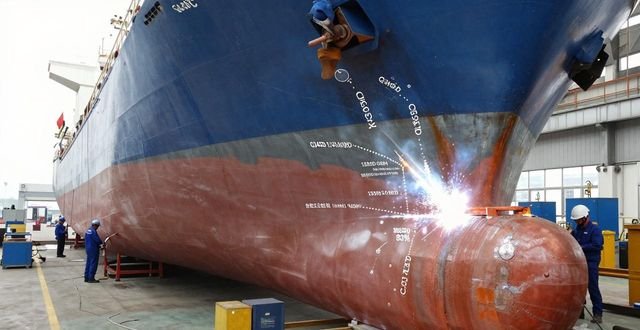
    To eliminate the stress of rivet weldments of Q345 and Q355, we mainly rely on tempering heat treatment, which is very effective in removing stress. As for the processing temperature, it generally needs to be controlled in the range of 580°C to 620°C. The holding time is scientifically calculated as 1.5 minutes per millimeter of thickness. For a Q345 steel plate with a thickness of 20 mm, the heat preservation time is 30 minutes, and then slowly cooled to below 300°C and then air-cooled, the residual stress can be reduced to below 50 MPa. Since the grains of Q355 are finer, the tempering temperature can be appropriately lowered to 560°C to 600°C to prevent the grains from growing. A certain year is 2025. At a shipbuilding plant in the Qingdao area, during the welding of the Q355 hull structure, a tempering operation of 580 degrees Celsius was used for 4 hours. The stress relief rate reached 92%, which is much higher than the 80% of 16Mn. If there are restrictions in conditions that prevent overall tempering, then low-temperature stress relief treatment can be carried out in sections.

    Welding process adjustment and testing

    The welding parameters of Q345 and Q355 are slightly different. The key is to control the heat input. The recommended heat input for Q345 is 15 to 25 kilojoules per centimeter. In view of the presence of vanadium and titanium elements, the heat input for Q355 needs to be controlled at 12 to 20 kilojoules per centimeter. Otherwise, it is easy to produce coarse grains. In terms of welding material selection, Q345 uses E5015 electrodes, and Q355 uses E5515 electrodes. The strength level must match, and post-weld inspection must use ultrasonic flaw detection, which is performed in accordance with the GB/T 2970 standard and usually requires Level I qualification. The Q355 steel plates were welded piece by piece. In a certain bridge project in Shanghai in 2024, a 100% ultrasonic inspection was carried out. The results showed that the defect rate was only 0.3%, which was far less than the 1.2% of alloy structural steel 16Mn. In terms of stress relief for riveted weldments, the final result is that the blind hole method can be used to measure residual stress. The qualification standard stipulates that the residual stress must be less than 30% of the material's yield strength.

    When faced with the decision between Q345 and Q355, what makes you most undecided is the price difference or the performance requirements? You are welcome to share your own actual operation experience in the comment area. Like and bookmark this article to help you avoid the traps caused by material selection and stress relief processing.

  • Detailed Explanation Of The Differences Between 16Mn, Q345 And Q355 Steel Grades

    Detailed Explanation Of The Differences Between 16Mn, Q345 And Q355 Steel Grades

    Detailed explanation of the differences between 16Mn, Q345 and Q355 steel grades

    Family tree from 16Mn to Q355

    16Mn is an old brand in the 1988 national standard GB 1591-88. Its main ingredients include 0.12% – 0.20% carbon, plus 1.20% – 1.60% manganese. This grade was widely used in bridges, boilers, and pressure vessels before the 1990s. For example, a thermal pipeline renovation project in Beijing completed in 1992 used nearly 2,000 tons of 16Mn steel plates. However, with the advancement of steel smelting technology, the phosphorus and sulfur control standards of 16Mn are relatively loose, with the upper limit of S content reaching 0.045%, and the low-temperature impact toughness is only 0℃ level, which no longer meets the safety requirements of modern engineering.

    In 1994, Q345 officially replaced 16Mn in the GB/T 1591-94 standard and became a new general-purpose low alloy steel grade. Among them, Q represents the yield strength, but 345 represents the minimum yield strength of 345MPa, which is slightly higher than the actual measured value of 16Mn. In 2008, in the steel structure project of the Shanghai World Expo venue, more than 60% of the load-bearing components were made of Q345B steel plates. Its phosphorus and sulfur content dropped to less than 0.030%, and the low-temperature impact test temperature was also increased to – 20°C.

    Why does Q355 replace Q345?

    In the GB/T 1591-2018 standard released in 2018, Q345 was directly canceled and replaced with Q355. The core upgrade lies in the microalloying process. During the smelting process of Q355, 0.02% – 0.15% vanadium was actively added, and 0.02% – 0.10% titanium or 0.015% – was added. With the addition of 0.060% niobium, it is these trace elements that can refine the grain size, allowing the steel to maintain good toughness while increasing its strength. In the 2020 steel structure bidding for the Xiongan New District High-speed Railway Station, it was clearly stated that all Q355C grade steel plates should be used, and the total usage reached 45,000 tons. It was decided.

    The minimum yield strength of Q355 has been increased to 355MPa, which is 10MPa higher than Q345, and the low-temperature impact toughness has been extended to the -40°C level. For example, the longitudinal impact energy absorption requirement of the Q355D grade at -40°C is no less than 47J, but the Q345E grade can only guarantee performance at -20°C. In addition, the carbon equivalent of Q355 is more strictly controlled, the CEV upper limit is reduced from 0.45% of Q345 to 0.42%, and the welding cold crack sensitivity coefficient is reduced by about 15%.

    Performance differences in actual use

    钢材牌号16Mn Q345 Q355演变关系_钢材牌号16Mn Q345 Q355核心差异_Q345厚板(30mm以上)铆焊价格

    The advantages of Q355 are even more obvious when thick plates are thicker than 30mm. Take a 4,000-ton coastal cargo ship built by a certain shipyard in 2022 as an example. The thickened part of the hull was originally designed to use Q345D, and then Q355D was used for alternative welding operations. The thickness of the plate reached 35mm, and the preheating temperature during welding dropped from the original 100°C to 80°C. The time for heat treatment after welding was reduced by 20%, but the impact toughness of the weld was increased by 12%.

    As far as riveting and welding processing companies are concerned, the improvement in the strength of Q355 will directly produce two benefits. One is that the thickness of the steel plate can be reduced under the same load. For example, a heavy machinery factory changed the crane boom from the 25mm plate of Q345 to the 22mm plate of Q355, which reduced the weight by 12%; the second is that during welding, due to the decrease in carbon equivalent, the sensitivity to heat input becomes weaker. In 2023, a steel structure factory in Shenyang observed through actual comparison that The occurrence rate of Q355 thick plate welding pores is 8% lower than that of Q345.

    Procurement and processing price comparison

    In the current market, Q355 thick plates are those with a thickness of more than 30mm. Generally speaking, its price per ton of steel is 200 to 400 yuan more expensive than Q345. Take the quotation given by a steel factory in Jiangsu in May 2024 to explain the differences between 16Mn, Q345, and Q355 steel grades. The ex-factory price of Q345B, a 35mm steel plate, is 4150 yuan per ton. As for the Q355B with the same specifications, the price is 4,380 yuan per ton. However, considering that the Q355 can reduce weight by 10% to 15%, in fact, the cost of a single unit may be reduced by 3% to 5%.

    In terms of the cost of processing involved in riveting welding, Q345 thick plate (above 30mm) riveting price Q345 thick plate (above 30mm) riveting price Q345 thick plate (above 30mm) riveting price , Q355 is simpler in view of the process used to connect and fuse (the temperature required for preheating is relatively low, and the types of materials that can be used as welding wires are wider). On average, the cost of workers and materials consumed per ton of welding can be saved by fifty to eighty yuan. According to statistics from a bridge component factory in Shandong in 2023, when processing 200 tons of Q355 plates with a thickness of 32 mm, the total man-hours required were reduced by 8% compared to Q345, and the number of welding rods consumed was reduced by 6%.

    Key points to note when replacing old with new ones

    Q345厚板(30mm以上)铆焊价格_钢材牌号16Mn Q345 Q355演变关系_钢材牌号16Mn Q345 Q355核心差异

    When old projects use 16Mn steel to carry out renovation work, it is feasible to choose Q345 or Q355 to replace them, but it is necessary to strictly check the grade matching. Once the original 16Mn steel plate is used in a -10°C environment, at least grade Q345C or Q355C must be selected; if the original structure is subject to dynamic loads, it is recommended to directly choose grade Q355D. When a chemical plant in Liaoning was updating its pressure vessels in 2021, Q345B was mistakenly used to replace 16Mn. As a result, the -15°C low temperature impact did not meet the qualified standard, and the final rework caused losses of more than 800,000 yuan.

    Controlling welding process adjustments is extremely critical. For Q355, the recommended control range for welding heat input is 15 to 25kJ/cm, which is narrower than the 20 to 30kJ/cm range for Q345. In terms of welding rods, it is recommended to use E5015 type, and for welding wire, ER50-6 can be selected. What needs special attention is that when the plate thickness exceeds 30mm, the preheating temperature of Q355 can be maintained at 60 to 80°C, but Q345 thick plates may need to be preheated at 100 to 120°C, otherwise, cold cracks will easily occur.

    Optimal solution for material selection for new projects

    When carrying out a new design project, it is very strongly recommended to give priority to Q355, which is a mandatory recommended grade in the current national standard. In 2024, new regulations issued by the Ministry of Housing and Urban-Rural Development require that steel structures with load-bearing functions in civil buildings must use Q355 and higher grades. Therefore, if you purchase Q345 now, you will face problems in supply and certification. For example, a large gymnasium insisted on using Q345 during design. In the end, it was discovered that the production schedules of major domestic steel mills were as long as 60 days, but with Q355, it only took 20 days.

    Compared with other situations, in scenarios where there are low temperatures and fatigue requirements, Q355 shows a more significant cost performance. In 2023, a bridge in Harbin will undergo a bridge deck system replacement project. The entire project will use Q355D steel plates. This method of use can ensure a 50-year service life in a -40°C environment. If you insist on using Q345D, then in view of the same fatigue life requirements, you need to increase the cross-sectional area by 12%. As a result, the overall cost will be 7% higher.

    Is the steel grade currently used by your company Q345 or Q355? Have you encountered welding or price problems during the replacement process? Welcome to share your own practical experience in the comment area, and give it a like so that more peers can see this useful information.