

リベット溶接における溶解技術の応用:原理、プロセス、ケーススタディ
The process boundaries of manufacturing are being redefined when dissolution ceases to be a separation and becomes a bridge to connectivity
In the field of rivet welding and soldering, dissolution is much more than a simple material separation process. From the formation of the solder alloy to the quality control of the joints, an in-depth understanding of the dissolution behaviour has become a key factor in optimising the joining process. In this paper, we will discuss the application principles, specific processes and practical examples of dissolution technology in rivet welding.
Solubility: a basis for material dialogue in rivet welding soldering
Solubility is essentially the ability of one substance to dissolve into another substance-7. In rivet welding welding, this definition is reflected on two levels:
Alloy Manufacturing Stage: The various elements that make up the solder alloy must dissolve into each other to form an alloy of the correct composition. If they do not mix/diffuse well, precipitates of individual metals are obtained in the solidified product-7.
Stage of the soldering process: Solubility depends on the ability of the alloy to diffuse in the metallisation. The solubility/diffusion rate in the substrate is different for different solder alloys-7.
Understanding this is essential for the optimisation of the rivet welding process. For example, in the unilateral self-punching friction rivet welding process, the friction between the rivet and the material produces heat to soften the plate to be joined, and the mutual diffusion behaviour of the materials in this thermodynamic coupling process directly affects the quality of the joint-3.
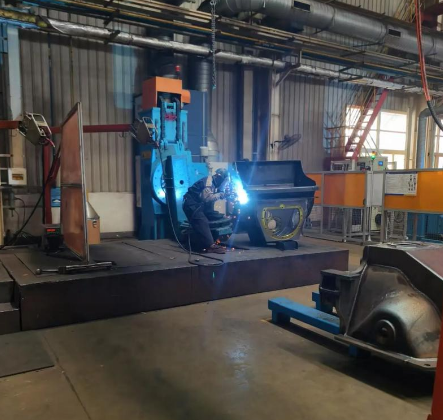
Heat-dissolution coupling effects in rivet welding soldering![图片[1]-溶解技术在铆焊焊接中的应用:原理、工艺与案例解析-大连富泓机械有限公司](https://cndlfh.com/wp-content/uploads/2025/10/QQ20250829-200957.png)
In advanced rivet welding welding process, there is a close coupling between heat input and dissolution behaviour. Taking the aluminium alloy unilateral self-punching friction rivet welding process researched by Shanghai Jiaotong University as an example, its process principle is to use high-speed rotating semi-hollow rivets to rivet into the plate to be connected, and the friction between the rivet and the material produces heat to soften the plate to be connected-3.
In this process, the heat input changes the dissolution properties of the materials, and the mutual dissolution of the materials affects the heat transfer and joint formation. It has been shown that under some parameters, the material between the upper and lower plates of the joint forms a metallurgical connection under the action of heat-3, which is similar to the mutual dissolution of metals in conventional welding.
Application of the dissolution process in connection pre-treatment
Dissolution technology also plays an important role in the pre-treatment stage of joining. Taking the efficient polymer dissolution process applied in the Bohai Oilfield as an example, the process controls the polymer dry powder dissolution time to about 40 minutes by optimising the three stages of the dissolution process-4, which greatly improves the efficiency of the subsequent joining process.
A similar principle is used in metal joining pre-treatment. By means of specific dissolution techniques, oxidised layers or contaminants can be removed from the metal surface, creating more favourable surface conditions for subsequent rivet welding.
Practical Example: Dissolution Technology Optimised Riveting Welding
Case 1: Automotive Lightweight Connectivity
In automotive lightweight manufacturing, press riveting (SPR) has been widely used for aluminium-aluminium joining and aluminium-steel joining-8 In this process, the understanding of the dissolution behaviour of the coated metal directly influences the selection of joining parameters. For example, the joining of galvanised steel sheets to aluminium alloys requires full consideration of the mutual dissolution characteristics of zinc and aluminium at elevated temperatures in order to avoid the formation of brittle phases.
Case 2: Plastic-metal composite structural connections
Dissolution technologies have shown unique value in the joining of plastic-metal composite structures. For example, the polystyrene dissolution process uses solvent dissolution to dissolve polystyrene waste plastic and recycle polystyrene pellets by heating, degassing, extruding and pelletising.9 This type of process can be used to prepare an intermediate layer for plastics-metal joining to optimise the joining properties of dissimilar materials.
Process optimisation: parameter selection based on dissolution behaviour
Parameter optimisation based on material dissolution behaviour is crucial in the development of rivet welding welding process. Taking the research of unilateral self-punching friction rivet welding process in Shanghai Jiao Tong University as an example, the two-stage process was optimised by orthogonal experimental design, and the joint geometric evaluation index and mechanical properties were used as the experimental indexes, respectively, and the optimal two-stage process parameters were selected in the end-3.
A similar approach applies to other forms of rivet welding soldering. By analysing the dissolution behaviour of the material in the coupled heat-force field, the process window can be determined more precisely, improving the quality of the joint and process stability.
結語
The convergence of dissolution technology with rivet welding and soldering represents a shift in manufacturing away from traditional process classification towards interdisciplinary integration based on materials science. An in-depth understanding of dissolution behaviour not only helps us to optimise existing joining processes, but also provides a scientific basis for the development of next-generation joining technologies. For manufacturing companies committed to technological innovation and process optimisation, capitalising on this convergence of technologies will be a key strategy to stay ahead of the competition.


暂无评论内容