

What are the advantages and disadvantages of riveting, bolting and welding?
You can hear that if you compare the Eiffel Tower in the 19th century with today's Boeing 787 airliner, you will find a strange situation: although they are both made of metal, the way they connect the metal is completely different. Behind this change is actually an evolutionary process of material connection technology, which is directly related to the safety of the cars and planes we ride every day, and even every bridge we walk on.
Different load-bearing characteristics
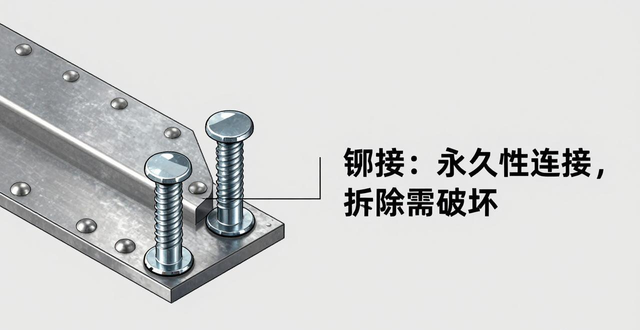
Riveting performs very well when subjected to shear forces, but becomes significantly disadvantaged when subjected to tension. Rivets use deformation to fill holes, and their shear resistance mainly relies on the shaft. However, pulling force can easily cause the rivet head to fall off. This is why riveting was often used in early automobile frames. The reason is that the main force type of early automobile frames was shear.
Threaded connections are an all-rounder, able to withstand both tension and shear forces. Bolts use preload to create a clamping effect and rely on friction to transmit load. Welding is also feasible in both tension and shear. However, the weld area is prone to stress concentration, and fatigue cracking may occur under repeated loading. This is a hidden danger for structures such as bridges that have been in service for a long time.
Essential differences in detachability
The outstanding advantage of threaded connections is that they are detachable. It only takes a few minutes to remove a bolt during car maintenance. Bridge maintenance also relies on this method to replace parts. Once the bolts are loose, the components can be separated. This convenient feature cannot be replaced by other connection methods.
![图片[1]-What Are The Advantages And Disadvantages Of Riveting, Bolting And Welding?-Dalian Fuhong Machinery Co., Ltd](/wp-content/uploads/2026/03/1773432403196_0.png)
Riveting is a permanent connection. If you want to remove the rivet after it is riveted, you can only destroy it. The welded seam will be integrated with the base material. Welding is also a permanent connection. This shows that for structures using these two methods, the service life and maintenance plan must be fully considered when designing.
The difficulty of quality assurance increases step by step
Quality control is relatively simple and easy for threaded connections. During installation, you can use a torque wrench to check whether the preload force meets the standard requirements. Construction personnel can operate it as long as they are trained, and the quality dispersion is small. This is also the reason why it is favored in the engineering field.
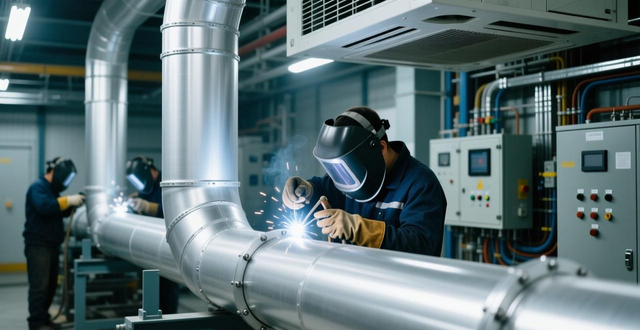
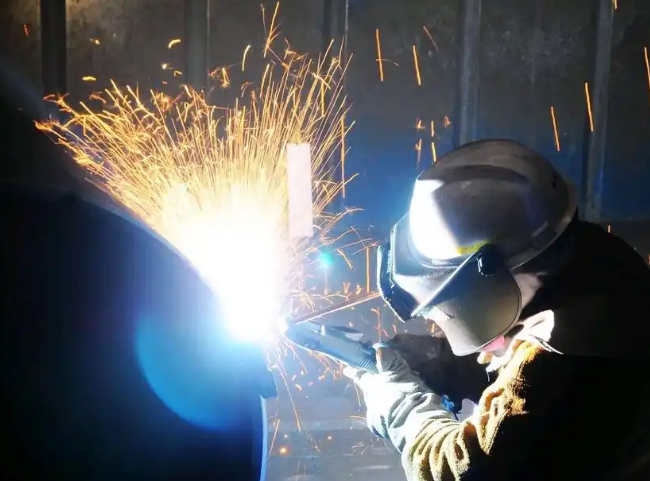
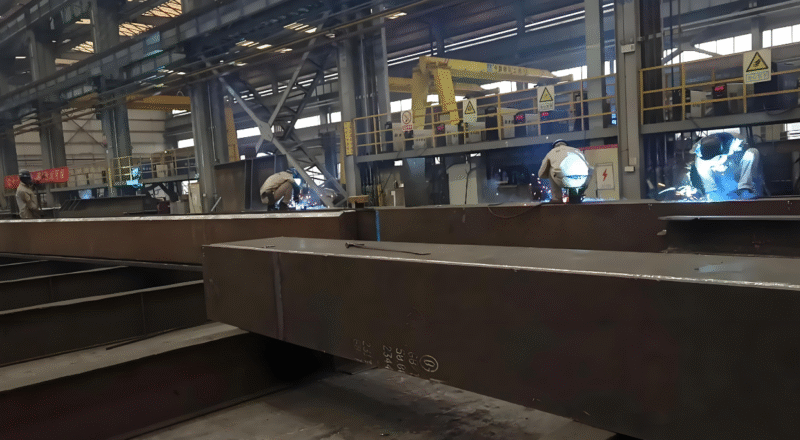
Judging the quality of riveting depends on visual inspection and percussion listening, which requires experienced technicians. Welding is the most complicated, and its internal defects are invisible to the naked eye. Ultrasonic or X-ray flaw detection is required to determine the impact of construction site conditions on the selection of welding or riveting . In addition, the cost of inspection is high. Welding is rarely used on aircraft fuselages because the reliability of weld quality is difficult to guarantee.
How material properties are affected
Welding of the heat-affected zone will change the material structure, resulting in residual stress and deformation. The bridge components are relatively thick, so such deformation is relatively acceptable. However, for components such as aircraft skins that have high requirements for aerodynamic appearance, it is undoubtedly a disaster. Structural distortion caused by welding heat input will directly affect flight performance.
Mechanical connections include riveting and threaded connections, and their processes do not involve material melting. They basically have no impact on the properties of the base material, but only cause stress concentration due to the opening of holes. Especially on aircraft, aluminum-titanium connections, composite materials and metal connections are often encountered. Dissimilar materials cannot be welded at all and can only be completed by riveting or screwing.
Cost vs. weight trade-off
![图片[2]-What Are The Advantages And Disadvantages Of Riveting, Bolting And Welding?-Dalian Fuhong Machinery Co., Ltd](/wp-content/uploads/2026/03/1773432403196_1.png)
Considering the economic aspect, welding is the cheapest, riveting is slightly more expensive than welding, and threaded connection is the most expensive. Welding is widely used in the automotive industry, and cost control is an extremely important consideration. The price of a self-piercing riveting equipment is sky-high, and automobile companies also need to make smart and careful calculations.
The weight aspect shows a completely opposite situation. Threaded connections are the heaviest. The impact of construction site conditions on the choice of welding or riveting is because it requires nuts and washers. The weight of riveting is second, and the weight of welding is the lightest. Aircraft have always been pursuing lightweight, so they prefer riveting. However, in recent years, laser welding and friction stir welding technologies have become mature. Their heat-affected zones are smaller and deformation can be controlled. The Airbus A340 fuselage wall panels have begun to use laser welding.
Why bridges prefer bolted connections
The complex on-site construction environment is present in large steel structure bridges, and it is difficult to control the welding quality. Residual stress will be generated when the welds cool and shrink under natural conditions. High-strength bolt friction-type connections are formed as an ideal choice. Force transmission occurs by friction. The bolt sole bears the tensile force, and the construction is highly controllable.
Rivets used in civil engineering need to be heated first and then shaped with the help of a rivet gun, which requires high technical requirements. What are the advantages and disadvantages of riveting, bolting and welding compared with each other? , the installation of high-strength bolts is relatively simple, easy to detect, and has good reliability. Although bolts are slightly more expensive, construction site conditions have an impact on the choice of welding or riveting . However, for a bridge that is related to a century-old project, the extra cost in exchange for safety and maintainability is quite cost-effective.
After reading the characteristics of these connection methods, you will think that in the future, as new materials continue to emerge, such as carbon fiber composite materials being used on a large scale, will the existing connection technologies be subverted, or will they be further upgraded? Welcome to share your personal views in the comment area and give it a like so that more friends can see this article.
![图片[3]-What Are The Advantages And Disadvantages Of Riveting, Bolting And Welding?-Dalian Fuhong Machinery Co., Ltd](/wp-content/uploads/2026/03/1773432403196_2.jpg)




暂无评论内容