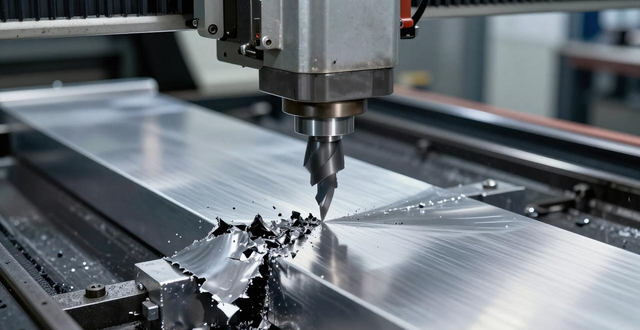


Why is titanium alloy a difficult-to-machine material?
Everyone who is engaged in titanium alloy processing has had this experience. Although a new blade has been replaced, a deep groove appears on the blade soon. The work cannot be continued, and the blade has to be scrapped in advance. The reason behind this is why titanium alloy is a difficult-to-machine material? , often contrary to our intuition… We think that the harder and stronger the blade, the more wear-resistant it will be, but we find that it breaks faster. What is going on?
New contradictions brought about by increased intensity
Improving the strength of a material generally means making it less susceptible to wear. However, when cutting titanium alloys, the actual situation is exactly the opposite. If the strength of the blade is higher, its hardness will usually be higher, but its toughness will decrease. The thermal conductivity of titanium alloy is very low and very poor. Almost all the heat generated during the cutting process is borne by the blade. The high-strength blade is more likely to produce microcracks because it is difficult to release thermal stress through micro-deformation.
Once such microcracks occur, they will quickly develop into chipping or groove wear. In 2023, when an aviation manufacturing company was processing TC4 titanium alloy casings, it was discovered that the life of super-hard blades was shortened by 30% compared with ordinary blades. The reason was that the thermal stress could not be released, causing the blades to fail prematurely.
The duality of tool tip arc radius
The increase in the tool tip arc radius can indeed enable more cutting edges to participate in the cutting process, thereby dispersing the cutting force and heat. However, when processing titanium alloy, if the arc radius is too large, it will cause the direction of the cutting force to change, causing the radial force to increase sharply. Once the radial force exceeds a certain value, the thin-walled titanium alloy workpiece will elastically yield, causing severe vibration.
An aerospace parts factory in Chengdu has tested the world's leading level of titanium alloy processing . When processing a titanium alloy frame with a wall thickness of only 2.5 mm, the tool tip arc radius was increased from 0.8 mm to 1.6 mm. As a result, the vibration amplitude nearly doubled, and the surface roughness deteriorated from Ra1.6 to Ra6.3. This shows that the larger the arc radius, the better. It must be weighed according to the rigidity of the workpiece.
Cutting speed is the life killer
Many experimental data confirm that when milling titanium alloys, the cutting speed has an extremely prominent impact on tool life, followed by the radial cutting amount. Once the cutting speed increases from 40 meters per minute to 50 meters per minute, the tool life is likely to be reduced by more than 50%. The reason is that the chemical activity of titanium alloys increases sharply at high temperatures. Once the cutting speed is too high , the temperature in the cutting zone instantly exceeds 800°C.
Data recorded by an aerospace engine factory in Guizhou shows that when processing titanium alloy blisks, when the cutting speed is controlled at 35 meters per minute, each tool can process four parts; when the cutting speed is increased to 45 meters per minute, the number of processed parts is less than one part and the tool needs to be replaced. The cost is really huge.
The real culprit of groove wear
Many field workers attribute the wear of the groove to the insufficient hardness of the blade. However, in fact, there are two reasons for its formation. The hardened layer retained during early processing is the direct trigger for its appearance. After the last cut, the surface hardness may increase to 1.5 times the hardness of the base material. At this time, the blade cuts in, just like chewing on hard bones. Another more hidden factor that causes groove wear is diffusion wear. When the temperature exceeds 800°C, a chemical reaction occurs between the cobalt element in the blade and the titanium alloy, thereby forming a brittle compound, which is then taken away by the cutting process.
The Tool Research Institute is located in Xi'an. It has conducted an analysis and found that the cobalt element content in the groove wear area has decreased by nearly 40% compared with the normal area. This means that the chemical reaction has consumed the binder inside the blade, and the remaining hard particles peel off in pieces under the action of cutting force.
Built-up edge is a double-edged sword
![图片[1]-Why Is Titanium Alloy A Difficult-to-machine Material?-Dalian Fuhong Machinery Co., Ltd](/wp-content/uploads/2026/03/1773332204744_1.png)
When titanium alloy is processed, titanium alloy processing reaches the international leading level . Under high temperature and high pressure, titanium molecules are easily welded to the blade to form built-up edge. Many people think that built-up edge can protect the blade, but in fact it causes more serious damage to the blade. The frequency of formation and shedding of built-up edge is very rapid. Each time it falls off, the coating on the blade and even the base material will be taken away.
Cutting experiments conducted by a machine tool factory in Shenyang show that when processing titanium alloys, if ordinary coated inserts are used, the cycle of built-up edge formation is only about 30 seconds. This means that the blade will experience coating peeling twice every minute. Under such working conditions, the life of the blade will naturally not be long. Because of this, special blade materials and special coatings must be used when processing titanium alloys.
Cooling method determines success or failure
When processing titanium alloys, the key point is to explore how to take the heat away. It is far from enough to rely solely on external cooling. If the cutting fluid cannot be sprayed accurately into the cutting area, then it is equivalent to adding it in vain. Contemporary titanium alloy machining tools often have special cooling channels designed inside, so that high-pressure cutting fluid can be ejected directly from near the tool tip to take away the heat immediately.
A corn milling cutter designed by Seco Tools for titanium alloy processing has three independent cooling channels inside, which ensures that each blade can receive sufficient cooling. When processing titanium alloy forgings, the tool life is more than twice that of ordinary tools, and the cutting speed can be increased by 20%. Only when the heat problem is solved can the blade actually function.
When you are processing titanium alloys, what is the most troublesome blade failure mode that you encounter? Is it the wear of the groove or the chipping of the blade? You are welcome to share your own experience and solutions in the comment area, and give it a like so that more people in the same industry can see this article.






暂无评论内容