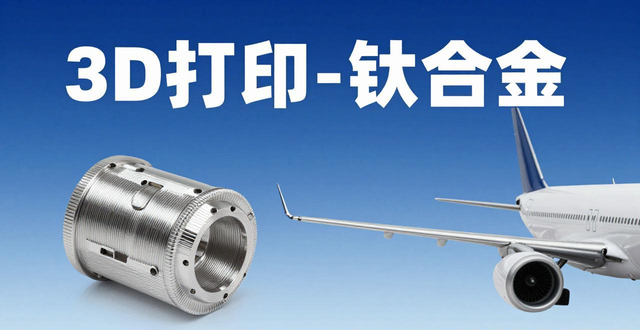


3D printing creates titanium alloy with the highest specific strength, which is expected to be used in many fields such as aerospace and medicine
A team of Australian engineers used 3D printing technology to create titanium alloy with the highest specific strength. This technology has allowed the tensile strength to soar to more than 1,600 MPa, which means that future aircraft parts and human implants may become lighter and more durable, and the cost will be lower.
Breakthrough results are born at Monash University
In the latest issue of "Nature Materials", a research team from Monash University published their results. This is a project led by Australian engineers. They chose a commercial titanium alloy for experimental 3D printing to create the highest specific strength titanium alloy, which is expected to be used in many fields such as aerospace and medicine. With the help of 3D printing and simple heat treatment, a material with a tensile strength of more than 1,600 MPa was created. This number broke the previous record of 3D printed metals, making it the titanium alloy with the highest specific strength.
The team leader introduced that this new material has properties that far exceed those of titanium alloys manufactured by traditional processes. In the past ten years, 3D printing has been quite popular in the field of metal manufacturing, but it has always been stuck at the bottleneck of insufficient strength. This breakthrough directly lifted the ceiling. This research to be launched in 2026 shows the international leading level of titanium alloy processing and may change the rules of the game for many high-end manufacturing industries.
The aerospace industry is the first to taste the benefits
On the one hand, aerospace has extremely strict requirements for materials, which requires materials to be both light and strong, and titanium alloys are originally regarded as their favorite materials. On the other hand, there is now this ultra-high-strength titanium alloy produced through 3D printing, with which aircraft parts can be made thinner and lighter, and at the same time can withstand greater pressure. For example, engine blades, fuselage structural parts, etc. are likely to be manufactured using this new material in the future.
![图片[1]-3D Printing Creates Titanium Alloy With The Highest Specific Strength, Which Is Expected To Be Used In Many Fields Such As Aerospace And Medicine-Dalian Fuhong Machinery Co., Ltd](/wp-content/uploads/2026/03/1773332147545_0.png)
Boeing and Airbus have always been looking for ways to reduce weight and increase materials, and the research results achieved this time hit their pain points. In the past, commercial titanium alloy 3D printing parts had insufficient performance and could only be used in non-critical parts. Now, the strength of 1,600 MPa is fully sufficient to support the main load-bearing structure. This means that flights in the future may save more fuel and fly farther.
The national defense field welcomes opportunities for equipment upgrades
The civilian industry has lower requirements for material performance than the military industry. The armor used for offensive and defensive tanks, the components for missiles, and the supporting skeleton of fighter aircraft all require ultra-high-strength materials. The breakthrough achieved by Monash University this time makes it possible for national defense equipment to be upgraded. 3D printing can produce complex shapes that traditional processes cannot achieve, such as structural parts with special shapes like stealth fighters.
The U.S. Department of Defense continues to invest money in additive manufacturing work. Now that the Australian team has produced such hard-core results, it will definitely attract the attention of the Pentagon. Equipment made of this titanium alloy can withstand strikes and is very light, and the mobility of soldiers will be greatly improved. And due to the characteristics of 3D printing on-site production, the pressure on logistics during wartime will also be reduced a lot.
Energy industry solves high temperature and high pressure problems
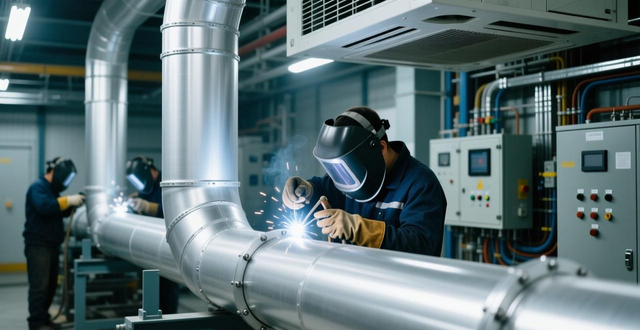
Energy mining equipment is constantly required to operate in extreme environments such as deep-sea drilling platforms and geothermal power stations. The materials required for it must not only be corrosion-resistant but also have high strength. The new titanium alloy shows excellent performance at room temperature and high temperature conditions, which exactly meets the relevant needs of the energy industry. If it is used to make valves, pump bodies, and pipelines, their service life can be significantly extended.
Nuclear power plants have extraordinary requirements for material strength, and the components inside the reactor have to withstand radiation and thermal stress for decades. The thermal stability of the 3D printed titanium alloy has been verified and has the potential to become a candidate material for the next generation of nuclear facilities. Costs can be reduced because complex thermomechanical processing is not required and can be accomplished by direct printing followed by simple heat treatment.
![图片[2]-3D Printing Creates Titanium Alloy With The Highest Specific Strength, Which Is Expected To Be Used In Many Fields Such As Aerospace And Medicine-Dalian Fuhong Machinery Co., Ltd](/wp-content/uploads/2026/03/1773332147545_1.png)
Biomedical implants are safer and more durable
When operating implants in the human body, the requirements for the materials used are that they must not cause rejection reactions and be strong enough, and titanium alloys have long been the material of choice. However, the strength of implants manufactured by traditional processes has a certain limit, and various related problems are prone to occur during large joint replacement surgeries. Nowadays, ultra-high-strength titanium alloys have been developed. In this case, hip and knee joint prostheses can be designed to be smaller, thus making the trauma caused by surgery smaller.
CT data can be used to 3D print custom implants that perfectly conform to the shape of the bone. The Monash team's method is simple and efficient, which means it is possible for hospitals to popularize this technology in the future. Patients do not need to wait for a long time. Titanium alloy processing is internationally advanced , and the cost is lower than imported implants. This is great news for the global aging society.
Cost reduction makes commercial use possible
In the past, if you wanted to obtain ultra-high-strength titanium alloys, you would need to go through many processes such as casting, forging, and heat treatment. The cost was extremely high and staggering. Now researchers claim that they have achieved this goal with the help of 3D printing and simple heat treatment, and the process cost can be significantly reduced. This is good news for small and medium-sized enterprises, as they can now afford top-quality materials.
Titanium alloys with commercial value inherently contain cheap characteristics. Titanium alloy processing is at the leading international level . Combined with the material-saving characteristics of adding additional materials for manufacturing, the price of the final product may be only a fraction of the original price. After analysis, Mangti.com concluded that once this technology is industrialized, the automotive and consumer electronics industries will follow suit. As shown in items such as bicycle frames and mobile phone cases, this kind of titanium alloy with super performance may be used in the future. In which industry do you think this new material will first become popular? Share your views in the comment area, and like and forward it to let more people know about this technological breakthrough.





暂无评论内容