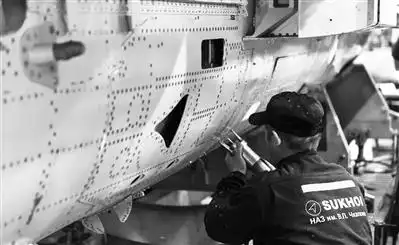


Riveting technology – "threading the needle and threading the thread" to assemble the fuselage
![图片[1]-Riveting Technology – "threading The Needle And Threading The Thread" To Assemble The Fuselage-Dalian Fuhong Machinery Co., Ltd](/wp-content/uploads/2026/02/1772215655812_0.webp)
Behind this question lies the hard-core logic of materials science and flight safety. Why does the aircraft use rivets instead of welding? In 2025, global commercial aircraft orders have exceeded 20,000 hull riveting and welding processing accuracy control standards . Each aircraft requires millions of rivets to ensure safety. This is not a backward process, but an inevitable manifestation of technology selection.
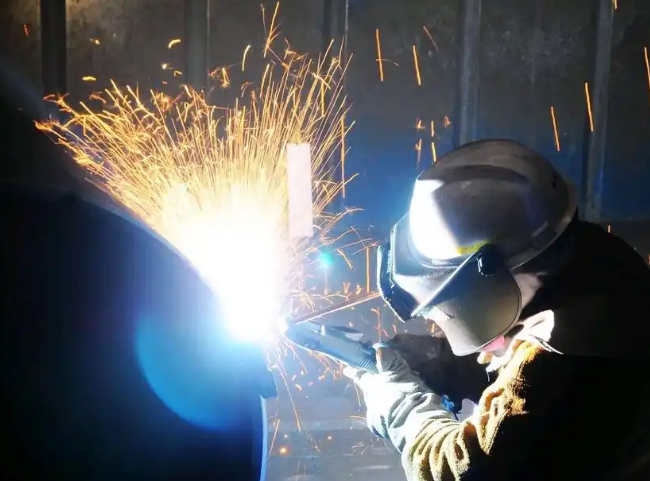
Aluminum alloy welding dilemma
Aluminum alloy materials account for more than 70% of modern aircraft skins. This material has the characteristics of light weight and high strength, but its welding performance does have shortcomings. In 2023, an internal report from Boeing showed that for aluminum alloy specimens using traditional argon arc welding, the average strength reduction in the welding area exceeded 30%.
Even more troublesome is the heat-affected zone generated during the welding process. Engineers from COMAC Shanghai Aircraft Manufacturing Co., Ltd. discovered during tests in 2024 that pores and micro-cracks are prone to appear after aluminum alloy welding. These problems will accelerate the expansion during metal fatigue testing and directly affect the life of the fuselage.
The harsh test of high-altitude environment
![图片[2]-Riveting Technology – "threading The Needle And Threading The Thread" To Assemble The Fuselage-Dalian Fuhong Machinery Co., Ltd](/wp-content/uploads/2026/02/1772215655812_1.png)
At an altitude of 10,000 meters, the aircraft is in cruising mode. At this time, the outside temperature is as low as minus 50 degrees Celsius, and the cabin pressure is increased to 0.8 atmospheres. In such an environment, the fuselage skin bears more than one ton of tension per square meter, and the reliability of the welding points faces extreme challenges.
In 2025, data from fatigue tests released by Airbus showed that after the continuous simulated take-off and landing reached 100,000 times, the crack growth rate of the welded test plate was four times faster than that of the riveted test plate. When the vibration frequency reaches two hundred hertz per second, the stress concentration in the weld area will cause premature failure of the metal structure.
Micron-level precision of rivets
The processing accuracy of rivets used in modern aircraft manufacturing is controlled within five microns, which is equivalent to one-twentieth the diameter of a human hair. Chengdu Aircraft Group used automatic drilling and riveting equipment during the J-20 mass production process. The position error of each rivet hole will not exceed 0.03 mm.
This precise fit ensures that the load in the connection area is evenly distributed. In 2024, more than 50,000 rivets were installed on the final assembly line of the domestically produced large aircraft C919 every day. The digital measurement system constantly monitored the verticality and depth of each hole to ensure the consistency of millions of connection points.
Core advantages of anti-fatigue
Fatigue resistance is the most prominent feature of riveting technology. Take the Boeing 787 as an example. The rivets on the fuselage were subjected to a prestress of up to 1,100 MPa during assembly. The riveting technology – "threading needles and threads" to assemble the fuselage, and this pressure is equivalent to bearing a weight of 11,000 kilograms in an area the size of a fingernail.
This kind of prestressed state can effectively offset the alternating loads that exist during flight. A test report issued by the China Aircraft Strength Research Institute shows that in 2025, the fatigue life of riveted structures will be up to three times higher than that of welded structures, especially in key stress-bearing parts such as wings and tails.
Practical Considerations for Repair Costs
The grounding of planes is extremely difficult and scary for airlines, which can cause losses of hundreds of thousands of dollars in one day. Once there is a problem with the welding construction, the entire skin usually needs to be replaced, just like the case of replacing a wing skin on the Airbus A380, which costs more than two million US dollars and takes more than two weeks. This is the case.
Detachability is an advantage of riveting. In 2024, a Boeing 737 of China Southern Airlines was hit by hail, and the nose skin was damaged. The maintenance team only spent three days replacing 17 pieces of skin and more than 2,000 rivets . After that, the aircraft was put into operation again, and its maintenance cost was less than one-third of the welding solution.
The continuation of the composite era
New-generation aircraft such as the Boeing 777X use more than 50% composite materials. These carbon fiber materials cannot be welded at all, and riveting has become the only reliable connection method. In 2025, material experiments at the University of Tokyo confirmed that the combination of titanium alloy rivets and carbon fiber composite materials has a tensile strength that is 40% higher than any bonding method.
With the progress of thermoplastic composite materials in the future, welding technology may return to the field of aircraft manufacturing. However, in the current situation, rivets have always firmly maintained the safety of every aircraft. From the Wright brothers' first airplane to Airbus's future concept aircraft, this connection method has withstood a hundred years of testing and has proven its reliability at an altitude of 10,000 meters.
Have you ever thought about how many rivets there are on the planes you take every day, quietly guarding your safety? Feel free to share your observations in the comment area and click like to let more people know the hard-core knowledge of aviation manufacturing.




暂无评论内容