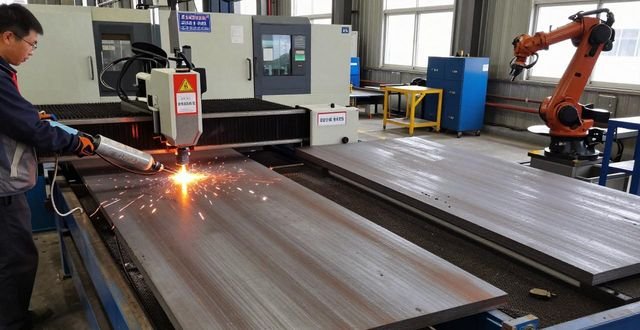


What are the characteristics of sheet metal laser cutting?
In sheet metal processing, the most troublesome situation is that there are deviations in cutting accuracy, a large amount of burrs, and considerable deformation. These problems will directly lead to a high scrap rate of products. However, laser cutting is the current mainstream process. As long as the key quality control points can be well controlled, the yield rate can be increased to more than 98%.
If the focus position is not controlled accurately, the quality of the cutting surface will directly overturn.
Only when the laser beam is focused on the surface of the material can it exert maximum energy. If the focus position is upward or downward, the cutting surface will show obvious differences. What are the characteristics of sheet metal laser cutting at the 2025 Guangzhou International Sheet Metal Exhibition? Han's Laser engineers found during an on-site demonstration that when the focus deviated by 0.2mm, the cutting surface of 12mm thick carbon steel The cut surface roughness soared sharply from Ra6.3 to Ra12.5. In the actual operation process, every time a plate of thickness or material is changed, the focus position must be recalibrated. Operator Master Wang has worked in a precision sheet metal factory in Dongguan for 8 years. The first thing he does after going to work every day is to use the inclined plate method to test the focus to ensure that the equipment is in the best condition.
Not only that, the focus position will also be affected by the thermal lens effect of the lens. Once the laser continues to operate for more than 4 hours, the temperature of the focusing lens will increase and the focus will drift downward, with the drift range being between 0.1 and 0.3mm. At the end of 2024, an auto parts supplier in Suzhou suffered from this. At that time, they continued to produce 300 battery pack cases. The first 100 products were qualified, but 30% of the middle 100 products had slag residue, and 25 of the last 100 products were scrapped. Later, they added a water-cooling circulation system to the lens, and also set it in the program settings to automatically compensate for the focus every 2 hours, so that this problem was solved.
The auxiliary gas parameters are mismatched and the back of the incision is full of slag.

Blowing molten material is not only a unique function of auxiliary gas, it also participates in the cooling and protection process. When oxygen is used to cut carbon steel, if the purity is lower than 99.5%, the oxidation reaction will be insufficient, and the lower edge of the cut will be filled with hard slag. There is a sheet metal processing quality control point in a steel structure processing factory in Jinan. Oxygen with a purity of 99.2% was used to cut the 20mm thick Q235 steel plate sheet metal processing quality control point . The result was that each part had to be polished manually for 15 minutes, which wasted 200 working hours in one night. After switching to 99.95% industrial liquid oxygen, the amount of slag was reduced by 90%, and the time spent on polishing was reduced to less than 2 minutes.
When nitrogen is used to cut stainless steel and aluminum, the setting of air pressure is a key point. For 3mm thick 304 stainless steel, when the air pressure is lower than 1.0MPa, the molten slag cannot be discharged and will adhere to the back of the cut to form a tumor-like object that is difficult to clean. A Shanghai company engaged in the production of elevator door panels conducted a comparative test in January 2026: when the air pressure was 0.8MPa, 62 of 200 parts needed to be reworked; after adjusting the air pressure to 1.2MPa, the rework rate was reduced to 3.5%. However, the air pressure cannot be increased without limit. Once it exceeds 1.6MPa, the thin plate will vibrate and the cutting accuracy will decrease.
Whether the cutting speed is too fast or not depends on the plate thickness.
There are many people who think that the faster the laser cutting speed, the better. However, this is not the case. If the speed is too fast, the slag will be dragged away before the material is completely cut through, resulting in incomplete cutting or slag bonding. There is an electrical cabinet manufacturer in Wenzhou that used a 6kW laser to cut 2mm galvanized sheets and increased the speed from 8 meters per minute to 12 meters per minute. As a result, incomplete cuts continued to occur, and the entire batch of 50 cabinet panels was scrapped. Later, it was returned to 8 meters per minute and operated according to the speed curve introduced in the equipment manual. Since then, there have been no batch problems.
If the speed is too slow, it will also be fatal. When the cutting speed is lower than 70% of the recommended value, the laser energy will accumulate excessively at the incision, and the width of the heat-affected zone will expand from 0.1 mm to more than 0.5 mm. For sheets with a thickness of less than 0.8 millimeters, this will cause the sheet to undergo thermal deformation, showing an undulating state like a wave. A mobile phone mid-frame processing factory in Shenzhen encountered this problem in March 2025. The operator reduced the speed by 40% in order to pursue a smooth cut. As a result, 300 deformations in a thousand mid-frames exceeded the tolerance range. After recalibrating the speed, the deformation rate was reduced to less than one percent.
Nozzle height and concentricity are overlooked invisible killers
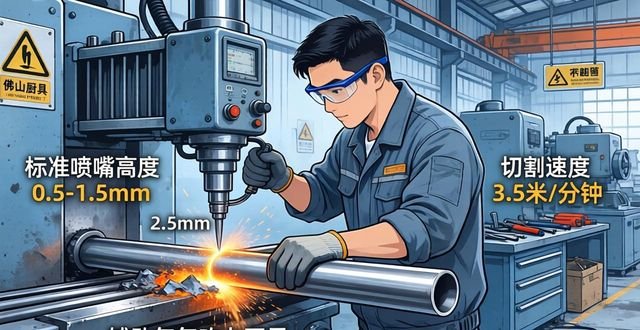
There is a situation where the distance between the nozzle and the plate surface is too far, and the blowing force generated by the auxiliary gas is not sufficient, so that the slag cannot be discharged. The standard has clear requirements. The height of the nozzle needs to be controlled within the range of 0.5 to 1.5mm. Every time it increases by 0.5mm, the cutting capacity will decrease by about 15%. For the sake of convenience and trouble-free operation, the operator of a pipe cutting machine in a kitchenware factory in Foshan fixed the height of the nozzle at 2.5mm. As a result, slag frequently appeared when cutting 1.5mm stainless steel pipes. After adjusting to 1.0mm, the problem disappears immediately, and the cutting speed can be increased from 3.5 meters/minute to 4.8 meters/minute.
What is more hidden is the deviation of the nozzle concentricity. If the deviation between the center of the nozzle hole and the center of the laser beam exceeds 0.1mm, there will be more slag on one side and less slag on the other side during cutting. A laser equipment service provider in Wuhan visited 30 customers in the fourth quarter of 2025 and found that 8 had concentricity problems, of which 3 had deviations as high as 0.3mm. The inspection method is quite simple: stick transparent tape on the nozzle mouth, apply a pulse, and see if the burned round hole is in the center. Once a deviation is found, replace the nozzle or adjust the optical path in time, and the problem can be solved.
The laser energy is wasted due to poor surface condition of the plate.
What will seriously interfere with laser absorption is the presence of rust, oil stains and oxide scale on the surface of the plate. The rust layer has a loose structure and will produce irregular reflections when irradiated by laser, which will lead to fluctuations in the energy actually acting on the metal. There is a heavy machinery factory in Tianjin. When it uses rusty hot-rolled plates to cut structural parts, the quality of the cuts at different positions on a plate varies greatly. Some cuts are smooth and some are rough. After asking the supplier to provide pickling plates or doing rust removal by themselves, the consistency of the cuts has been greatly improved.
The impact of oil pollution cannot be easily underestimated. Cutting oil and anti-rust oil will vaporize and produce smoke when the laser is at high temperature, and this smoke will cause pollution to the protective lens. An agricultural machinery parts factory in Qingdao discovered such a problem in July 2025. When cutting plates with oil, the protective lens The service life dropped sharply from the original 240 hours to 80 hours, and irregular ablation marks appeared on the cutting surface. Later, they added an online cleaning process, using industrial alcohol to wipe the surface before cutting. As a result, the lens life was restored to more than 200 hours, and the monthly lens replacement cost was also saved by 4,000 yuan.
After reviewing the 5 quality control points, which problem did you encounter in actual production that was the most troublesome? You are welcome to share your experience in the comment area. If you find it useful, please like and forward it so that more colleagues can avoid detours.




暂无评论内容