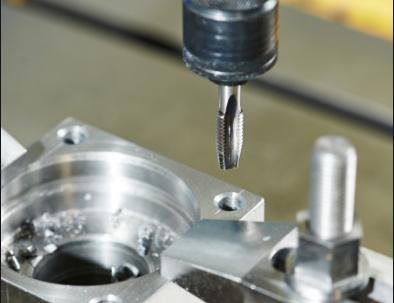


When milling threads, there are three cutting methods: radial, arc, and tangential. Which one do you use?
Don't think about thread milling if the CNC machine tool does not have three-axis linkage. This technology transforms traditional "tapping" into "thread milling". The tool follows a spiral trajectory in the air, and then processes the thread you desire. Its core value is reflected in: a milling cutter can process threads of different diameters, and has good chip breaking and chip removal effects, and the thread quality is also higher. Next, we are going to dismantle this practical technology that even the machining masters think is very good.
You need to understand spiral interpolation to get started
![图片[1]-When Milling Threads, There Are Three Cutting Methods: Radial, Arc, And Tangential. Which One Do You Use?-Dalian Fuhong Machinery Co., Ltd](/wp-content/uploads/2026/03/1773591244175_0.jpg)
When thread milling, the motion trajectory seems very mysterious, but in fact it is a combination of plane circle drawing and vertical movement. For example, from point A to point B, the X-axis of the machine tool will work with the Y-axis to walk out an arc. At the same time, the Z-axis carries the tool downward, and the three axes work together to draw a spiral.
Today's CNC systems are generally implemented using the two instructions G02 and G03. G02 is clockwise arc interpolation, and G03 is counterclockwise. You only need to enter parameters such as arc radius and pitch during programming, and the system will calculate the path by itself. Many masters find it difficult when they first come into contact with it. In fact, once they understand this principle, they get started much faster.
The tool rotates and revolutions to form a thread
![图片[2]-When Milling Threads, There Are Three Cutting Methods: Radial, Arc, And Tangential. Which One Do You Use?-Dalian Fuhong Machinery Co., Ltd](/wp-content/uploads/2026/03/1773591244175_1.jpg)
The movement method of thread milling is quite interesting in CNC milling . The tool itself is in a state of high-speed rotation, and at the same time it is revolving around the center of the workpiece. The trajectory formed by this revolution is the helical interpolation mentioned before. Every time it rotates, the tool drops exactly one pitch in the Z-axis direction.
![图片[3]-When Milling Threads, There Are Three Cutting Methods: Radial, Arc, And Tangential. Which One Do You Use?-Dalian Fuhong Machinery Co., Ltd](/wp-content/uploads/2026/03/1773591244175_2.jpg)
The shape of the tool itself plays a decisive role in the thread profile. For example, a thread milling cutter with a 60-degree sharp angle can process standard metric threads in conjunction with helical interpolation motion. The advantage of this processing method is that the cutting force is relatively uniform and it is not as easy to squeeze chips as tapping. It is especially suitable for processing difficult-to-machine materials such as stainless steel and titanium alloys.
The three entry methods each have their own merits
There are three cutting methods for thread milling, the first of which is the arc cutting method. The tool will first start from the rapid positioning point and cut into the workpiece along the arc path. During this process, the tool has already started helical interpolation. After cutting in, it travels a 360-degree full circle, and at the same time the Z-axis descends by one lead, so that the thread is completely milled out.
The advantage of this cutting method is that the cutting in and out are smoother and no cutting marks will be left on the thread surface. I have witnessed that many masters who process high-precision threads prefer this method, especially when carrying out precision thread processing, the surface roughness can be controlled within Ra1.6.
![图片[4]-When Milling Threads, There Are Three Cutting Methods: Radial, Arc, And Tangential. Which One Do You Use?-Dalian Fuhong Machinery Co., Ltd](/wp-content/uploads/2026/03/1773591244175_4.jpg)
The radial cutting method is the simplest and most direct
The radial cutting method is to insert the tool directly against the center line of the thread, and then start to perform helical interpolation. This method is the simplest in terms of programming and is easiest for novices to master. When processing some ordinary precision threads, this method is quite efficient.
But there are two small problems with milling threads. There are three cutting methods: radial, arc, and tangential. Which one do you use? , Firstly, there will be some slight vertical marks left at the place of cutting in and out, but it does not hinder the use of ordinary threads. Secondly, when processing hard materials, if the depth of cut is too large, the contact area between the tool and the workpiece will suddenly increase, and vibration is very likely to occur. At this time, the feed rate during cutting can be reduced to one-third of the normal cutting CNC milling , so that the vibration of the tool can be effectively prevented.
![图片[6]-When Milling Threads, There Are Three Cutting Methods: Radial, Arc, And Tangential. Which One Do You Use?-Dalian Fuhong Machinery Co., Ltd](/wp-content/uploads/2026/03/1773591244175_6.jpg)
Tangential cutting method specializes in external threads
![图片[7]-When Milling Threads, There Are Three Cutting Methods: Radial, Arc, And Tangential. Which One Do You Use?-Dalian Fuhong Machinery Co., Ltd](/wp-content/uploads/2026/03/1773591244175_7.png)
The tangential cutting method combines the advantages of the first two methods. On the one hand, it has smoothness when cutting, and on the other hand, it has simplicity in programming. However, it has a limitation and is mainly suitable for external thread processing. The tool first cuts in from the outside of the workpiece in the tangential direction, and then exits along the tangential direction after completing the thread milling.
This method is particularly useful when processing externally threaded parts such as screws and studs. For example, when processing stainless steel screws with a diameter of 20 mm, using the tangential cutting method and using a carbide thread milling cutter, the thread can be milled with just one cut, and the efficiency is much higher than that of traditional thread turning.
When choosing the right method, you also need to pay attention to details.
In actual processing, choosing the appropriate cutting method is only the initial step. The parameter of the tool's rotational speed needs to be adjusted according to the material hardness, etc. The parameter of the feed amount also needs to be adapted based on the material hardness, etc., and the parameter of the depth of cut of each layer must also be adjusted according to the material hardness, etc. Just like processing aluminum alloy threads, the rotation speed can be set to more than 3,000 rpm, but for processing hardened steel, the rotation speed must be reduced to about 1,000 rpm.
The use of coolant is also very important. Thread milling is an intermittent cutting situation. The temperature change range of the tool is relatively large. Sufficient cooling can extend the service life of the tool. I recommend using emulsion or cutting oil. The flow rate needs to be larger and directed towards the cutting area. In addition, the overhang length of the tool should be as short as possible, which can enhance rigidity and reduce the possibility of tool vibration.
![图片[8]-When Milling Threads, There Are Three Cutting Methods: Radial, Arc, And Tangential. Which One Do You Use?-Dalian Fuhong Machinery Co., Ltd](/wp-content/uploads/2026/03/1773591244175_8.jpg)
During thread processing, have you ever encountered tool collapse during CNC milling , or has the surface roughness of the thread not met the standard? Hurry to the comment area to share your practical experience, and quickly give a like so that more peers can see these practical skills.







暂无评论内容