


How does five-axis machining achieve stable and repeatable processing of medical devices?
Even the slightest deviation in the artificial joint is likely to directly affect the patient's ability to move after surgery, and may even affect life safety. Medical device manufacturing has supreme requirements, which makes the stability and repeatability of the processing process core indicators that cannot be compromised.
Technical principles of five-axis machining
The five-axis machining center allows the tool or workpiece to move flexibly in five directions, making it possible to carry out cutting from almost any angle. This capability is a decisive technological breakthrough in terms of five-axis machining accuracy and repeatable positioning accuracy for the processing of bone curved surfaces or surgical instruments with complex grooves.
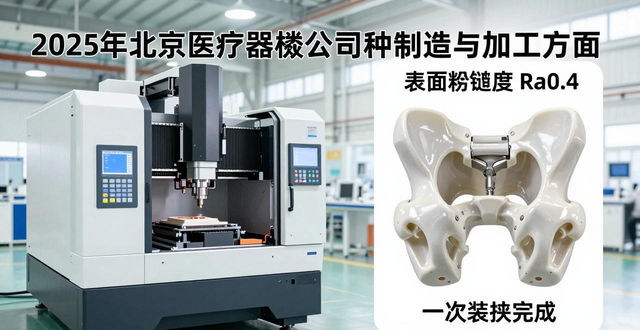
Traditional three-axis machine tools in the past often required multiple disassembly and re-fixing of the workpiece when processing complex parts. Each clamping operation will lead to the introduction of small positional deviations, and once these deviations accumulate, they will have a direct impact on the accuracy of the final product. Five-axis technology can complete the entire machining process with a single clamping . Five-axis machining accuracy and repeatable positioning accuracy completely eliminate this problem from the root.
Eliminate duplicate positioning errors
When manufacturing precision screws for spinal fixation, the thread accuracy must be perfectly matched with the nut geometry. The biggest disadvantage of multiple clamping is the repeated positioning error. If the screws are processed in two times, even with the most precise fixture, it is difficult to guarantee the absolutely precise relative position between the two parts.
![图片[1]-How Does Five-axis Machining Achieve Stable And Repeatable Processing Of Medical Devices?-Dalian Fuhong Machinery Co., Ltd](/wp-content/uploads/2026/01/1768752868478_0.jpg)
![图片[2]-How Does Five-axis Machining Achieve Stable And Repeatable Processing Of Medical Devices?-Dalian Fuhong Machinery Co., Ltd](/wp-content/uploads/2026/01/1768752868478_1.png)
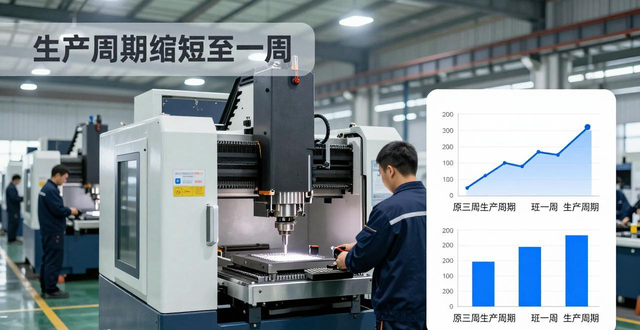
In one clamping operation, the five-axis machine tool can process all the features of this screw. No matter how complex the processing surface is, the reference between the workpiece and the tool is stable and unchanged. How can five-axis machining achieve stable and repeatable processing of medical devices? , ensuring that every dimension in the design drawings can be accurately copied to the actual object.
Improve complex feature processing capabilities
There are many medical devices, such as the femoral condyle of an artificial knee joint, whose surface presents an extremely complex human body bionic curved surface. When processing these curved surfaces, not only does the tool need to be able to reach a specific angle, but it is also required to maintain an absolutely stable state of angle and speed during continuous motion.
![图片[3]-How Does Five-axis Machining Achieve Stable And Repeatable Processing Of Medical Devices?-Dalian Fuhong Machinery Co., Ltd](/wp-content/uploads/2026/01/1768752868478_2.jpg)
Five-axis linkage technology allows the tool to always contact the workpiece surface in the most ideal posture, which not only obtains a smoother surface quality but also reduces subsequent polishing processes. In turn, the service life of cutting tools can be extended, further ensuring the consistency of parameters in mass production.
Guarantee of precision rotating shafts
The stability of a five-axis machine tool is highly dependent on the indexing accuracy of its rotating axis. Currently, the industry-leading rotary table has an astonishing repeatability accuracy of within ±2 arc seconds. Such accuracy is achieved through rigorous testing and calibration with the help of precision equipment such as laser interferometers.
Take the processing of dental implant guide plates as an example. The positioning holes on them often present a specific spatial angle distribution. The high-precision rotary axis ensures that the angle of rotation of the machine tool is exactly the same for each hole processed, thereby ensuring that the five-axis machining accuracy and repeatable positioning accuracy in thousands of products are exactly the same, and the relative position of each hole is exactly the same.
Intelligent error compensation technology
![图片[4]-How Does Five-axis Machining Achieve Stable And Repeatable Processing Of Medical Devices?-Dalian Fuhong Machinery Co., Ltd](/wp-content/uploads/2026/01/1768752868478_3.jpg)
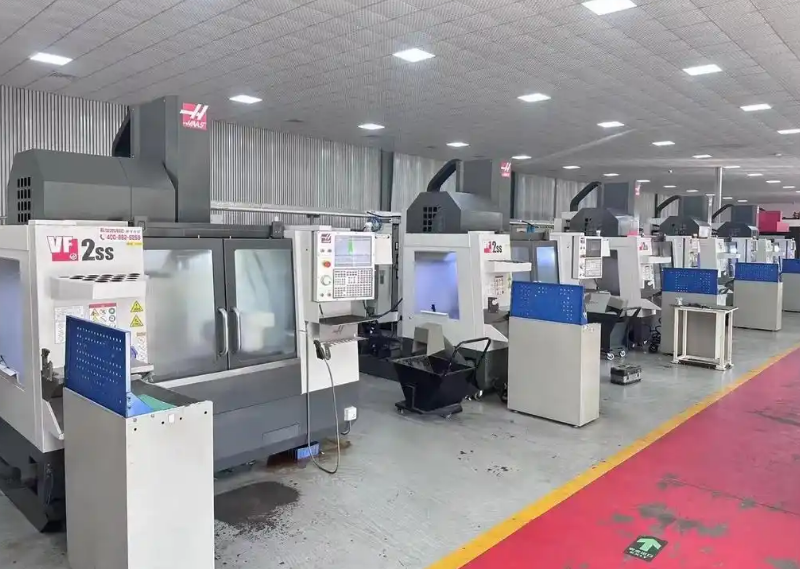
As a mechanical structure machine tool, it is unavoidable that slight thermal deformation or wear will occur during long-term and continuous operation. Modern five-axis CNC machining centers integrate spatial error compensation technology. This technology can measure and record the comprehensive error generated by the machine tool within the entire space including the working range based on a strict organizational system, thus forming a three-dimensional "error map" showing the error situation.
When processing the artificial acetabular cup, the system will automatically call the compensation value according to the actual spatial position of the tool to fine-tune the instructions. This shows that even if the mechanical structure changes slightly, the output processing trajectory is still accurate, which greatly improves the stability of long-term processing.
Real-world validation in medical manufacturing
In the field of orthopedic implants, five-axis machining can now complete all processes from rough machining to finishing on one piece of equipment. Take the tibial tray as an example, its porous structural surface in contact with the bone and smooth joint surface can be processed and formed at one time, preventing errors caused by switching machine tools.
Multi-leaf grating blades are radiotherapy equipment, and the machining accuracy of the blades requires extremely high tolerances. The tolerance range is often within ±0.025 mm. After adopting five-axis processing technology, the production qualification rate of the blade can reach more than 99.999%, which perfectly meets the stringent requirements for precise dose control in the field of radiotherapy and provides a solid and powerful guarantee for the safety of cancer patients' treatment.
Don’t you think that in addition to the processing technology itself, what other factors are extremely important to ensure the final quality stability of medical devices? Welcome to share your insights in the comment area. If you think this article is valuable, please like it and support it.




暂无评论内容