

At the heart of today’s precision manufacturingCNC machiningLike a beating heart, it drives the creation of complex parts from smartphone components to aerospace engines. If you’re familiar with the term “CNC” but don’t know much about it, this article will give you a clear explanation: What is CNC machining? How does it work? What are the main types? And what are its irreplaceable core benefits.
I. Definition of CNC machining: a digital bridge from blueprint to reality
CNC, Computer Numerical Control, is a technology that automatically controls machine tools (e.g., milling machines, lathes, grinders, etc.) to perform precision machining through pre-programmed computer software instructions. In short, it is an automated process that converts a designer’s digital three-dimensional model (CAD file) into code (G-code) that can be understood by the machine, and drives precise movements of the machine tool or workpiece to “carve” the target part from a piece of raw material.
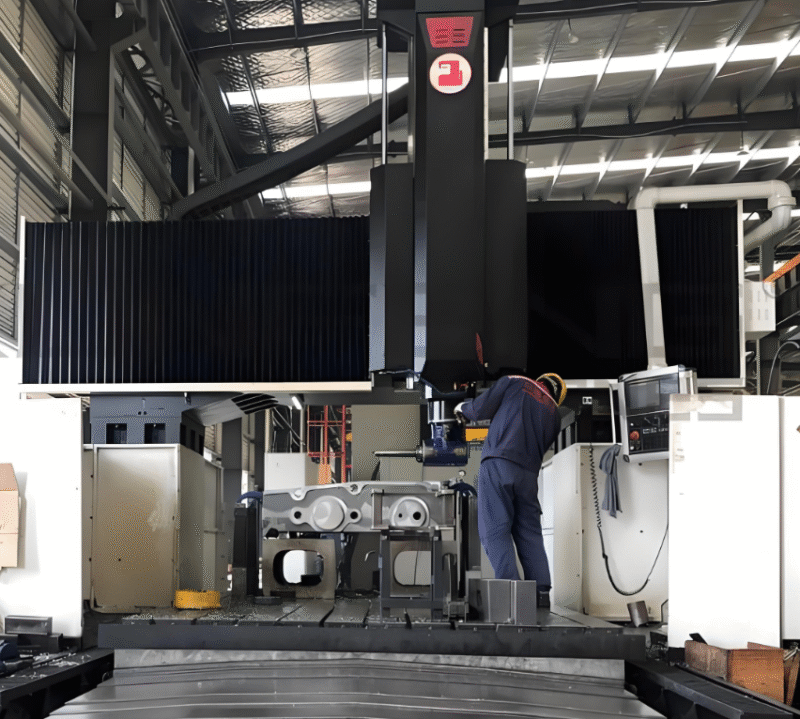
The essence of CNC is “automation” and “digitalisation” compared to the traditional “manual machine tool” that relies on a human operator’s handle. It eliminates the inconsistencies and skill threshold limitations of human operation, making batch, high-precision manufacturing of complex geometries possible.![图片[1]-Getting Started and Core Technologies: What is CNC CNC machining? Its working principle, types and core advantages in detail-Dalian Fuhong Machinery Co., Ltd](https://endlfh.com/wp-content/uploads/2025/12/QQ20251102-193919-800x455.png)
II. The working principle of CNC systems: the three-step dance of precision
CNC machining is not a one-step process, but an interlocking systematic project whose workflow can be divided into three core stages:
1. Design phase: CAD modelling
It all starts with computer-aided design (CAD). Engineers use software such as SolidWorks, AutoCAD or Fusion 360 to create a three-dimensional digital model of a part. This model defines all the geometric features, dimensions and tolerances of the part and is the “digital blueprint” for all subsequent operations.
2. Programming phase: CAM conversion and G-code generation
This is the “brain programming” part of CNC. With computer-aided manufacturing (CAM) software, the operator or programmer imports the CAD model. Within the CAM software, a number of key decisions are made:
Process planning: Selection of the machine tool to be used (milling, turning or multi-axis machining centre).
Tool selection: Matching the right tool to the different machining features (e.g. roughing, milling, drilling, tapping).
Path Planning: Defines the trajectory of the tool relative to the workpiece, ensuring efficient, collision-free material removal.
Parameter setting: Setting spindle speed, feed rate, depth of cut, etc.
Once set up, the CAM software automatically compiles all this information into G-code, a standardised programming language containing coordinate points, movement commands and speed commands that are directly recognised by the machine tool.
3. Implementation phase: machine tools
The CNC controller (the “brain” of the machine) reads the G-code and accurately drives the servo motors. These motors control the movement of the machine’s axes (such as X, Y, Z, and even more rotary axes), allowing the tool to follow a set path and cut the material fixed to the table. The entire process is highly automated and usually only requires the operator to clamp the workpiece, set the tool and start monitoring.
Mainstream CNC machine types and their application scenarios![图片[2]-Getting Started and Core Technologies: What is CNC CNC machining? Its working principle, types and core advantages in detail-Dalian Fuhong Machinery Co., Ltd](https://endlfh.com/wp-content/uploads/2025/09/QQ20250829-202203-1.png)
CNC machines are mainly classified into the following categories according to the mode of motion and machining characteristics:
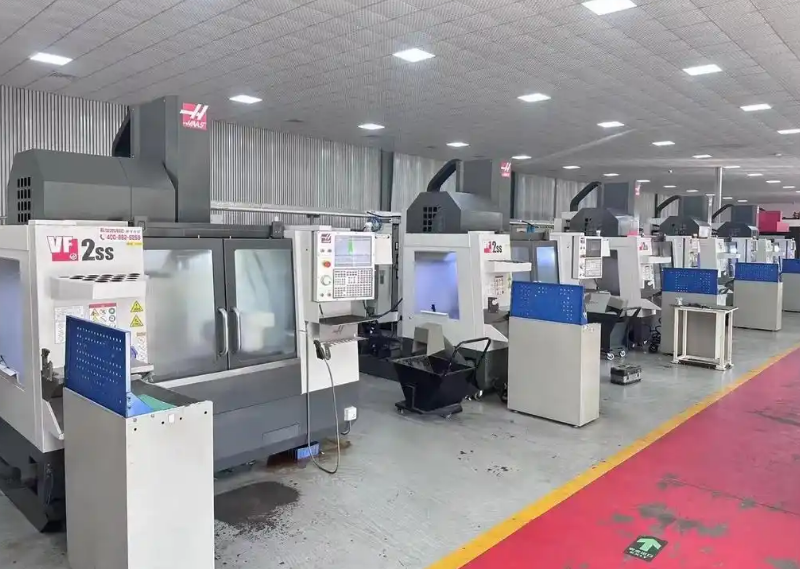
1. CNC milling machine: The most versatile type. The tool rotates at high speed and the workpiece is fixed on the table and cuts through a multi-axis linkage. Expertise in machining flat surfaces, grooves, complex contours and three-dimensional surfaces. Typical applications: moulds, housings, structural parts.
2. CNC Lathe: The workpiece rotates under the spindle and the fixed tool cuts it radially or axially. It is good at machining cylindrical, conical and other rotary parts. Typical applications: shafts, screws, joints, flanges.
3. CNC machining centre: Can be regarded as an “upgraded milling machine”, usually refers to CNC milling machines equipped with automatic tool changers and tool magazines. It can complete a variety of processes such as milling, drilling, boring, tapping, etc. in a single clamping, with high efficiency.
4. Multi-axis CNC machines: e.g. 5-axis machining centres. In addition to the three linear axes, the tool or workpiece can move in two rotary axes. This makes it possible to approach the workpiece from almost any direction and to machine extremely complex geometries without the need for repeated clamping, making it a great tool for the manufacture of complex parts such as aerospace blades, impellers and high-end medical devices.
5. Other specialised CNC equipment: e.g. CNC electric discharge machines (EDM), CNC laser cutting machines, CNC grinding machines, etc. for specific material and process requirements.
Four, CNC numerical control machining unparalleled core advantages
Choosing CNC machining means choosing a manufacturing solution that combines precision, efficiency and flexibility:
1. Extraordinary accuracy and consistency: CNC machines have positioning accuracy down to the micron level (0.001mm). Once a programme has been validated, it can produce thousands of parts with identical dimensions around the clock, eliminating human error, which is critical for quality control.
2. Ability to handle extremely complex geometries: With multi-axis linkages and advanced CAM software, CNCs can easily machine complex surfaces, cavities, and shaped structures that are virtually impossible to achieve by hand or with conventional machines.
3. Superior repeatability and scalability: Digitised programs can be saved, recalled and optimised. Whether you are producing 10 prototypes or 100,000 parts, you only need to call the same programme, ensuring absolute consistency throughout the product lifecycle and a seamless transition from prototype to series production.
4. Increased productivity and safety: Automated, continuous operation reduces set-up and tool change times (especially on machining centres) and allows operation in dimly lit “lights out shops”. At the same time, operators are kept away from the cutting area, which significantly improves production safety.
5. Optimised material utilisation and cost control: Material waste can be reduced through intelligent tool path planning. Although the initial investment in equipment and programming is high, the cost-per-piece advantage is significant in medium to high volume production and optimises total cost of ownership in the long term by reducing scrap and rework.
Schlussbemerkungen
CNC machining is a cornerstone technology of modern manufacturing, not only as an automation tool, but also as a sophisticated bridge between virtual design and the physical world. Understanding how it works, the types and benefits will help you make more informed decisions about product development or manufacturing outsourcing. Whether you need to prototype a precision part or plan for mass production, CNC technology provides a powerful, reliable and efficient solution.


暂无评论内容