

At the crossroads of today’s product development and manufacturing, designers and engineers are often faced with a critical decision: should they use 3D printing orConventional machining (CNC)? Both are powerful techniques for transforming digital models into physical parts, but their philosophies, processes and areas of application are very different. This article aims to cut through the marketing jargon to reveal the essential differences between the two and provide a clear set of decision-making frameworks to help you make the optimal technology choice for any project.
Part I: Philosophical Oppositions at the Roots – Enrichment vs. Reduction
This is the cornerstone of understanding all distinctions.
3D Printing (Additive Manufacturing): As the name suggests, it is an “additive” process. It builds parts by stacking materials (metal powders, resins, plastic filaments, etc.) layer by layer, similar to the idea of creating solids “from scratch” using calculus. It is centred on the idea of “free manufacturing” and is almost insensitive to geometric complexity.
Conventional machining (subtractive manufacturing): its essence is “subtraction”. Starting with a complete solid piece of material (metal, plastic block), the cutting tool gradually removes the excess to obtain the desired shape. The core idea is “precision carving”, limited by the geometry and accessibility of the tool.
This fundamental opposition draws out the differences between the two in almost every way.
Part II: Multi-dimensional depth comparison: the game of capacity, cost and quality![图片[1]-3D打印与传统机械加工的本质区别及如何选择?-大连富泓机械有限公司](https://cndlfh.com/wp-content/uploads/2025/12/QQ20251102-193739.png)
We can systematically compare the following key dimensions:
1. Geometric complexity and design freedom
3D printing (wins): This is where its revolutionary advantages lie. It can create virtually any shape imaginable, including those that are impossible with traditional methods: complex internal runners, honeycomb lightweight structures, integrated assemblies, organic bionic forms. Design is virtually unlimited, truly enabling “design-driven manufacturing”.
CNC machining (limited): Limited by the linear and rotational characteristics of the tool. Closed cavities cannot be machined directly, deep and narrow grooves, complex internal geometries, negative angle features often require multiple clamping or special tooling, which can be costly or even impossible. The design must take into account “tool accessibility”.
2. Material properties and isotropy
3D Printing (Challenges and Opportunities):
Material pool: The range is rapidly expanding to cover engineering plastics (nylon, ULTEM), photosensitive resins, metals (titanium, aluminium, stainless steel, nickel-based alloys) and even ceramics. However, specific grades and property states (e.g. heat treatment) often differ from those of the same grade of wrought material.
Anisotropy: Due to layer-by-layer stacking, the bond strength between layers is usually lower than the strength within the layers, resulting in mechanical properties that may be directional. This is an issue that must be considered for high load bearing components.
CNC machining (proven and reliable)
Material library: Almost all machinable engineering materials are covered, from common steel and aluminium to high-temperature alloys, titanium alloys, brasses, engineering plastics (PEEK, PTFE), and so on. Standard profiles (plates, rods, tubes) are used, which are well established, with complete property data, and whose mechanical properties (obtained by forging, rolling) are usually superior and isotropic.
Material Integrity: Machined parts retain the dense structure and excellent properties of the base material.
3. Accuracy, surface finish and details![图片[2]-3D打印与传统机械加工的本质区别及如何选择?-大连富泓机械有限公司](https://cndlfh.com/wp-content/uploads/2025/10/QQ20251002-202038-800x562.png)
3D printing (usually requires post-processing):
Accuracy: Metal printing (SLM/DMLS) up to ±0.05-0.1mm, high precision resin (SLA/DLP) even higher. However, there are dimensional risks from shrinkage and warpage.
Surface: Will produce a “step effect”, surface roughness (Ra value) is usually in a few microns to a dozen microns, the direct state (As-built) is rougher, often need sandblasting, polishing, grinding and other post-treatment to meet the requirements of use.
CNC machining (native high precision):
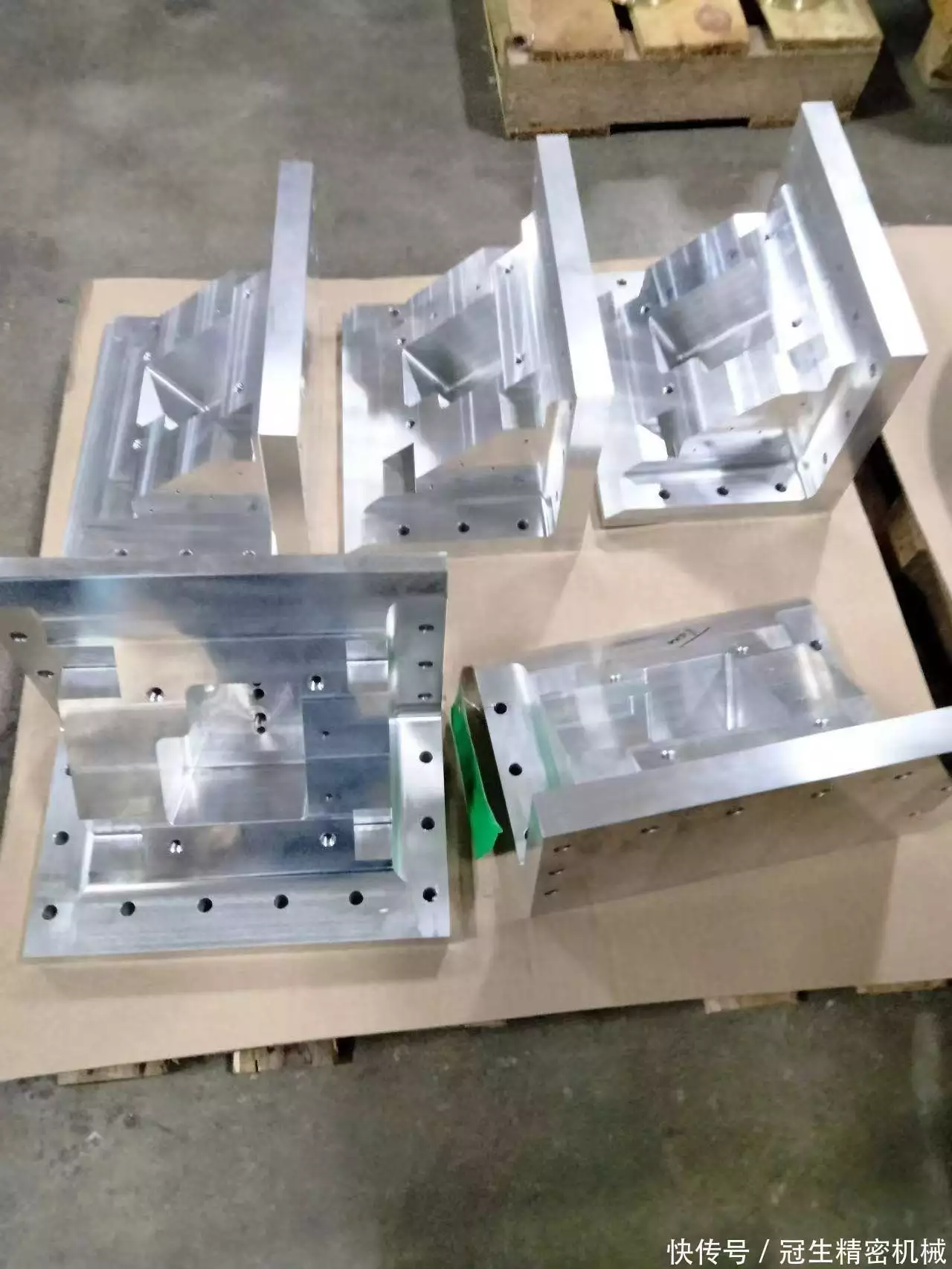
Accuracy: A benchmark for precision manufacturing. Standard CNC milling easily reaches ±0.025mm, and high precision machines reach micron levels. Extreme dimensional stability and predictability.
Surface: Mirror-grade finish (Ra < 0.4 μm) can be obtained directly by fine milling and grinding processes. CNC is the default choice for high standard applications such as optics and seal fits.
4. Production cost structure and economics
3D Printing: Cost per piece has little to do with volume. Upfront costs are mainly in equipment and materials (specialised powders/resins are expensive). The economic model is: “complex is simple, simple is expensive”. Perfect for:
Small lot/single piece complex parts (no tooling/tooling costs).
Topologically optimised lightweight parts (saving expensive materials).
Design validation prototypes with fast iteration rate.
CNC machining: Costs are made up of “equipment depreciation + materials + labour hours”. The cost per piece decreases significantly as the volume increases (sharing programming and clamping time). The economic model is: “Simple is cheap, complex is expensive”. It fits perfectly:
Medium to high volume production.
Parts with relatively simple structures.
Any batch that requires excellent surface and accuracy.
5. Manufacturing speed and lead times
3D Printing: Build time is proportional to part volume/height. Print one or a full version of a part with little difference in time. Good for parallel manufacturing of many different parts. For complex parts, may be faster than CNC programmed machining.
CNC machining: Machining time is positively correlated to the amount of material removed. Small simple parts can be extremely fast. However, each new part requires separate programming and tooling preparation, with long first setup times, and is suitable for serialised manufacture of identical parts.
Part III: How to choose? –Decision-making flowchart based on application scenarios
Instead of asking “which one is better,” ask “which one is better for my specific needs?” . Follow the decision-making logic below:
Examine the geometric complexity of the part:
Does it contain integrated internal structures, extremely complex surfaces or topologically optimised shapes? → Priority is given to 3D printing.
Is it a part that consists primarily of regular geometry (planes, cylinders, holes)? → Priority is given to CNC machining.
Evaluate production lot sizes and cost targets:
Need 1-100 pieces? And complex parts? → 3D printing is usually more economical.
Need more than 500 parts? Or simple parts? → CNC machining will be more advantageous in terms of cost per piece.
Verify material and performance requirements:
Is isotropic high strength and toughness required? Or must you use a specific forging grade? → CNC machining is the safe choice.
Are performance data sheets accepted and materials available in powder/resin form? Or pursuing speciality alloys/composites? → 3D Printing can evaluate.
Consider precision and surface requirements:
Assembly and sealing surfaces require Ra < 1.6μm or tolerances tighter than ±0.05mm? → CNC machining is preferred or as a means of post-processing finishing for 3D printing.
As functional prototypes, internal runner parts or with general surface requirements? → 3D printing can be used directly or with simple post-processing.
Part IV: Convergence and the Future – The Rise of Hybrid Manufacturing
The most efficient solutions are often not either/or. Hybrid manufacturing is becoming the trend:
3D Printing + CNC Finishing: Rapidly create complex blanks or near-net shapes with 3D printing, and then precision machine critical mating surfaces with CNC, balancing complexity with high precision.
CNC Substrates + 3D Printed Features: Add complex features or repair worn areas to conventional parts with 3D printing (e.g. DED Directed Energy Deposition).
Conclusion: complementarity, not substitution
3D printing and traditional CNC machining are not rivals, but tools with different characteristics in the toolbox. 3D printing frees up design and excels in handling “impossible” geometries and small quantities of complex parts; CNC machining guarantees extreme precision and reliable performance, and excels in efficiently manufacturing “possible” regular parts and medium- to large-volume products. CNC machining guarantees extreme precision and reliable performance, and is good at efficiently manufacturing “possible” regular parts and medium- to high-volume products.
A wise engineer will make rational trade-offs based on the five core elements of a project: geometry, materials, lot size, cost, and cycle time. For your next project, draw your part and compare it to the framework in this article, and a clear path will emerge. For challenging parts with both complex interiors and precise shapes, we also offer one-stop hybrid manufacturing solutions from 3D printing to 5-axis CNC finishing, so bring your 3D models along for a consultation.




暂无评论内容