

Machining method and its economic accuracy
There is a situation that has happened to every boss of a mechanical processing factory: the customer proposed to improve the precision of the parts to a higher level. Subsequently, the processing time doubled. In the final calculation, instead of generating profits, this order resulted in losses. There is a high-precision machining factory in Zhejiang. In 2025, due to its blind pursuit of high precision, a batch of 3,000-piece orders was delayed in delivery to customers, resulting in a loss of 150,000 yuan in liquidated damages. This is a very painful lesson caused by not understanding economic precision.
What is economic precision in machining
Economic precision is not the highest precision a part can achieve, it is the most cost-effective precision category under normal production conditions. The normal conditions mentioned here cover the fact that the equipment is in good condition, the tools and fixtures are complete, the workers' skills are up to standard, and the time consumption is reasonable. Take an ordinary lathe in good condition. Under normal operation, the machining method and its economic precision can achieve IT11 to IT12 level precision for rough turning. However, if it has to do IT6 level work, it must be operated with precision, which will increase the time cost.
Simply put, economic accuracy is the accuracy range with the highest cost performance. Data presented in the 2024 industry survey show that more than 60% of machining companies do not understand the concept of economic precision and often use high-precision equipment to perform rough work, or use low-precision equipment to barely support high-precision requirements. Both of these behaviors will cause costs to get out of control and ultimately have an impact on corporate profits.
Economic accuracy range for cylindrical machining
When performing cylindrical processing, the most commonly used methods are turning and grinding. The rough turning operation can achieve the accuracy of IT11 to IT12 level, and its surface roughness is at an average level, but the speed of removing the allowance is faster, so it is suitable for preliminary processing of blanks. Semi-precision turning operation can achieve IT8 to IT10 level accuracy, and the dimensions are already relatively accurate at this time. The finishing operation can reach IT6 to IT7 level accuracy, which is already the limit that ordinary lathes can achieve. If you want to further improve the accuracy, you have to replace the equipment or change the processing process.

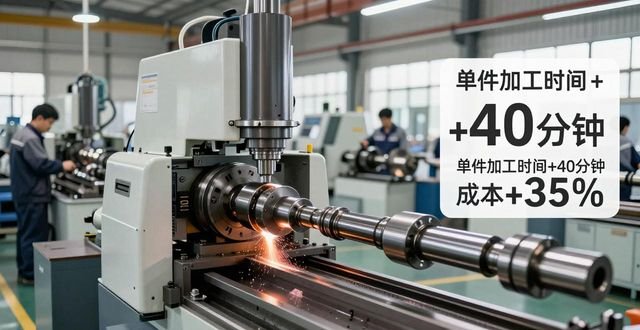
Under the condition that the customer requires IT5 to IT6 level cylindrical accuracy, fine turning or grinding must be used. Rough grinding can reach IT8 level, fine grinding can reach IT6 to IT7 level, and fine grinding and super-finishing can reach IT5 level. At this point in March 2025, a company in Changzhou, Jiangsu Province accepted an order for IT5-level precision shaft parts. The company chose the method of finishing turning and grinding. However, the result was that the processing time of a single piece was 40 minutes longer than that of ordinary finishing turning, and the cost increased by 35%.
Economic accuracy comparison of hole machining
For hole processing, there are many methods, including drilling, reaming, reaming, boring and drawing. However, the economic accuracy of each method is different. As far as drilling with ordinary drilling machines is concerned, the accuracy it can achieve is only in the IT11 to IT12 level. As for hole expansion, it is slightly better in comparison and can reach IT12 level. If there is a situation where more precise hole diameter accuracy is required, then reaming is needed. Coarse reaming can reach IT9 level accuracy, while fine reaming can reach IT7 to IT8 level accuracy. If the cost of fine reaming is different between precision machining and ordinary processing , the accuracy can even reach IT7 level accuracy.
Boring is suitable for processing holes with large diameters or high positional accuracy requirements. The accuracy level of rough boring is IT11 to IT12, semi-finish boring is IT8 to IT10, fine boring is IT6 to IT7, and diamond boring can also reach IT6 level. Hole drawing is a very efficient hole processing method, and fine drawing can reach IT7 level. A gearbox factory in Shanghai tested the cost difference between precision machining and ordinary processing in 2024. It used a broach to process a batch of 30 mm diameter holes. The time spent on a single piece was only one-sixth of that of reaming, and the accuracy was more stable.
Which method of plane processing is more cost-effective?
There are several common methods of surface processing such as milling, planing, grinding, and scraping. Rough milling can only reach IT11 to IT14 level standards, which is suitable for removing excess margin. Semi-finishing or one-time processing can reach IT11 to IT13 level. Fine milling can reach IT10 level with the help of end milling cutter. The economic precision of planing and cylindrical milling is roughly the same. Roughing is IT9 level, and semi-finishing is IT7 to IT9 level.
Grinding is an effective way to improve surface accuracy. The accuracy level of rough grinding is between IT7 and IT8, the accuracy level of fine grinding is in the range of IT6 and IT7, and the accuracy level of fine grinding can reach IT6. If you need to achieve a high-precision surface of IT5 level, you have to use grinding or scraping. In January 2025, a mold factory in Shenzhen, Guangdong Province needed to process a batch of precision templates with a flatness requirement of 0.002 mm. They chose the scraping and grinding process. It took three master craftsmen two weeks to complete it, and labor costs accounted for 70% of the total cost.
The law of doubling the cost by increasing the level of accuracy
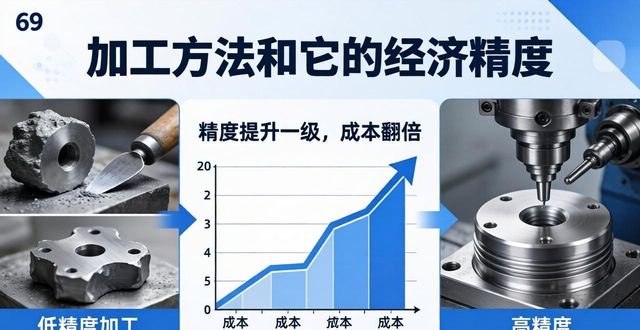
In the machining industry, there is an unwritten rule, that is, if the accuracy increases by one IT level, the processing time will increase by 50% to 100%. This is not an unfounded rumor about the cost difference between precision machining and ordinary machining . In 2024, some research machines The organization conducted a follow-up survey on 50 mechanical processing plants and found that when it was upgraded from IT9 to IT8, the average working hours increased by 55%, from IT8 to IT7, the working hours increased by 80%, and from IT7 to IT6, the working hours directly doubled.
Why does such a pattern exist? This is because high-precision machining requires smaller cutting amounts, slower feed speeds, and more measurements. For example, one tool for rough turning can cut off 3 mm, but one tool for fine turning can only cut 0.2 mm. If you want to achieve IT6 level accuracy, you may need to sharpen the tool again. In February 2025, a company in Qingdao, Shandong Province accepted an order for an IT5-level precision shaft. They made some calculations: the single cost of ordinary IT8-level parts is 50 yuan, IT6-level parts cost 120 yuan, and IT5-level parts directly rise to 280 yuan.
How to choose the appropriate processing accuracy
When selecting accuracy, you should not only consider the requirements of the drawings, but also take into account the actual use of the parts. For example, shaft parts in ordinary mechanical equipment can meet the demand if they are at level IT8 to IT9, and do not need to reach level IT6. However, for key parts of aeroengines, IT5 to IT6 levels are essential. Industry statistics in 2024 show that about 30% of mechanical parts have been over-processed, resulting in a waste of resources of more than 5 billion yuan every year.
Before starting construction, an economic calculation must be made: can the benefits brought by improved accuracy offset the increased costs? If the parts are produced in batches, saving ten yuan per piece will amount to one million yuan per 100,000 pieces a year. In early April 2025, a company in Ningbo, Zhejiang Province received a batch of orders for auto parts. The drawings were marked with IT7 level. However, after communicating with the customer, they found that IT8 level could definitely meet the requirements for use. In the end, they made money on this batch of orders at a price that was 15% lower than their competitors' quotations.
Do you think that during daily processing, have you ever encountered a situation where the cost was out of control due to extremely high accuracy requirements? Welcome to share your experience in the comment area, and don’t forget to like it and forward it to more friends in the machinery industry to take a look.



暂无评论内容