

What are the processing specifications for sheet metal chassis?
A set of sheet metal chassis starts from a drawing, goes through many steps, and finally becomes a physical object. There are a lot of links in this process, and these links have more possibilities for problems. Many companies only realize during delivery that the dimensions do not meet the requirements, cracks appear in the welding joints, and paint peels off the surface. They need to pay surprisingly high costs for reprocessing. In fact, as long as we tightly grasp the key control points from selecting materials to finished products, we can completely avoid most quality accidents.
Wrong choice of materials and everything ends up in vain
Among the most commonly used materials for sheet metal chassis, there are cold-rolled sheets and galvanized sheets. However, many people are not able to distinguish their usage scenarios clearly. The price of cold-rolled plate is relatively low, but it is easy to rust, so it must be sprayed. Galvanized sheets have good corrosion resistance, but during welding, the zinc layer will volatilize and produce toxic gases. In 2025, there was a chassis factory in Dongguan that replaced cold-rolled plates with galvanized plates but did not adjust the welding parameters. As a result, the welders were collectively poisoned and stopped working for three days.
The strength of the chassis is directly determined by the thickness of the board. The conventional thickness is between 0.8mm and 3.0mm. The bottom plate and load-bearing parts of the chassis should be at least 1.5mm, and the side panels can be reduced to 1.0mm. If the thickness is insufficient, the chassis will be deformed after the circuit board is installed, making it impossible to align the card slot when inserting or removing it. When purchasing, you need to use a micrometer to randomly inspect the incoming materials. If the thickness deviation of the same batch exceeds 0.1mm, you will have to return it.
Cutting accuracy determines assembly efficiency
The two mainstream blanking methods at present are CNC punching and laser cutting. Laser cutting accuracy can reach ±0.1mm sheet metal processing quality control point , which is suitable for small batch and multi-variety chassis production. Although CNC punching is highly efficient, mold wear will cause edge burrs to become larger. A random inspection in Shenzhen in the first quarter of 2026 showed that 23% of sheet metal complaints were caused by blanking burrs scratching assembly personnel or scratching wire harnesses.

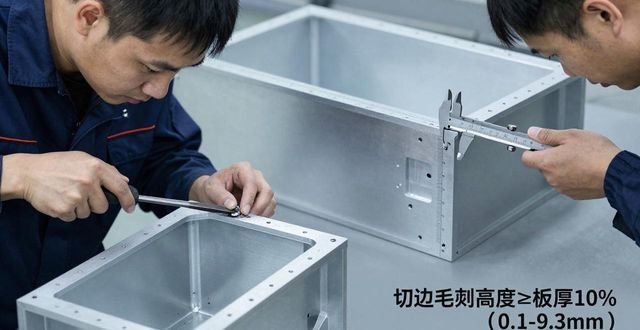
The height of the trimming burr cannot exceed 10% of the plate thickness, which is approximately between 0.1 and 0.3 mm. If it exceeds this range, it will not only affect the appearance, but also cause cracks during bending. After processing, you need to use a file or chamfering machine to remove burrs, especially around screw holes and cable holes. Before mass production, be sure to conduct first-piece inspection and use calipers to measure the overall dimensions and hole distance.
Bending parameters should match plate properties
The main cause of cracking is that the bending radius is too small. Among them, the minimum bending radius of low carbon steel is about 0.5 times the sheet metal processing quality control point of the plate thickness, while that of stainless steel should reach 1.5 to 2 times the plate thickness. In 2025, a company in Suzhou used a 1mm bending die when making 2mm stainless steel chassis. As a result, 40 out of 100 chassis had cracks at the bending corners . Sheet metal processing quality control points caused direct losses of more than 80,000 yuan.
Another common problem, especially with high-strength sheets, is bend springback. During processing, trial bending must be used to determine the compensation angle, which usually requires pre-pressure and bending of one to three degrees. The bending order is equally important. Fold the short sides first and then the long sides, fold the edges first and then the middle. For complex chassis, it is recommended to use bending simulation software for pre-verification to prevent interference and tool collision.
Problems with welding quality can be seen at a glance
What is required is that the welding seam must be uniform and strong, which is a very basic requirement. However, when actually operating, the situation of weak welding and welding penetration frequently appears. Carbon dioxide gas shielded welding is suitable for plates thicker than 2mm, and argon arc welding is used for stainless steel and thin plates. There must be at least one 10 mm intermittent welding spot for every 50 mm of weld bead length, and those parts that can withstand gravity must be fully welded. In 2025, a certain communication chassis had solder joints falling off, which caused the internal modules to shake. In the end, the entire batch of goods was returned, causing a loss of more than 500,000 yuan.
Many factories cut corners in the post-weld polishing process. After the weld is polished, it must be flush with the base metal, and there must be no pits or over-grinding. To check the weld bead, you can use the tapping method. Use a small hammer to gently tap the weld. If the sound is crisp, it means the welding is firm. If the sound is muffled, it means there is a weak weld. The welding deformation can be controlled through fixture fixation and symmetrical welding. What are the sheet metal chassis processing specifications? For severe deformation, plastic surgery is required.
Insufficient cleaning before surface treatment equals zero

Before spraying and electroplating, grease and rust must be completely removed, otherwise, the coating will blister and fall off within three months. The commonly seen treatment process is: degreasing, then washing, then pickling, then phosphating, and finally drying. In 2026, a company in Zhejiang shortened the phosphating time from fifteen minutes to five minutes in order to meet the construction deadline. However, the result was that two months after the chassis left the factory, a large area of rust appeared on its surface, and the cost of repairs exceeded 300,000 yuan.
The thickness of the spray coating needs to be controlled within the range of 60 to 120 microns. If it is too thin, the anti-rust ability will be poor. If it is too thick, brittleness will easily occur. For color and gloss, it needs to be compared with the color plate. The color difference ΔE value of the same batch of products cannot exceed 1.0. The silk-screened text must be clear and wear-resistant. When using 3M tape for adhesion testing, the entire piece must not fall off. Important chassis must also undergo a salt spray test, and the requirement is that no red rust will appear for at least 48 hours.
Unclear inspection standards equal no inspection
The most basic dimensional requirement of the chassis is flatness. The bottom surface of the chassis should be within the range of every 500 millimeters, and the deformation should not exceed one millimeter. Use feelers and rulers to quickly detect. Once out of tolerance is found, the bending or welding parameters must be adjusted in time. Verticality is related to panel installation. The angle deviation between the front and rear elevations and the bottom surface must be within 0.5 mm, otherwise the PCB board will get stuck or have poor contact when it is installed.
To test the assembly function, you need to simulate actual use scenarios, place the chassis on a horizontal platform, plug and unplug the connector twenty times to feel whether it is smooth, tighten and loosen the screws, and check whether the threads have slippage. For special inspections of welding, you must use a magnifying glass to view key stress-bearing welds, because cracks and pores are defects that can have fatal effects. It is best to make a pass-and-stop gauge and use it to quickly check the hole spacing. It is more than ten times faster than measuring with a caliper.
Is it your sheet metal chassis supplier that provides the first article inspection report and process inspection records? Will it take the initiative to do so? Welcome to share your acceptance experience in the comment area and like it to let more engineers see this quality control checklist.






暂无评论内容