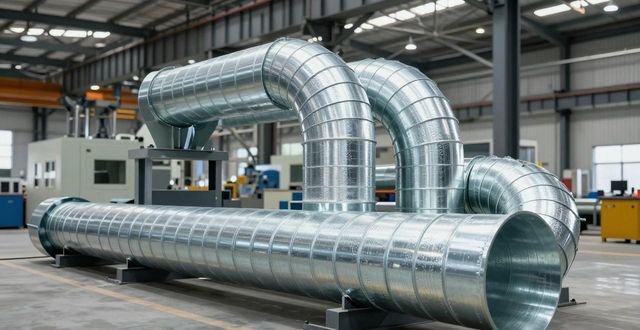


Central air conditioning exhaust pipe galvanized spiral duct industrial air supply and exhaust ventilation duct and other accessories processing
If the wrong material is selected for the central air conditioning exhaust pipe, the risk of air leakage and water leakage will remain throughout the entire service life, and the subsequent maintenance costs will be many times higher than during installation. Because of its non-welding and strong sealing properties, spiral air ducts are slowly replacing traditional galvanized iron pipes as the preferred choice for industrial air supply and exhaust systems.
Material advantages of galvanized spiral air duct
A galvanized sheet with a uniform zinc layer on the surface. The protective film can effectively prevent the metal from rusting due to lack of oxygen. In the field of central air conditioning and ventilation, pipes are exposed to moisture for a long time, and pipes made of ordinary iron sheets are easily corroded at the welds. However, there are no welds in spiral air ducts, and the zinc layer is completely covered, so the service life is significantly longer.
Judging from actual engineering cases, a large shopping mall located in Tianhe District, Guangzhou used 0.8mm-thick galvanized spiral air ducts during the renovation of its ventilation system in 2025. After more than a year of operation, it was inspected and the inside of the pipes was still as smooth as new, without any rust spots or leaks.
Applicable scenarios for different thickness specifications
0. Wall tubes with thicknesses of 5mm and 0.6mm are suitable for use in home central air conditioners or air supply systems in small shops. They are easy to install because of their light weight. The thickness of the wall pipe is in the range of 08mm to 1.0mm, which is the most commonly used specification for commercial projects. This range is basically chosen for the exhaust ducts in hotel lobbies and public areas of office buildings.

1.2mm and 1.5mm thickened pipes are used in smoke exhaust systems in industrial plants or large shopping malls. There is an electronics factory in Longhua, Shenzhen that processes galvanized spiral ducts for central air-conditioning exhaust ducts, industrial supply and exhaust ventilation ducts and other accessories. When the ventilation ducts in the workshop were replaced in 2024, in view of the high power and fast wind speed of the fans, a 1.2mm thick spiral duct was specially selected to avoid the problem of resonance noise caused by thin-walled pipes under strong wind pressure.
Key points in diameter and length customization
This is the starting point for spiral air ducts with diameters starting from 80mm. The specific size to choose depends on the air volume and installation space. When performing smoke exhaust operations in the back kitchen of restaurants, 300mm to 500mm pipes are usually used. However, for the air supply and exhaust system of underground garages, large diameter pipes of more than 600mm are often required. Manufacturers can customize any diameter according to the actual situation on site. In this regard, it is more flexible than traditional galvanized iron pipes, that's it.
Transportation restrictions have resulted in the standard length being generally 3 meters. Pipes exceeding 3 meters are expensive to transport, and it is troublesome to enter the elevator, and it is also difficult to make turns. During the construction of an office building project in Chaoyang District, Beijing, in early 2025 , the central air-conditioning ventilation ducts (white iron/galvanized sheets) were riveted and welded . Because transportation issues were not taken into consideration, a 4-meter-long pipe was customized. After arriving at the site, it was discovered that it was impossible to enter the freight elevator. In the end, it was forced to cut it on site, which actually increased the cost.
The difference between spiral air duct and traditional white iron pipe
For traditional white iron pipes that use straight seam welding technology, the weld is the weakest link in the entire pipe. After long-term use, the weld is prone to cracking due to vibration, resulting in air and water leakage. The spiral air duct is rolled and formed. There is no longitudinal weld in the entire pipe, and its sealing performance is one level better than that of tinplate pipes in its natural state.
In terms of installation efficiency, there are significant differences. Tinned iron pipes need to be riveted and spliced on site. Just one joint requires dozens of rivets. The spiral air duct uses flange connection or plug-in connection, and two people can install it up to 100 meters in one day. A construction team in Pudong, Shanghai gave feedback that after using spiral ducts, ventilation projects of the same scale saved about 30% of the man-hours compared to using white iron pipes.
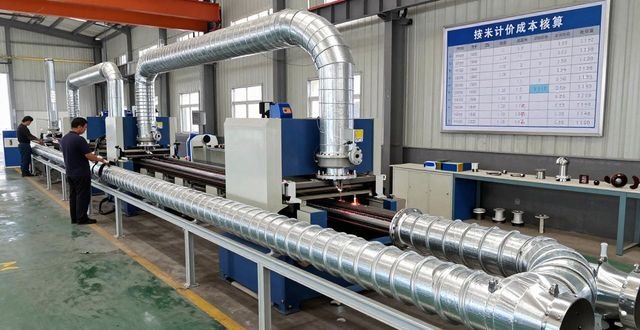
Cost accounting method based on meter price
The spiral air duct is priced in meters, which is extremely transparent to customers. Different central air-conditioning ventilation ducts (white iron/galvanized sheet) are riveted and welded , with different diameters and different thicknesses, and thus there are differences in unit prices. Through this price difference, customers can accurately calculate the total amount of materials based on the drawings provided, which facilitates budgeting. Compared with pricing by piece, pricing by meter can prevent budget deviations caused by inaccurate statistics on the quantity of accessories.
It should be noted that when quoting, you should ask whether flanges, hangers and other accessories are covered. In 2025, a project in Hangzhou was invited to bid. During the period, a supplier gave a very low unit price. However, after signing the contract, it was discovered that the flange and gasket needed to be billed separately. The final total price was 15% higher than the regular quotation. The accessories included must be clearly stated before signing the contract.
Practical precautions for transportation and installation
When transporting a 3-meter-long pipe, sufficient bundling and buffering protection must be done to prevent the zinc layer from being scratched; during unloading, it is better to use a forklift or have multiple people cooperate with each other to carry out the transportation operation. The reason is that although a single pipe is not heavy, it is long, and if it is carried by only one person, it is easy to cause collision and deformation of the pipe; after receiving the goods, be sure to check immediately whether the pipe mouth is flattened or deformed.
When performing installation operations, be sure to pay attention to the slope setting of the pipes. For air supply pipes, it is usually necessary to maintain a slope standard of three thousandths, while for exhaust pipes, it is necessary to maintain a slope value of five thousandths. In this way, condensate water can be prevented from accumulating inside the pipes. At the connection, special sealing strips or gaskets should be used, and the screws need to be tightened evenly. There is a hospital in Nanjing. When the installation work was carried out in 2024, it was precisely because the screws were not tightened evenly in the riveting and welding of the central air conditioning ventilation duct (white iron/galvanized sheet) , which caused air leakage at the interface. The subsequent rework cost a lot of unjust expenses.
May I ask what kind of pitfalls you have encountered when selecting or even installing central air conditioning ventilation ducts? Feel free to share your past experiences in the comment area to help more people avoid such traps.





暂无评论内容