

MIM Process and Design Principles for Metal Parts Manufacturing
Within the scope of metal parts manufacturing, metal injection molding technology is rapidly replacing traditional machining methods. However, many designers copy the design habits of plastic molds unchanged into metal injection molding, causing parts to deform and have dimensions outside the tolerance range after sintering, thus unnecessarily increasing costs. The first important step in making good metal parts is understanding the differences between metal injection molding and plastic injection molding.
The wall thickness should be designed to be as thin as possible
In metal injection molding, the design of wall thickness will directly affect the success rate of degreasing and sintering. The thinner the wall thickness of MIM parts, the shorter the path for binder precipitation during degreasing. When sintering metal parts are customized according to creativity , the densification will be more uniform, which is different from plastic injection molding. Generally speaking, it is recommended to control the wall thickness within the range of 0.5 mm to 5 mm. If it exceeds this range, it is easy to cause internal defects.
A medical device company in Shenzhen designed surgical forceps parts in 2025. The wall thickness of the surgical forceps parts was reduced from 6 mm to 3 mm, and then the sintering time was shortened from 48 hours to 28 hours. At the same time, the output of each furnace was nearly doubled. When designing this part, the MIM process and design principles of metal parts manufacturing are to keep the entire wall thickness as consistent as possible to avoid uneven shrinkage caused by sudden changes in thickness.
There is no need to deliberately leave the draft angle
Normally, traditional plastic injection molding operations require a draft of one to two degrees, otherwise the parts will get stuck in the mold. However, the MIM process uses a mixture of metal powder and binder. When demoulding, the material is still in an unsintered state. The binder plays a lubricating effect, and its demoulding resistance is much smaller than that of plastic.
The measured data presented at zero draft angle analyzed auto parts from a manufacturer in Shanghai. Among them, the ejection success rate of the MIM mold exceeded 98%. However, it should be noted that once the part contains a deep cavity structure, or the surface finish of the mold does not meet the standard, adding an appropriate slope of 0.5 degrees can further benefit the long-term performance of the mold. Generally speaking, the function of the part will not be damaged for demolding.
Plan ahead for sintering support points

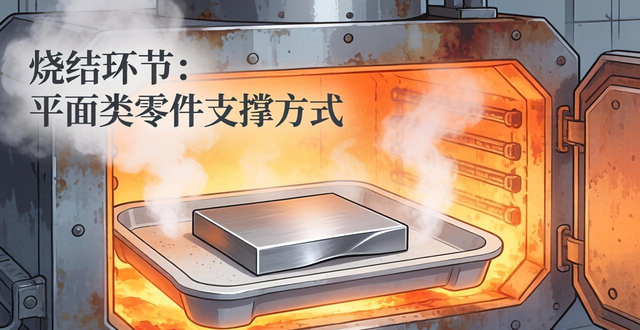
In the MIM process, sintering is the most problematic link. In a high-temperature furnace, parts will shrink by 15 to 20 percent. If the support points are unreasonable, gravity will cause the parts to collapse or distort. Planar parts can be directly placed on standard alumina trays for sintering, but parts with cantilevers or special-shaped structures require customized support fixtures.
In 2024, a MIM factory in Suzhou received an order for a drone bracket. The original design had three cantilever structures. However, after sintering, they all sagged and deformed. Subsequent design changes were made, and a temporary support column was added under the cantilever, which was then removed after sintering. The scrap rate was reduced from 35% to less than 5%. The matter of sintering support must be considered at the mold design stage.
Allow a margin for calculation of shrinkage rate
The shrinkage rate of MIM parts is not a fixed value and is affected by multiple factors such as powder loading, sintering temperature, and holding time. The shrinkage rates of different material systems vary greatly. The shrinkage rate of stainless steel is generally 16% to 18%, the shrinkage rate of iron-based materials is 15% to 17%, and the shrinkage rate of titanium alloy may reach more than 20%.
There is a company in Dongguan that is engaged in consumer electronics. Once, it directly used the shrinkage data given by the supplier, resulting in the size of the middle frame of a batch of mobile phones being 0.2 mm smaller, and the entire batch of products was scrapped. The correct approach should be to first make a trial mold sample, then measure the actual shrinkage before and after sintering, and then use this data to correct the mold size. It is also recommended to reserve at least two rounds of mold testing cycles and budget.
Feature dimensions must comply with processing limits
MIM can make complex geometric shapes, but there are processing limits for some feature sizes. Generally speaking, the minimum hole diameter cannot be less than 0.3 mm, otherwise it will be easily blocked during degreasing. The minimum thickness of thin ribs is recommended to be no less than 0.4 mm, otherwise it will be easy to bend during sintering. The thread structure is not suitable for direct molding, and a margin is usually left for subsequent machining.
In 2023, a dental implant designed by a company in Hangzhou required direct molding of internal threads. However, after sintering, microcracks appeared at the roots of the threads. Later, it was changed to formed light holes and subsequent tapping was added, and the problem was completely solved. Designers must understand the factory's process capabilities in advance to avoid treating MIM as a panacea.
Material selection affects post-processing
Materials commonly used in MIM include stainless steel, iron-based alloys, titanium alloys, nickel-based alloys, tungsten alloys, etc. Different materials not only have extremely significant cost differences, but also have different subsequent heat treatment methods. For example, 17-4PH stainless steel can increase its hardness through aging treatment, but 316L stainless steel cannot be strengthened through heat treatment.
A military industry company in Beijing failed to take post-processing requirements into consideration when selecting materials and chose 316L to manufacture highly wear-resistant parts. However, the surface hardness of the parts was only about 150HV, and wear occurred after two weeks of use. After that, the company switched to 440C stainless steel, and after vacuum quenching operations, metal parts were customized based on creativity . The hardness reached 580HV, and the service life of the parts was increased ten times. It can be seen that when selecting materials, it is necessary to comprehensively consider the final usage conditions, and must not just focus on the difficulty of molding.
Cost accounting depends on the entire process
A large number of companies only compare the unit prices of MIM and machining, but ignore the entire process cost. The unit price of MIM has dropped significantly with the increase in production. Generally speaking, prices only have a price advantage if the price is more than 5,000 pieces. However, the mold cost is in the range of 30,000 to 80,000 yuan, and the mold trial and certification cycle takes 4 to 8 weeks. If the product is still in the verification stage, you can first consider machining or 3D printing for small batch production.
For a company engaged in smart watches in Shenzhen, when the new product was in the research and development period, it directly used MIM to produce 200 watch case samples. The mold and trial mold cost a total of 60,000 yuan, and the average cost per piece was 300 yuan. Subsequently, the plan was changed and the shape was transformed, resulting in all the molds being scrapped. For metal parts in the research and development stage, it is recommended to customize the metal parts based on creativity before opening the MIM mold, confirm the design and finalize it, which can save a lot of upfront costs.
Have you ever considered sintering support and shrinkage issues for the metal parts you are currently designing? Welcome to share your own design experience in the comment area.






暂无评论内容