


Introduction to mechanical design, detailed calculation method for machining quotation? Do you understand?
If a mechanical design engineer only knows how to draw, he or she will generally be in a passive position as the project moves forward. Being able to understand the approximate quotation of machined parts will enable you to determine the economic rationality of the plan during the design stage to prevent continuous modifications in the later period because the cost exceeds the budget.
Material cost is the starting point for quotation

After getting the part drawings, the first step is to calculate the number of raw materials required. This cost is the most direct. The formula is that the material cost is equal to the material density multiplied by the volume and then multiplied by the unit price. It is like having a piece of specific specifications. It is 200 mm long and 150 mm wide. It is 20 mm thick and belongs to the No. 45 steel plate. Its volume is 0.0006 cubic meters and the density is calculated according to 7850 kilograms per cubic meter, so the weight is about 4.71 kilograms. The current price of No. 45 steel in the market is about 6 yuan per kilogram, so the material cost is 28.26 yuan.
When calculating values, do not neglect to consider the margin of the blank. If the part is square in shape, the cutting operation is usually carried out with the help of a steel plate, so the materials need to be calculated based on the outer contour size; if it is a shaft part, then a bar stock must be used, and the length needs to add the allowance required for clamping at both ends. In the actual production process, the material utilization rate rarely reaches 100%. This part of the loss should also be included in the material cost, otherwise the quotation will be low.
Process arrangement determines processing cost
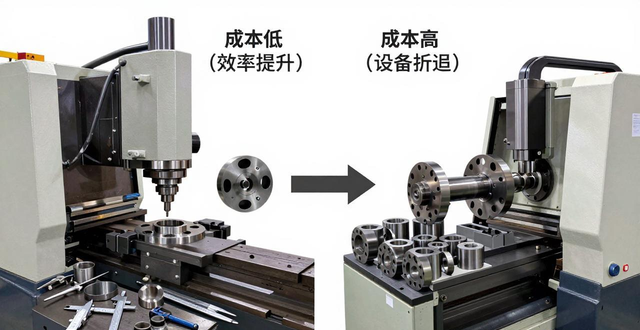
For the same part, the cost difference may be particularly large whether the machined surface is cut first and then turned, or whether the surface is turned first and then turned. Before quoting, you must analyze the structure of the part to establish the most economical and cost-effective main process route. Take the flange as an example. If the batch quantity is relatively small, then use an ordinary lathe to process the outer circle and end face, and then place it on the top of the milling machine for drilling operations. In this way, the equipment depreciation costs and man-hour costs will be relatively low; if the batch quantity is particularly large, then you can consider using a CNC lathe to complete multiple processes through one-time clamping . How is the machining quotation calculated? , although the unit price of this equipment is relatively high, the unit cost will become lower after the efficiency is improved.
The key point is that when evaluating the difficulty of the process, it is mainly to check whether there are high-precision tolerance requirements, whether the Ra value of the surface roughness is below 1.6 microns, and whether there are deep holes, slender shafts or even thin-walled structures. It is precisely the many such features that can force craftsmen to choose more precise equipment . How is the machining quotation calculated? , using slower cutting speeds, and even needing to add heat treatment or grinding processes. This situation directly pushes the labor cost to a higher level.
Labor hour unit price and equipment depreciation
The difference in operating costs of each piece of equipment is significant, clear and obvious. The unit labor price of ordinary lathes is usually in the range of 60 yuan to 100 yuan per hour, but the machining center can reach 120 yuan to 200 yuan per hour. This unit price covers equipment depreciation, electricity costs, site rental and basic wages of operating workers. A machining center with a purchase price of 400,000 yuan is depreciated over 10 years, plus an annual maintenance fee of 5%. The depreciation amount apportioned to each processing hour is about 20 yuan, which is accurate and without deviation.
The following is the rewritten content: In actual operation situations, the calculation of working hours needs to be broken down according to the process. For example, if you want to mill a square plane with a side length of 200 mm, if you use an ordinary milling machine, it is estimated that the time required for clamping is 5 minutes, and the time spent on cutting is 10 minutes, which adds up to a total of 0.25 hours; if you use a machining center, the clamping time may be shorter, but the programming and debugging time also need to be calculated. When in small batch production, preparation work takes up a relatively high proportion of time, and the larger the batch, the closer the man-hours required for a single piece are to pure cutting time.
Other expense items cannot be omitted
Packaging and transportation costs are easily overlooked. If you use bubble wrap and carton packaging for local customers, the cost of each piece is only a few yuan. If it is shipped to other provinces, wooden boxes need to be reinforced, and the logistics cost may be as high as hundreds of yuan. This cost is either charged separately or evenly divided into the unit price of the parts. Management costs are generally 5% to 10% of the total of material costs and processing fees, including the expenses of quality inspection, warehousing, and sales personnel.
The cost of tooling tools has a significant impact on mass production. A customized molding milling cutter may cost 800 yuan. If only 10 parts are produced, each part will bear a tool cost of 80 yuan. If 1,000 parts are produced, the cost of a single part will be reduced to 0.8 yuan. Therefore, be sure to verify the order quantity when quoting. When the quantity is not clear, a stepped quotation can be given so that customers can see the cost reduction space brought by batch production.
Profit and final quote

There is no fixed standard for setting profit margins, which needs to be determined based on project risks. It must also be determined based on the customer payment cycle and market competition. How is the machining quotation calculated for conventional machined parts? , its profit margin is usually between 15% and 25%. Once the part process is complex and the processing involves high risks, or the customer account period is very long and funds are occupied for a long time, the profit rate can be increased appropriately. If you are dealing with old customers and long-term cooperation, or if the parts structure is simple and competition is fierce, the profit margin should be set more conservatively.
All costs include material costs, processing fees, equipment depreciation amortization, management and packaging fees, etc. First add these costs, then multiply by one and add the profit margin. This is the formula for calculating the final quotation. For example, the material cost of a certain part is 80 yuan, the processing fee is 120 yuan, and other expenses are 30 yuan. The total cost is 230 yuan. Calculated based on a 20% profit margin, the final quotation is 276 yuan. After this price is quoted, almost 5% of the bargaining space should be left to allow room for communication between the two parties.
Regional differences and supplier selection
Processing quotations may differ by more than 30% in different regions. Dongguan, Kunshan and other areas with many manufacturing industries have concentrated equipment and complete supporting facilities, and the price of ordinary processing is relatively low. However, in some industrial cities in the northwest or northeast, the price may be higher due to the high transportation and supporting costs. Even in the same area, companies with imported five-axis equipment have completely different quotation systems from small workshops with ordinary lathes.
When selecting suppliers, when getting started with mechanical design, what is the detailed calculation method for machining quotations? Do you understand? , we must not just focus on the unit price. The manufacturer with the lowest price is most likely using second-hand equipment, and its processing accuracy is unstable, otherwise the delivery time is not guaranteed. It is recommended to urge two to three suppliers to produce samples simultaneously, compare sample quality and delivery speed, and then make a decision based on price. For mechanical design engineers, building two or three trustworthy processing outsourcing resources is more practical than mastering an accurate quotation formula.
When designing parts, have you ever encountered a situation where the plan was rejected by the cost due to a lack of understanding of the processing costs? We warmly welcome you to share your experiences in the comment area, or talk about some cost estimating tips commonly used in various locations.






暂无评论内容