

Additive Manufacturing Software: Transforming Product Design
Only with the right tools can 3D printing be considered truly practical. Between industrial-grade design and consumer-grade gaming, what they lack is not a machine, but a set of software that can realize your inner thoughts.
What additive manufacturing software can do
Many people think that 3D printing is just a matter of modeling and clicking to print. In fact, there are a lot of technical details that need to be dealt with. The additive manufacturing software is responsible for converting the 3D model into instructions that the printer can understand, and will take into account material properties, support structures, and printing directions.
Take the tools we usually use, it can support the entire process from conceptual design to final printing. Among the data shown in 2025, users who use professional software have a 43% higher printing success rate than users of ordinary modeling software. Behind this is the credit brought by the software's automatic optimization.
Software support for multi-jet melting technology
The multi-jet melting technology promoted by HP is that technology. It uses spray flux and then heats it to achieve the purpose of molding. This process has special requirements for the design of the model, such as the wall thickness must not be less than 0.3 mm, otherwise the molding will not be able to be molded.
![图片[1]-Additive Manufacturing Software: Transforming Product Design-Dalian Fuhong Machinery Co., Ltd](/wp-content/uploads/2026/02/1772222947166_0.png)
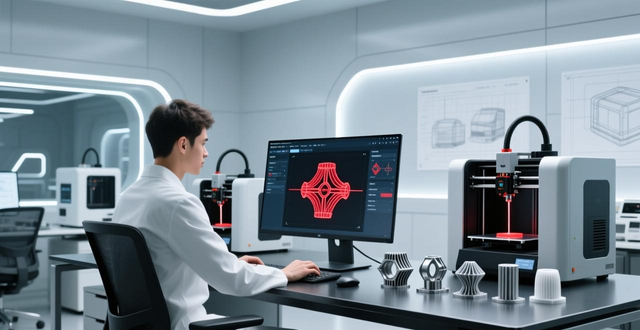
Our software tools have built-in design rules for multi-jet melting, so what? When you design parts in February 2026, the software will automatically detect which structures do not meet the requirements, and then highlight them in red. Compared with the past repeated trial and error based on experience, this saves a lot of time and material costs.
Design Essentials for Binder Jetting
Binder jetting technology is suitable for printing large-sized and complex structures. However, there are many post-processing processes, and cleaning channels must be reserved for processing during the design process. Many novice designers easily overlook this important point.
Our additive manufacturing software can be used to simulate powder cleaning paths during the design phase. In January this year, a mold factory in Shenzhen used this function to process parts that had to be printed three times in one go, shortening the construction period from two weeks to four days. The software can also compensate for sintering shrinkage by adjusting the scale of the model itself based on material density.
Optimization function of fuse prefabrication process
The common FDM printing is fuse prefabrication. However, there is a big difference between the industrial level and the desktop level. The industry has higher requirements for the high temperature control of the equipment and the accuracy of the layer thickness. In terms of software, the injection volume needs to be accurately calculated.
Our tool has a special slicing algorithm for fuse prefabrication. At the end of last year, test data showed that after using optimization algorithms, the use of support materials for overhang structures was reduced by 32%. And the surface smoothness has been nearly doubled. This directly reduces the post-processing workload for printing engineering plastic parts.
![图片[2]-Additive Manufacturing Software: Transforming Product Design-Dalian Fuhong Machinery Co., Ltd](/wp-content/uploads/2026/02/1772222947166_1.png)
Special tools for mechanical parts design
When designing mechanical parts, tolerance fit is one of the key points, and stress analysis is also one of the key points. Ordinary modeling software on the market often lacks these engineering functions, which results in printed parts that cannot be installed or are not used for a long time.
Another specialized tool in our possession that is particularly well-suited for this type of need. For example, during gear design, the standard gear library can be directly called, and the module and number of teeth will be automatically generated once input. This tool also has a finite element analysis function, which can simulate the deformation of parts under actual stress conditions. Last year, a robotics company in a city in Shanghai used this tool to reduce the overall development cycle of joint parts by 60%.
Design-to-print workflow
No matter how good the software is, it only has meaning if it can be printed out smoothly in the end. The tools we have can support direct export to a file format common to printers. Whether it is sent to your own device or outsourced to an outsourcing service provider, it saves you the trouble of format conversion.
The process is extremely simple: you must first use software to design the 3D model presentation, and after checking that there are no errors, save it as a presentation in the specified format, and then transfer it to the printing device for execution. During the entire process of small-batch machining and 3D printing , the software will record the parameter settings of each step to facilitate subsequent traceability and adjustments. The latest version released in February this year also added a cloud collaboration function, allowing teams to modify the same design online at the same time.
Which 3D printing software are available for you to use? In terms of design, have you ever encountered any problems that gave you a headache? Welcome to share the stories you have experienced in the comment area. If you think there are practical uses for small batch machining and 3D printing , don’t forget to like and forward it so that more people can see it.






暂无评论内容