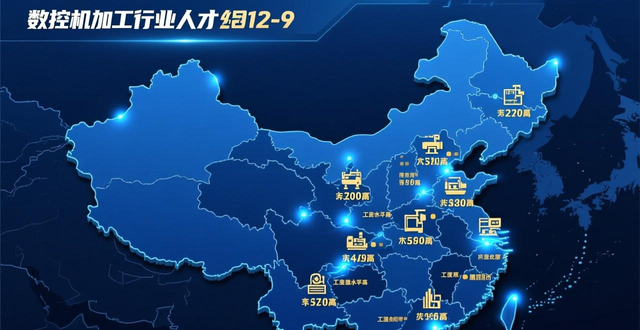


CNC machining industry, a city with high wages and good benefits
In 1980, Grandpa Deng drew three circles in Guangdong. Today, among the three special economic zone cities of Shenzhen, Zhuhai and Shantou, Shenzhen has developed into a super first-tier city. However, many people do not know that there is an undervalued and high-paying industry hidden here, and that is machining. By 2026, the median monthly salary of senior CNC technicians in Shenzhen has reached 28,000 yuan, which is 6,000 yuan higher than their counterparts in Guangzhou. Why are Shenzhen's wrenches so valuable even if they are also engaged in screw tightening?
Hong Kong master teaches us mold ABC
Across the Luohu Bridge, we have to talk about the starting point of high wages for machining in Shenzhen. In 1992, statistics from the Hong Kong Mold and Die Association showed that there were 3,800 mold factories in Hong Kong at that time, employing more than 60,000 people. As the rent of Hong Kong factories soared, these technicians moved to Shenzhen on a large scale in 1995. At that time, the Hong Kong-owned mold factory in Fuyong Town, Baoan, Shenzhen had English drawings hanging in the workshop, and the master's work badge was printed with "Tooling" Manager", one detail is that in 2001, the monthly salary of a senior mold master in Shenzhen exceeded the 12,000 yuan wage level in the machine processing industry , while the equivalent position in Shanghai was only 4,500 yuan. This technical generation gap directly drives up the salary benchmark for machining in Shenzhen.
This master-disciple inheritance is real. An old teacher from Shenzhen No. 2 Advanced Technical School recalled that in 2003, they invited a Hong Kong master to come for training. The master showed the knife repair operation of the Mitsubishi system. The fifty apprentices in the classroom were silent. It was not because they were paying attention, but because they did not understand the English terminology at all. However, after three years, the wages in the machining industry were low . These apprentices became the first operators in Shenzhen to understand international standards, and their salaries doubled after they changed jobs.
High precision forced by copycat machines
Many people think that Shenzhen machining relies on cheap labor dividends, but the actual situation is completely opposite. In 2005, when the Huaqiangbei mobile phone stalls changed, what was the status of the orders received by the Shenzhen Mold Factory? There is a slider mobile phone that requires 5 days from drawing to making the mold. In the CNC machining industry, the salary level is high and the treatment is good. But at that time, the delivery time of international molds was 30 days. In order to continue operating, the masters in Shenzhen have developed a unique skill: relying on the sound of sparks to judge the gap during electrical discharge machining. CNC milling does not use a tool setter but relies on manual shaking. In 2008, the Shenzhen Mold Association conducted a survey and found that a mold factory with 40 people in Bagualing, Futian, actually owned 11 on-site improvement patents.
It is this high-pressure environment that selects top craftsmen. In 2010, Foxconn's Longhua plant recruited five-axis machining center operators with a monthly salary of 18,000. The requirement was to be able to solve the error codes reported by the HEIDENHAIN system. At that time, there were less than 200 people in the country who knew this system, 150 of whom were in Shenzhen. The density of technology has increased bargaining power. To this day, when Shenzhen machining masters change jobs and negotiate salary, the first sentence is still: "What difficulties do you have to solve?"
A complete set of methodologies for moving from Taiwan-funded factories
Around 2000, more than 300 Taiwan-funded mold factories flooded into Chang'an Town, Dongguan. The most valuable thing these Taiwan-funded mold factories brought was not machines, but work instructions. When the Taiwanese master took over, local apprentices in Dongguan needed to be taught how to read vernier calipers. However, three years later, these people have learned to use PFMEA to analyze failure modes. In 2005, Taisheng International set up a factory in Dongguan, which required operators to write daily work logs to record spindle load rates and tool wear curves. At that time, workers were tired of this, but now these logs have become the core evidence of ISO certification. The person who wrote the logs now earns an hourly salary starting at 200 yuan.
What is particularly important is the awareness of quality control. In 2007, a Taiwanese-owned factory in Dongguan received an order from Nokia, which clearly required that the burrs of injection molded parts should be less than 0.02 mm, which is equivalent to 1/5 of the diameter of a human hair. At that time, the masters in Shenzhen modified the process overnight and used frozen trimming instead of manual scraping. Later, this set of technology was applied to the processing process of the middle frame of Apple mobile phones. By 2018, a state-owned enterprise in Guangzhou paid a high salary to tap a team of technicians in Dongguan. One of the conditions given was to "retain the subsidy of the original Taiwanese section chief" – the machining methodologies of Shenzhen and Dongguan are already too expensive to be taken away.
The legacy of the world’s factory
In 2014, Dongguan officials announced a set of data that there were 3,934 industrial enterprises above designated size in the city, including more than 1,000 electronic information manufacturing enterprises. When mobile phone OEMs were at their craziest, there was a street in Dalingshan Town with 17 CNC processing shops, which specialized in making camera decorative rings for OPPO. This cluster effect has pushed the efficiency limit. In 2016, a supply chain company in Shenzhen calculated that the same aluminum-magnesium alloy shell would take 7 days to sample in the Yangtze River Delta and 3 days in the Pearl River Delta. Two days were saved because "you can buy non-standard tools downstairs."
To this day, this ecology is still being monetized. In 2023, a certain electronics factory in Vietnam came to Shenzhen to purchase accessories for the automated production line. On its drawings, there was a special-shaped ceramic piece. The supplier in the Yangtze River Delta quoted a price of 12,000, and the delivery time was 25 days. A workshop located in Xixiang, Bao'an, Shenzhen, accepted this order. The price quoted was 6,800 yuan and the order could be delivered within 7 days. This was because the owner of the workshop knew that someone in the next village was hoarding imported zirconia powder and that the opposite side could program five-axis programs. And this is not an involution, but the premium capability of the industrial ecology.
![图片[1]-CNC Machining Industry, A City With High Wages And Good Benefits-Dalian Fuhong Machinery Co., Ltd](/wp-content/uploads/2026/02/1770912717299_1.png)
Thirty years of building up a talent map
There are open secrets in the field of machining in Shenzhen. If you open the WeChat address book, you can scroll from Fuyong to Humen. Each person's name is followed by the type of work and the model of the machine tool. The 2025 Zhaopin Recruitment Report shows that the mobility of machining jobs in the Pearl River Delta is 1.7 times that of the Yangtze River Delta. However, companies would rather retain them with high salaries than let them go. The reason is simple. When the gantry milling master changes jobs, he may take away the inspection standards of three foreign trade customers. Before the discharge master leaves, there will be three headhunters guarding the factory gate.
What supports the technical ceiling is the thickness of this talent. In the 2024 National CNC Skills Competition, 7 of the top 10 employees in the employee group are from Dongguan, Shenzhen. At the competition site, they were able to perform blind disassembly and blind installation of five-axis linkage tool magazines. The judges privately said that it was not that the contestants from other provinces did not work hard, but that they had not encountered a single collision accident in the workshop for three years. However, the Shenzhen masters had to deal with three alarm situations every month, and also helped the salesmen write English fault analysis reports for foreign customers.
Don’t just focus on the first line of your pay stub
I know a master who earned more than 10,000 yuan a month when he was working as an operator in Longhua, Shenzhen in 2008. However, he did something strange. He lowered his salary by 2,000 yuan and went to a newly established new energy company to follow the production line. At that time, his colleagues laughed at him. Stupid, he currently leads a technical team of 200 people in that company, and holds 17 patents for battery case die-casting. In 2026, CATL built a factory in Zhaoqing and offered him an annual salary of 800,000 yuan, but he did not leave, saying that here he can see where the next wave of technology will emerge.
After all, wages are a lagging indicator. In 2019, the Shenzhen Machining Association conducted visits to 58 regulated companies and found that the local supply rate for technical director-level positions exceeded 80%, which shows that most of the professional ceilings were broken in Shenzhen. For young people, this place not only has money in hand, but also has heavy-duty five-axis machine tools running in front of you every day, newly coated tools shipped by air from the Hong Kong laboratory, and Apple factory inspection standards that are always more stringent than you think. So, do you think that to enter the machining industry, should you choose a city where the current starting salary is 2,000 yuan more, or should you choose an area where you will still have companies competing to pay liquidated damages in five years? Discuss your choice in the comment area. If you find it useful, pass it on to your colleagues who are still struggling with where to go.



暂无评论内容