

Amidst the wave of automationRivet weldingRevolution
Against the backdrop of global manufacturing advancing towards Industry 4.0 and China’s “Made in China 2025” initiative, traditional riveting and welding processes—historically reliant on manual skills—are undergoing profound automation transformation. Robotic automated riveting and welding systems are reshaping production landscapes across multiple industries—from automotive manufacturing to heavy equipment—through their exceptional repeatability, consistent quality output, and remarkable productivity. This article delves into the core advantages, technical architecture, implementation pathways, and future trends of robotic automated riveting and welding, revealing how this technology serves as a pivotal engine for enhancing corporate competitiveness.
Part One: The Disruptive Advantages of Robotic Automation in Riveting and Welding
A geometric increase in production efficiency
Continuous operation capability: The robot can operate 24 hours a day without interruption or fatigue issues, enhancing overall equipment effectiveness (OEE) by 30%-50%.
High welding speeds combined with multi-pass welding: Robotic motion speeds far exceed manual capabilities, and synchronised welding at multiple workpiece locations can be achieved through multi-robot workstations, thereby reducing cycle times. For instance, in the welding of construction machinery boom structures, multi-robot coordination can shorten production cycles from several days to a matter of hours.
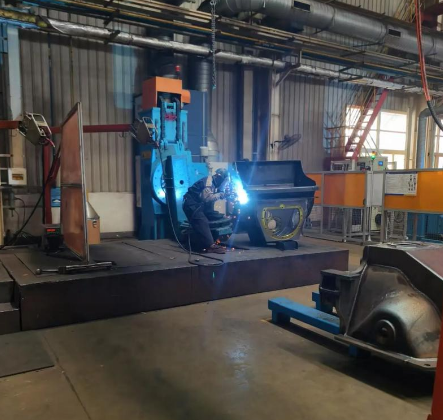
The fundamental guarantee of welding quality and consistency![图片[1]-机器人自动化铆焊加工如何提升生产效率和一致性-大连富泓机械有限公司](https://cndlfh.com/wp-content/uploads/2025/12/QQ20251230-190450.png)
Precise parameter replication: Current, voltage, speed, angle and other parameters for each weld are rigorously guaranteed by the programme, completely eliminating human-induced fluctuations.
Flawless execution of intricate paths: For complex trajectories such as spatial curves and saddle-shaped welds, the robot’s six-axis synchronisation capability achieves millimetre-level precision in perfect tracking – a feat even advanced welders struggle to maintain consistently.
A significant reduction in overall costs
Direct labour costs: Significantly reducing reliance on highly skilled welders alleviates the challenges of labour shortages and high labour costs.
Hidden cost savings: Reduced rework rates (typically by over 60%), minimised material wastage (through precise control of filler metal consumption), and reduced training expenditure.
Improvements to the working environment and safety
Freeing workers from harsh environments characterised by high temperatures, smoke, dust and intense light, transitioning them to roles involving programming, monitoring and maintenance.
Reduce the risk of workplace injuries and comply with increasingly stringent occupational health and safety regulations.
Part Two: Core Technologies of Robotic Automation Systems
Robot body and positioner
Robot selection: Typically, six-axis articulated arm robots (such as Fanuc, ABB, or KUKA) are employed, with payload capacity sufficient to accommodate the welding torch and wire feeding system. For high-precision applications, hollow-wrist robots may be selected to minimise cable bundle interference.
Positioning device (positioner): Acting as the “seventh axis”, it enables optimal flipping of the workpiece. Single-axis, dual-axis, and head-tail frame positioners must be selected based on the workpiece geometry and weld seam distribution.
Intelligent Welding Power Source and Sensor
Digital power supply: Featuring waveform control and expert database functionality, it automatically matches optimal parameters for different materials and positions.
Weld Tracking System:
Contact sensing (positioning): TCP positioning and arc positioning, compensating for workpiece assembly errors.
Laser vision sensing: Real-time scanning of weld bevel geometry with adaptive adjustment of welding torch posture and trajectory, serving as the core technology for addressing issues such as gap and misalignment.
Software and Programming Systems![图片[2]-机器人自动化铆焊加工如何提升生产效率和一致性-大连富泓机械有限公司](https://cndlfh.com/wp-content/uploads/2025/12/QQ20251230-190440.png)
Offline Programming (OLP) software: such as RobotStudio and MotoSim, enables robot layout simulation, path planning and cycle time analysis within a virtual environment, significantly reducing on-site commissioning time.
Process Database: Integrates mature welding process packages (WPP) to enable “one-click retrieval”, thereby reducing the reliance on programmers’ welding expertise.
Part Three: Implementation Pathways and Key Success Factors
Feasibility Analysis and Workpiece Selection
Highly suitable workpiece characteristics: Batch or medium-batch production; Long, regular weld seams; Workpiece weight/dimensions suitable for automated fixtures.
Typical industrial applications: automotive body-in-white, excavator boom arms, shipping containers, longitudinal circumferential welds in wind turbine towers, aluminium alloy bicycle frames.
System Integration and Fixture Design
Selecting a professional integrator: The integrator’s experience is more crucial than the robot brand; one must evaluate their industry case studies and depth of technical understanding.
“Fixture design centred on the welding torch: The fixture must ensure high repeatability positioning accuracy (±0.1mm), whilst accommodating weld accessibility, workpiece deformation release, and ease of slag removal.
Talent Team Transformation
Developing multi-skilled professionals in both welding techniques and robotics programming.
Digitise the expertise of seasoned welders and convert it into a process parameter library for robotic systems.
A step-by-step implementation strategy
Begin with workstation automation (individual welding workstations) to gain experience.
Progressively expanding to production line automation (integrating multiple workstations with logistics), the ultimate objective is to establish flexible manufacturing cells (FMCs) or digital twin-driven smart factories.
Part IV: Future Development Trends and Challenges
Frontiers of Technology Convergence
Collaborative robot (Cobot) welding: Human-machine collaboration, suitable for small-batch, multi-variety scenarios, lowering the automation threshold.
Artificial Intelligence and Machine Learning: By collecting big data from the welding process (arc sound, spectral data), AI algorithms can predict and adjust parameters in real time to eliminate defects, achieving a leap from “adaptive” to “self-learning”.
Cloud-Edge Collaboration and Remote Operations: Welding data is uploaded to the cloud for comprehensive efficiency analysis and process optimisation; real-time edge-side control is implemented, with remote expert diagnostics and guidance facilitated through augmented reality technology.
Challenges Faced and Responses
Initial investment threshold: Adopting new models such as financial leasing and production-based payment to reduce initial outlay.
High demands on product design and consistency: Promoting the DFM/A (Design for Manufacturing/Assembly) philosophy to create conditions for automation from the design stage.
Suitability for SMEs: Modular, standardised, plug-and-play lightweight automation solutions are emerging to serve specialised, sophisticated, distinctive and innovative enterprises.
reach a verdict
Robotic automated riveting and weldingThis represents not merely a simple substitution for manual labour, but a systematic upgrade of the entire production system in terms of quality, efficiency, traceability and flexibility. It is evolving from an “optional extra” to an “essential requirement” for high-end manufacturing. Enterprises should scientifically plan and implement this transition in stages, tailored to their specific product and production characteristics, actively embracing this technology-driven revolution in productivity. By doing so, they will secure a commanding position in future market competition.


暂无评论内容